







AI-powered search module

Osavul's AI search module puts that work in one place, as a single OSINT search engine. You type the query the way you'd say it out loud, then tighten it: keywords, 11 Boolean operators, rules that apply to the post and to what sits behind it - who posted it, from where, on which account, at what hour. Same box for the Monday morning sweep and for the night you're trying to show that one claim started in one Telegram channel and spread from there. People who move over from a pile of open source intelligence tools mention the tabs first. Then they mention that they can show their work.
Key Metrics
500
million data points collected monthly
100
countries covered
30
Languages supported

Use AI to search
Not every question fits neatly into keywords. Describe what you're after in plain language - a rumour about a plant closing, accusations pointed at one candidate, chatter around a shipment - and the OSINT search engine returns the posts that actually mean it, in whichever language they were written. Synonyms, slang, transliterated spellings, the phrasings your own query would never have guessed. From there you pull what belongs together into a narrative and analyse it in a click, without exporting a thing to a second tool.

Create analytical cases
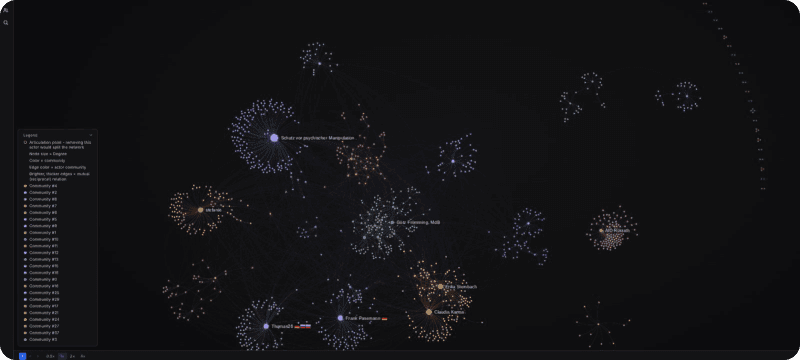
A search is a moment. A case is the file you keep. Pin the results worth holding onto into an analytical case and the platform drafts the report around them: what the narrative claims, how far it travelled, which accounts carried it, and how those accounts connect to one another. Actor-based analysis sits in the same view, so the person behind the account gets read as closely as the message. The raw open source intelligence stays attached underneath as evidence, which means whoever reviews the report later - a client, a board, a regulator - can retrace every step you took to reach it.

Break big narratives into smaller ones
A big narrative is rarely one argument. “The vaccine is unsafe” splits into a rumour about one batch, a claim about the regulator who approved it, and a quote a doctor never said - each with its own audience and its own lifespan. One click separates those strands from the parent so you can see which one is still growing and which died on a forum three weeks ago. It changes the response, too: a fabricated document and genuine local anger need different answers, and treating them as a single message usually makes both louder. Every strand keeps its source posts, so you can drop back into the search results behind it whenever someone asks where a number came from.

Millions of datapoints
Every month the platform takes in about 500 million data points - social platforms, news sites, blogs, forums, messaging apps, 100 countries, 30 languages. Big numbers don't win arguments, though. What they buy you is the channel nobody was watching. A claim starts somewhere with 400 subscribers, sits there a fortnight, then turns up in a national paper - and if that channel was never collected, your OSINT search engine tells you the story began with the paper. Collection here runs whether or not anyone is asking. So when the call comes on Thursday afternoon, the month before Thursday already exists.
Related features
Explore related platform features
Built on the same data layer and AI as every Nebula feature.
See your organization’s risk landscape
Book a demo tailored to your sites, people and sector.
Book a tailored demo
Latest articles about Osavul
Research, webinar recordings and news from the Osavul team on hybrid threats, FIMI and narrative attacks.