The fake domain was gone by lunch. The rumor it started was still trending eleven days later.
We keep running into this in our tracking of narrative attacks across Central and Eastern Europe, and it rarely looks dramatic at first. Someone registers a lookalike of a bank's login page. The security team spots it, files an abuse report, and the registrar pulls it fast. Good work, ticket closed. Then a few dozen accounts, most of them created the same week, start sharing screenshots of that dead page as "evidence" the bank is leaking customer data. Nobody owns that part. Security thinks it's a PR issue; PR thinks it's handled because security closed the ticket.
Most programs fall into exactly this crack. So in this guide we'll walk through what digital risk protection actually covers, how digital risk protection services work once the contract is signed, where they quietly stop, and what it takes to catch the fake page and the story people build around it.
What Is Digital Risk Protection?
Digital risk protection (DRP) means finding and shutting down threats to your organization that live outside your own network. Think lookalike domains, fake social profiles, leaked credentials, exposed internal documents, and accounts pretending to be your CEO. Your firewall watches what comes in. DRP watches everything that's out there using your name.
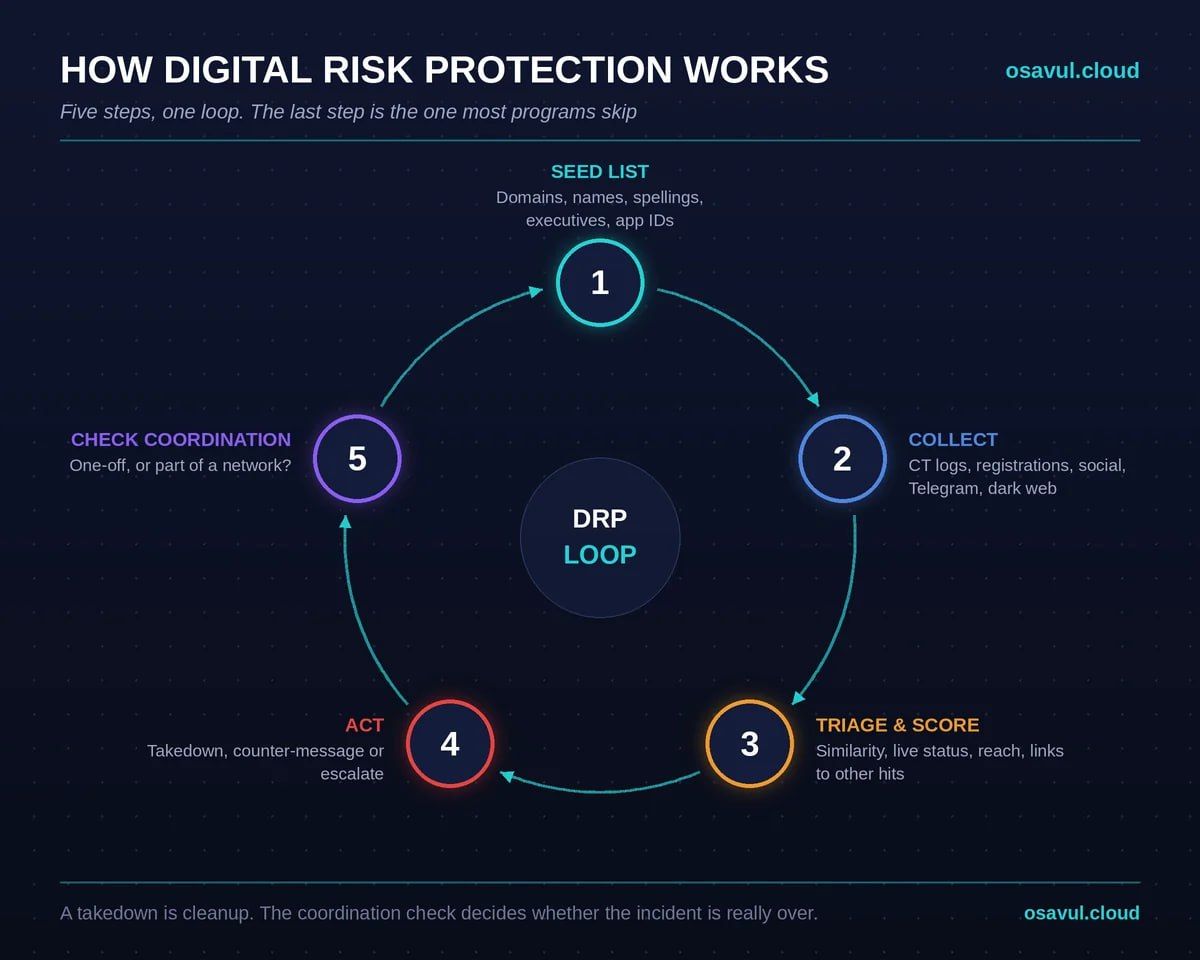
That "out there" is big. It covers the open web, social platforms, app stores, Telegram and other messengers, paste sites, and the dark web. Gartner treats digital risk protection services as a market of its own, and if you sit through a few vendor demos you'll notice they all describe roughly the same loop: collect external data, match it to your assets, score it, then act. "Act" usually means a takedown request.
Here's the part people underestimate. Your SOC sees a brute-force attempt on the VPN gateway in seconds. It will never see a Telegram channel selling an employee's session cookies, or fifteen TikTok accounts quietly rehearsing a boycott hashtag. That's the blind spot digital risk monitoring is there for, and it's why more teams we talk to now park it next to the SOC instead of leaving it with marketing.
DRP vs. Threat Intelligence vs. EASM
The three overlap, which is why they get confused in budget meetings. The quick way to separate them is by the question each one answers. Threat intelligence wants to know who's coming after you and how. External attack surface management (EASM) checks which of your systems face the internet with a door left open. DRP is about abuse: where your brand, your people and your data are being misused, and what you're going to do about it.
Table 1. How DRP differs from threat intelligence and EASM
| Dimension | Threat Intelligence | EASM | |
| Core question | Who targets us, and with which TTPs? | What do we expose online? | Where are our brand, people and data being abused? |
| Main sources | Malware analysis, threat feeds, actor tracking, closed forums | Internet-wide scans, DNS, TLS certificates, cloud assets | Social platforms, domain registrations, app stores, messengers, paste sites, dark web |
| Typical output | Actor profiles, IOCs, strategic reports | Asset inventory, misconfiguration and vulnerability alerts | Impersonation, leak and fraud alerts; takedown requests |
| Usual owner | CTI team | Security engineering / vulnerability management | Security, brand protection, legal, communications |
| Blind spot | Low-volume brand abuse | Anything you don't own | Coordinated narratives spread across many accounts |
You don't have to pick one. The stronger teams we work with run all three and pipe the alerts into a single triage queue. If your analysts already work through the threat intelligence lifecycle, treat DRP as one more collection stream feeding it, not a separate island with its own dashboard nobody opens.
One warning before we move on. Look at the last row of the table. A DRP tool is very good at catching artifacts: the domain, the fake profile, the leaked spreadsheet. It's much worse at seeing the network of accounts that turns those artifacts into a campaign. Hold that thought, because that's where the expensive incidents start.
The Digital Risk Surface: Four Exposure Zones
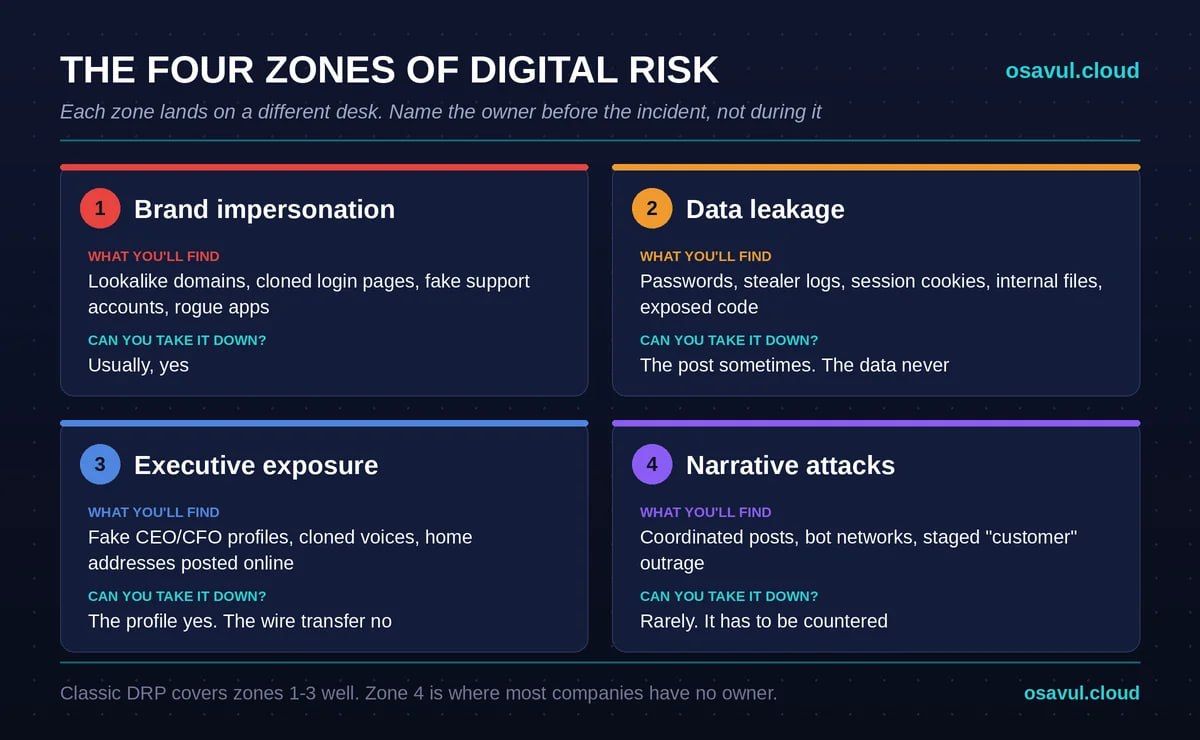
Digital risk usually lands in one of four places: someone impersonating your brand, your data leaking somewhere it shouldn't be, your executives being copied or targeted, or a coordinated narrative attack on your reputation. Vendors are comfortable selling the first three. The fourth is where we've watched attackers move over the last couple of years.
Why bother with zones at all? Because each one ends up on a different desk. A leaked password goes to security. A fake CFO profile drifts between security, legal and the executive office, and sometimes sits there for a month because nobody's sure it's theirs. Name the zones up front and you skip that argument.
Table 2. The four zones of digital risk at a glance
| Zone | What you'll actually find | Who usually picks it up | Can you take it down? |
| Brand impersonation | Lookalike domains, cloned login pages, fake support accounts, rogue apps, phishing ads | Security or brand protection | Usually, yes |
| Data leakage | Passwords, stealer logs, session cookies, internal files, exposed code | Security / CTI | The post, sometimes. The data, never |
| Executive exposure | Fake executive profiles, deepfake voice or video, home addresses online | Security plus the executive office | The profile, yes. The wire transfer, no |
| Narrative attacks | Coordinated posts, bot networks, staged "customer" outrage | In most companies, nobody | Rarely. You have to counter it |
Brand Impersonation and Lookalike Domains
If someone is using your name, logo or look to fool people, that's brand impersonation. Most of the time it's a typosquatted domain or a cloned login page. Fake "support" accounts on X and Instagram come next, then rogue apps and search ads that drop the victim right onto a phishing kit.
For an attacker, the domain is prep work. MITRE ATT&CK even gives buying domains its own entry (T1583.001), separate from the phishing it usually leads to. That gap between registration and launch can be days or weeks, which is good news for you. Watch new registrations and certificate transparency logs, and you often see the trap before anyone walks into it.
Funny thing is, finding lookalikes isn't the hard part. A mid-sized consumer brand can rack up dozens a month, most of them parked and harmless. The real work is choosing the two or three that need a takedown today and letting the rest sit on a watchlist.
Data Leakage and Dark Web Exposure
Leakage is anything of yours that's already out: passwords, session cookies, internal files on paste sites, a customer table someone is selling, code pushed to a public repo on a Friday night. Dark web monitoring is what most people picture here. In our experience, though, Telegram is often where a leak shows up first.
This changed how our analysts collect. Stealer-log channels on Telegram post in bulk, price low and don't bother with Tor. A provider that only crawls dark web markets will still find your leak, just usually after the buyers have tried the credentials.
Executive and Employee Exposure
Your executives get impersonated more than anyone else in the company, for a simple reason: their name gets things approved. Expect fake CEO and CFO profiles, cloned voices, personal addresses posted online, and scraped staff lists that help attackers pick who to phish.
Deepfakes get the press coverage. The cheap tricks do more damage. A LinkedIn profile copied from your head of procurement. A WhatsApp number with the CFO's photo. A payment that's "needed before close of business" on a Friday. If your team wants to get faster at spotting these, start with our guide to what fake accounts are and how they're put together.
Narrative Attacks and Coordinated Inauthentic Behavior
A narrative attack is when a false or twisted story about your company gets pushed by many accounts working together, so that it looks like real public anger. The method has a name, coordinated inauthentic behavior (CIB): bots, sockpuppets and paid accounts posting in step until the story looks organic.
This is where classic DRP tools go quiet. Take any single post and it reads like a fed-up customer, so there's nothing to report and nothing to take down. You only see the attack when you zoom out. The accounts were all created in the same fortnight. They reuse the same sentences with a word or two swapped. They post minutes apart, and the same hashtag hits X, TikTok and Telegram within one hour.
It's also the zone that ties the other three together. Go back to the bank from the intro. The fake domain was just the prop; the story was the real attack. That's why we treat corporate cognitive security as part of digital threat protection, and not as something comms will sort out later.
How Digital Risk Protection Services Work
Ask five vendors how their digital risk protection services work and you'll hear the same story told five ways. They watch the internet for your name, figure out which hits are dangerous, and then deal with them. Fine. The part worth your time is what happens inside each of those steps, because that's where a decent tool and an expensive alert generator stop looking alike.
Discovery and Collection
Everything starts with a seed list you give the vendor. Your domains, brand names, product names, a few key people, maybe your app IDs and logo. From there the digital risk protection platform builds its watchers. One reads certificate transparency logs as new certs get issued. Another hashes your logo and goes hunting for copies. Others sit quietly in public Telegram channels or crawl paste sites and dark web markets.
Here's a mistake we've seen more than once. A client hands over a list with their brand name in English, nothing else, and wonders why the dashboard is so calm. Meanwhile the fake investment pages aimed at their customers in Kazakhstan all use the Cyrillic spelling. Two weeks of silence, and none of it was the tool's fault. So before you judge any vendor, grab someone from marketing, HR and each regional office and write down every spelling and old product name people still type into Google. It's a boring afternoon. It saves months.
Triage and Risk Scoring
Triage is where ten thousand raw hits turn into the five you look at before lunch. Decent digital risk protection software checks how closely the thing copies you, whether it's live, how far it can reach, and whether it's connected to anything else that looks off.
That last check is the one we'd grill vendors about. A lookalike domain with no traffic and no MX record? Watchlist, move on. The same domain dropped into forty posts within an hour by accounts that are all a month old? That's your morning now. Tools that only score the artifact miss the difference, and your analysts end up closing junk until they stop trusting the alerts at all.
Takedown, Counter-Messaging or Escalation
Once you're sure something is hostile, you've got three options. Get it pulled, answer it out loud, or hand it to people with more muscle: legal, the police, or the platform's trust and safety team. Most DRP contracts lean hard on the first one. Check the pricing page and you'll usually see why.
Removal is great when the case is obvious. Phishing pages go to the registrar's or host's abuse desk. Trademark fights go through UDRP or a platform's IP form. Fake profiles go through impersonation reports. A provider who actually knows people at those desks can get a page down the same afternoon, while a cold ticket can sit for three weeks. If the content is misleading but legal, nobody's removing it, so you answer it. And if there's money lost or someone's safety at stake, skip the queue and escalate.
What Takedowns Can't Fix
A takedown kills a link. It doesn't touch whoever posted it, and it can't pull back the screenshots already doing the rounds. In campaigns we've tracked, a banned account was usually back under a new handle within a day, often with a sad little post about being "censored" by the brand.
So don't pop the champagne after a removal. Have whoever's on duty ask the boring follow-up: was this a lone troll, or one thread of something bigger? You can't answer that by looking at one account, and that's exactly the problem we get into next.
Where Classic DRP Stops, and Why Attackers Know It
Classic digital risk protection stops at the single artifact. It's built to find one bad domain, one fake profile, one leaked file, and get each of them removed. What it usually can't see is the relationship between those things, and the people running influence operations figured that out a while ago.
Think about how they plan. If one account gets you suspended, use fifty. If a post with your phishing link gets flagged, post a screenshot instead, which no URL scanner will catch. If your brand's name trips a keyword filter, misspell it, or just call it "that bank" and let the replies fill in the rest. None of this is clever hacking. It's just working around tools that look at items one at a time.
One Fake Account vs. a Coordinated Network
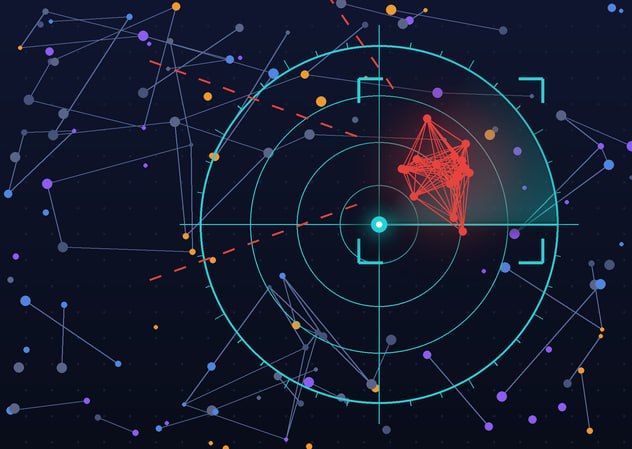
One fake account is an impersonation case. A coordinated network is a campaign, and you can only spot it by looking at many accounts together: when they were created, what they post, who they boost, and how their timing lines up.
Here's what that looks like in practice. On its own, each account in a network seems almost normal. A stock photo, a few hundred followers, some football posts. Line twenty of them up and the pattern jumps out. They were all registered within the same ten days. They go quiet at the same hours. Half of them reuse the same three sentences about your "data leak," with a word or two shuffled. That's the signal our analysts actually hunt for, and it's the reason we built bot detection and network analysis into the same workflow as brand alerts instead of treating them as two products.
Table 3. Classic DRP vs. narrative-aware DRP
| Classic DRP | Narrative-aware DRP | |
| Classic DRP Unit of analysis | One domain, profile or file | Networks of accounts and the stories they push |
| Main question | Is this item abusing our brand? | Who's behind this, and how far will it spread? |
| Typical signal | Lookalike name, copied logo, leaked credential | Shared creation dates, synced posting, recycled text, cross-platform jumps |
| Default response | Takedown request | Takedown plus counter-narrative, stakeholder briefing, platform report on CIB |
| Where it misses | Screenshots, coded mentions, "real" people repeating the story | Little, if the collection covers closed channels like Telegram |
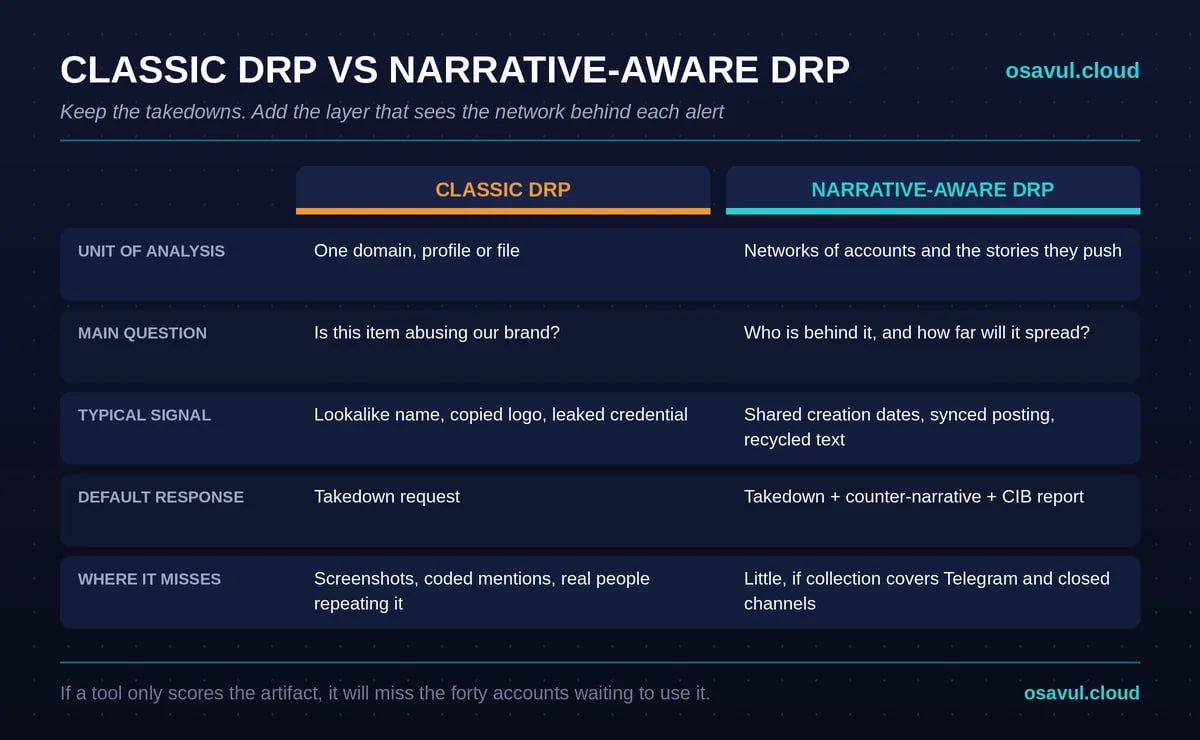
The fix isn't throwing out your DRP vendor. Keep the takedowns, they work. Just add a layer that reads the conversation around each alert, the way a narrative intelligence tool does, so the domain from the intro gets flagged together with the forty accounts that were waiting to use it.
How to Choose a Digital Risk Protection Platform
Pick a digital risk protection platform by testing it on your own threats, not on the vendor's demo data. Every demo looks great, because demos are built around cases the tool already handles well. Ask for a trial on your real brand, your executives and your regional names, then compare what it finds with what your team already knows about.
It also helps to decide early what you're buying for. If your main pain is phishing domains and fake apps, plenty of tools will do the job. If you've already had one of those "the domain is gone but the story isn't" weeks, your shortlist gets a lot shorter.
Questions to Ask Every Vendor
Six questions do most of the work in a vendor call. They cover where the tool looks, how it decides what matters, and what happens after an alert fires.
Table 4. Evaluation questions for DRP vendors
| Question | What a good answer sounds like |
| Which sources do you collect from, and which do you skip? | A specific list, including Telegram, TikTok and regional platforms, plus honest gaps |
| Do you cover non-Latin scripts and local languages? | Yes, with native-language analysts or models, not just machine translation |
| How does risk scoring work? | Context counts: reach, account age, links to other findings, not just name similarity |
| Can you detect coordination between accounts? | Shows network graphs and timing analysis on real cases |
| What's your median takedown time, by platform? | Real numbers per platform, with how they're measured |
| What do we get besides alerts? | Analyst reports, briefings for comms and leadership, API access for your SOC |
Red Flags in a Vendor Demo
Watch for a demo that only ever shows single alerts and never shows how they connect. Same goes for a "dark web coverage" slide that turns out to mean a few Tor forums, with Telegram nowhere in sight.
Two more things should make you pause. One is takedown stats quoted without saying which platforms they cover, since removing a phishing page and removing a TikTok account are completely different fights. The other is a vendor who can't explain why something scored as high risk. If the analyst can't explain the score, your team won't trust it, and an alert nobody trusts is worse than no alert.
Building a Digital Risk Management Program
A digital risk management program is everything around the tool: who owns what, what counts as an incident, and how fast each kind of mess gets cleaned up. Skip it and even a great platform ends up as a tab someone opens on Monday mornings. Get it right and a fairly average tool will still catch most of what hurts you.
So before you sign anything, do the slightly awkward exercise. Open a doc and write a name next to each zone. Who takes the fake domains? Who takes leaked passwords? Whose phone rings when a deepfake of the CEO lands on Friday night? And who owns the story when forty accounts start pushing it? In most companies we talk to, that last line stays empty for a long, uncomfortable minute. That's your gap. If you want a longer take on splitting these jobs between security, legal and comms, our brand protection guide gets into it.
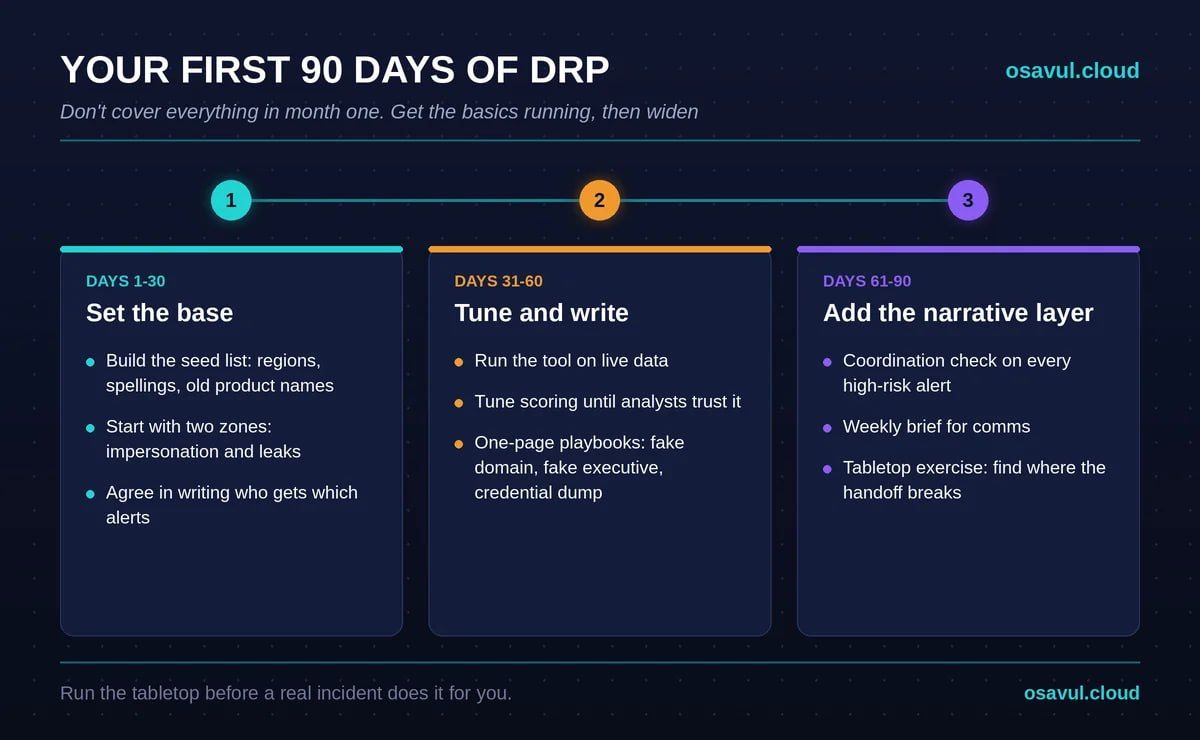
The First 90 Days
Three months is plenty to go from zero to a routine that works. The trick is not trying to cover everything in the first month.
Days 1–30. Build the seed list properly, Cyrillic spellings and dead product names included. Pick two zones to start with (impersonation and leaks are the usual pair) and agree who gets which alerts. Yes, in writing.
Days 31–60. Let the tool run on live data and keep tuning until your analysts stop rolling their eyes at it. Write one-page playbooks for the cases you'll see every week: a fake domain, a fake executive, a credential dump.
Days 61–90. Now bring in the narrative side. Every high-risk alert gets a quick coordination check, and comms gets a short weekly brief. Then run a tabletop on the bank scenario from the intro and watch where the handoff falls apart. It will, somewhere, and better now than live.
Metrics That Hold Up in a Board Review
Boards care about speed and damage avoided. Alert counts bore them. Tell a CFO you found 4,000 lookalike domains and you'll get a polite nod. Tell them the phishing site aimed at your customers came down in six hours, before a single fraud claim came in, and they'll remember it at budget time.
You don't need a big dashboard for this. Time to detect and time to remove, split by platform, covers the basics. Then count how many incidents turned out to be part of a coordinated campaign; that number decides whether the narrative layer keeps its budget next year. Last, keep an eye on repeat offenders. When the same crew keeps coming back under new handles, takedowns alone clearly aren't working, and it's time to talk about attribution and escalation instead.
FAQ
What's the difference between digital risk protection and threat intelligence?
Threat intelligence tells you who's targeting you and how they operate. Digital risk protection finds the specific places your brand, people and data are being abused right now, and gets them dealt with. In practice they feed each other: CTI explains the actor, DRP finds the actor's latest fake domain.
Is dark web monitoring enough?
No. Dark web monitoring catches leaked credentials and data for sale, which matters, but it misses impersonation on social platforms, fake apps and coordinated narratives. It also misses a lot of leaks that now show up on Telegram first and reach the forums later, if at all.
Can digital risk protection services take down fake accounts and domains?
Yes, most of them can, and that's the core of what they sell. Phishing domains, cloned sites and fake profiles usually come down through registrar abuse desks, UDRP and platform impersonation reports. What they can't take down is a story that real people have started repeating. That needs a response, not a removal.
How do you measure the ROI of a DRP program?
Look at losses avoided and time saved, not alert counts. Useful numbers are time from detection to removal, fraud claims before and after, and the analyst hours your team no longer spends on manual searches. If a campaign was caught early, estimate what the same incident cost you or a peer the last time nobody caught it.
Who should own digital risk protection inside a company?
Security usually owns the tooling and the takedowns, but the work can't sit with one team. Legal handles trademark and escalation, comms handles the public answer, and someone has to own the narrative side outright. Write those names down before an incident, not during one.
Where to Start This Week
You don't need a new budget line to make progress by Friday. Take the four zones from this article and put a name next to each. Then spend an hour building your seed list, with every spelling, region and old product name you can think of. After that, search your brand on Telegram and TikTok yourself, not through a tool, and see what turns up.
There's a reason to start now. The World Economic Forum has kept mis- and disinformation near the top of its short-term risk rankings for several years running, including in the Global Risks Report 2026. Attackers have noticed that brands are an easier target than governments, with slower response and fewer analysts watching.
If your current setup catches the fake domain but not the forty accounts around it, that's the gap to close first. It's the problem we built Osavul to solve: finding coordinated narrative attacks early, while there's still time to answer them.