Most brands find out they are under attack from a journalist. The call comes in, someone asks for comment on a claim nobody in the building has heard before, and the comms team spends the next six hours reverse-engineering a story that has already been running for eleven days somewhere they were not looking.
We have watched this exact sequence play out with consumer brands, energy companies and banks. The pattern almost never changes. The signal existed. It sat in a Telegram channel, a regional forum, a comment thread under a mid-tier news aggregator — places the listening subscription did not index. By the time it surfaced on a platform the dashboard covered, the narrative had a shape, an audience and momentum.
That gap is what this guide is about.
What Is Brand Monitoring?
Brand monitoring is the continuous collection and analysis of everything published about a company, its products, its executives and its markets, across every channel where that conversation happens. The goal is not a mention count. The goal is knowing, early, when a conversation stops being organic and starts being engineered.
Two things separate it from the marketing-era version of the same phrase. The first is source depth: a program built for reputational defence has to reach messengers, closed communities and low-visibility regional media, not just the four or five platforms with public APIs. The second is interpretation. A spike in volume tells you something moved. It does not tell you whether a competitor ran a campaign, a customer complaint went viral, or a coordinated network decided your supply chain was a useful wedge issue this quarter.
Practitioners who come from a security background tend to get this immediately. Practitioners who come from marketing tend to inherit a tool built for the other job.
Brand Monitoring vs Media Monitoring vs Social Listening
These three terms get used interchangeably, and the confusion costs money at procurement. They differ in scope, output and who is supposed to act on the result.
| Social listening | |||
| Primary question | What are people saying? | Where were we published? | Is anyone working against us? |
| Public social platforms | |||
| Volume, sentiment, share of voice | |||
| Marketing | |||
| Weekly |
The overlap is real, which is why vendors blur the categories. Our own split is practical: media monitoring answers coverage questions, and we treat brand monitoring as the layer that asks whether that coverage was planted. If you want the coverage-side argument in full, we unpacked it in this piece on what media monitoring means in 2026.
Why Mention Counting Stopped Working
Mention counting fails because the volume metric treats a paid network and a real customer as the same data point. A hundred posts from a hundred coordinated accounts and a hundred posts from a hundred angry buyers produce an identical line on the chart, and the two situations demand opposite responses.
The economics moved against defenders somewhere around 2022. Running an influence operation against a corporate target got cheap — account farms, generative text, translation at zero marginal cost. Running detection against one stayed expensive, because detection requires reach into places that do not want to be indexed. The World Economic Forum has now ranked misinformation and disinformation as the most severe short-term global risk in successive editions of its Global Risks Report, and the corporate share of that risk keeps growing.
Here is the part that surprises executives. The attacks that damage valuation are rarely dramatic. They are slow, plausible and built from real fragments — a genuine product recall in one market, restated as a safety cover-up in another; a real executive quote, clipped four words shorter. We put numbers to that damage pattern in our analysis of what reputational harm actually costs, and the recurring finding is that recovery cost scales with detection delay, not with attack volume.
The Attacks That Never Show Up in Your Dashboard
Most enterprise listening stacks cover roughly a third of the surface where reputational attacks originate. The blind spots cluster in four places.
- Messengers. Telegram, WhatsApp channels and Discord servers carry the seeding phase of most narrative attacks we investigate. There is no public firehose, so generic tools return nothing and report zero — which reads, dangerously, like good news. We wrote up why standard tooling breaks here in this piece on Telegram brand monitoring.
- Short-video platforms. Claims made in TikTok voiceover never enter a text index. Without transcription and visual analysis, the mention does not exist as far as your platform is concerned.
- Regional and non-English media. A story about a European bank often runs first in Serbian, Georgian or Kazakh. English-first collection sees it a week late, if at all.
- Review and comment layers. App store reviews, marketplace Q&A, comment sections under aggregators. Low prestige, high search visibility, and frequently the first place a coordinated campaign parks its keywords.
Our joint research with Edelman on the top 100 global brands found the majority of measurable reputational threat activity sitting on exactly these emerging surfaces rather than on the platforms most teams pay to watch.
The Five Source Layers a Brand Monitoring Program Must Cover
A defensible program covers five distinct source layers, and each one needs a different collection method. Teams usually buy for layers one and two, discover layer three exists during an incident, and never get to four and five.
| Layer | What it contains | ||
| 1. Mainstream media | National press, broadcast, wires, trade titles | Legitimises a narrative; drives search results | Low — licensed feeds |
| 2. Mainstream social | X, Facebook, Instagram, LinkedIn, YouTube | ||
| 3. Emerging media and messengers | Telegram, Discord, WhatsApp channels, TikTok, regional apps | ||
| 4. Forums, reviews, comment layers | Reddit, niche forums, app stores, marketplace Q&A | ||
| 5. AI answer engines | Chatbot and search-generative responses about your brand |
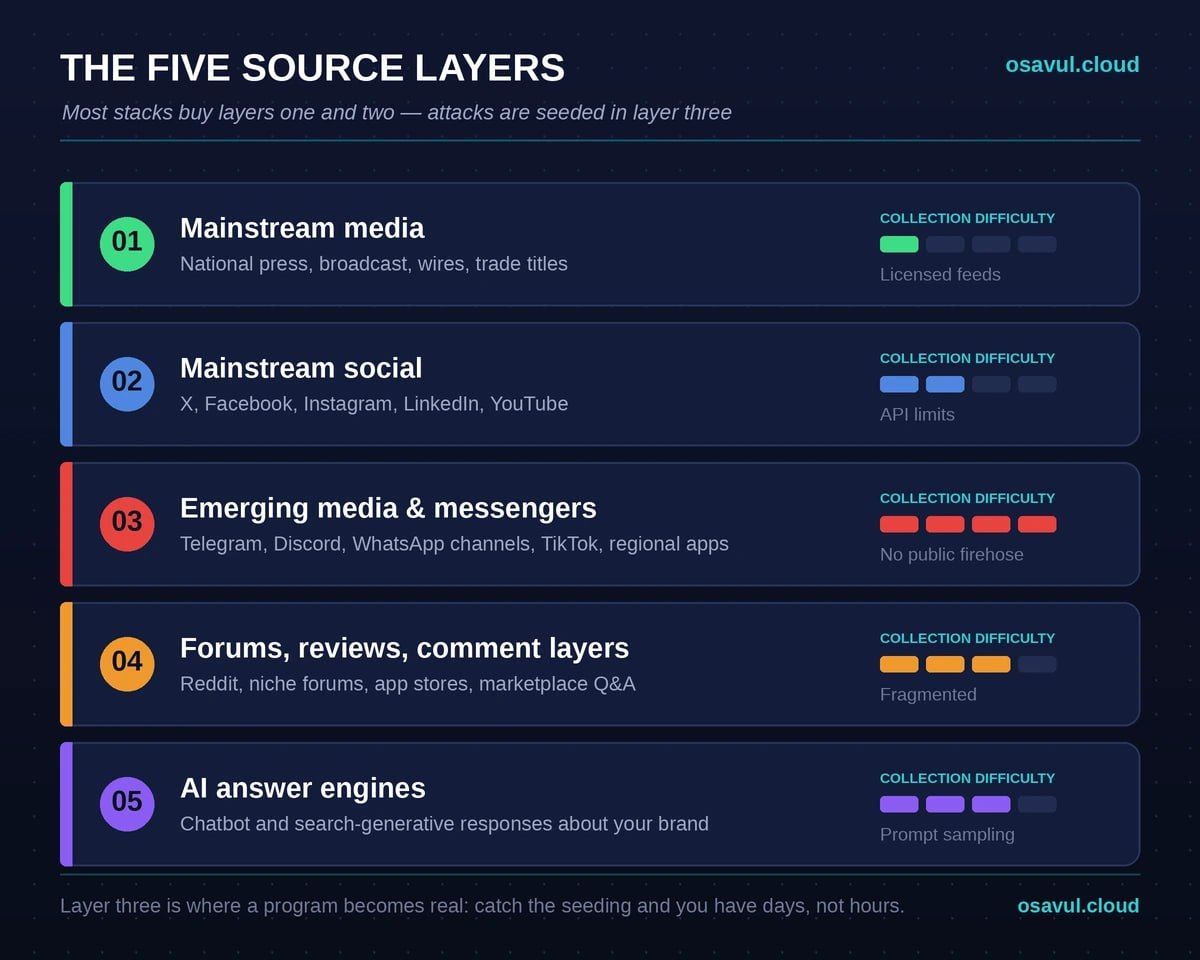
Layer three is the one that decides whether your online brand monitoring is real or decorative. Seeding happens in closed and semi-closed spaces because operators want to test framings before spending amplification budget. Catch it there and you have days. Catch it in layer one and you have a crisis with a headline attached.
Our own collection splits along these lines deliberately — social platform coverage for layers two and four, Telegram-native collection and TikTok transcription for layer three, across roughly 150,000 sources in 100 countries.
Layer five deserves a note, because it is new enough that most procurement documents do not mention it. When a customer asks a chatbot whether your product is safe, the answer is assembled from whatever the model retrieved — including layer four content that no human ever read. A false claim parked in a well-indexed forum thread now has a distribution channel that did not exist three years ago. Sampling those answers on a schedule is becoming a standard line item, and teams that skip it are monitoring a version of the internet their customers have partly stopped using.
Signal Taxonomy: Telling Noise From a Narrative Attack
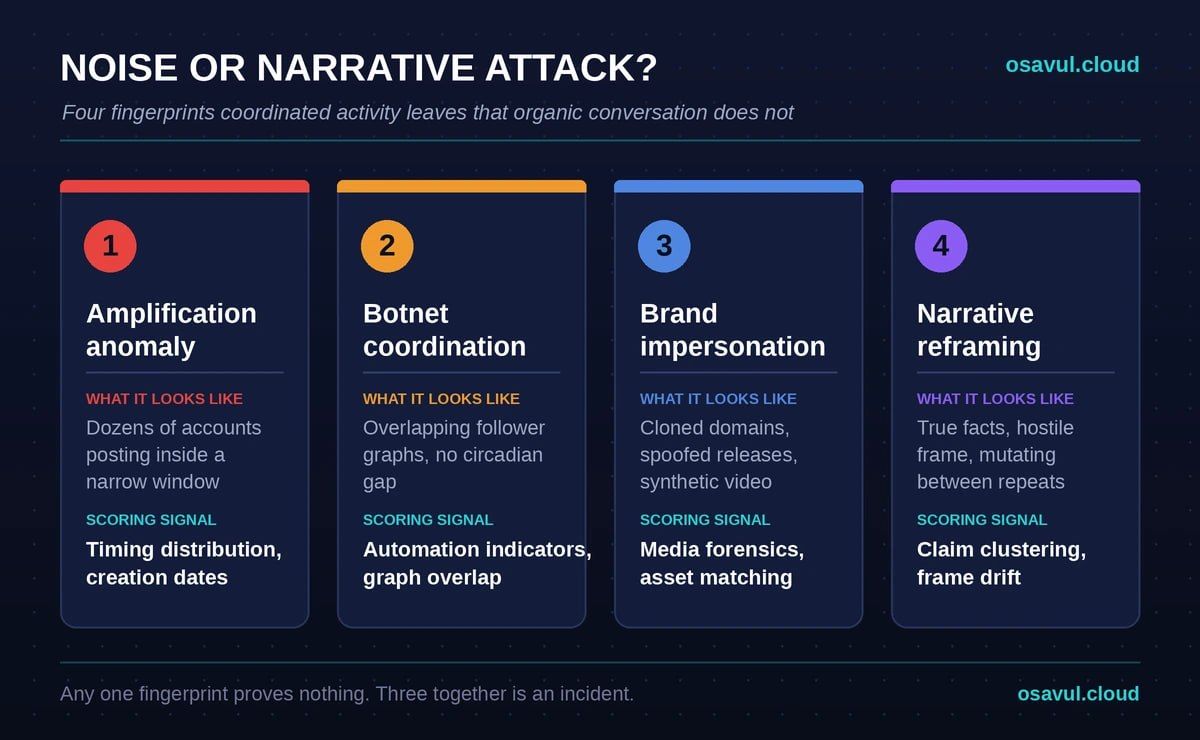
A narrative attack shows four fingerprints that organic conversation does not: unnatural timing, account-level artificiality, message discipline, and a frame that serves someone other than the people repeating it. Any one on its own proves nothing. Three together is an incident.
This is the triage judgement that separates an analyst from a dashboard. The EU's External Action Service publishes the most usable public taxonomy of these behaviours in its FIMI threat reports, and the tactics catalogued there against states map almost cleanly onto what gets run against corporations.
Amplification Anomalies and Botnet Coordination
Coordination shows up in the timing distribution long before it shows up in the content. Organic conversation about a brand has a ragged, long-tailed posting curve. Coordinated activity clusters — dozens of accounts posting within a narrow window, often with identical link parameters or the same four-word phrase in different sentence positions.
The tells we weight most heavily: account creation dates bunched in the same month, posting rhythms with no circadian gap, follower graphs with near-total overlap, and cross-platform arrival in a fixed order. Human networks are messier than people expect, and synthetic ones are tidier.
Automation detection sits underneath all of this. If you want the mechanics, we covered them in what bot detection actually involves and in the companion piece on fake accounts; the bot monitoring module is where that analysis runs in our stack.
Brand Impersonation and Executive Deepfakes
Brand impersonation is the fastest-moving category we track, and the cheapest to execute. Cloned domains, fake support accounts, counterfeit recruitment posts, spoofed press releases — each takes minutes to produce and can take weeks to fully retract.
Synthetic executive video changed the risk profile again. A forty-second clip of a CEO appearing to announce a product withdrawal does not need to survive scrutiny; it needs to survive one trading session. Detection here depends on media forensics running against the video artefacts and on monitoring the seeding channels rather than the platforms where the clip eventually lands. That containment work is the online brand protection side of the discipline, and the two functions share the same collection layer for good reason.
Narrative Reframing
Reframing is the hardest signal to catch because nothing in it is false. The facts stay intact; the frame around them flips. A factory closure becomes abandonment of a region. A price adjustment becomes exploitation during a crisis. A routine regulatory filing becomes evidence of a cover-up.
Keyword monitoring is blind to this by construction — the brand mention looks normal, the sentiment shifts only slightly, and the volume stays under threshold. Catching it requires clustering claims into narratives and tracking how the framing mutates between repetitions, which is what narrative intelligence is built to do. We saw this run at scale against commercial targets in our Central Asia investigation, where the underlying facts were accurate in almost every post.
How AI Brand Monitoring Changes the Economics
AI brand monitoring matters because the constraint was never collection volume — it was the analyst hour spent reading. A mid-size enterprise generates somewhere between 40,000 and 400,000 brand-relevant items a month across all five source layers. No team reads that. The old workaround was sampling, and sampling is exactly how a slow, low-volume attack survives its first three weeks undetected.
Three capabilities do the actual work, and it is worth separating them, because vendors sell all three under one label.
Multilingual claim extraction. Machine translation is the boring half. The useful half is pulling the specific assertion out of a post — this company knowingly shipped contaminated product — so that the same claim in Georgian, Turkish and German collapses into one tracked object instead of three unrelated spikes.
Clustering into narratives. Individual mentions are almost useless as units of analysis. Grouping them into narratives, then watching each narrative's velocity, reach and source mix, turns a flat feed into something with a shape you can brief on. Sentiment scoring rides on top of this rather than underneath it — a point we make in more depth on the sentiment analysis module, since sentiment averaged across an unclustered feed is close to meaningless.
Drafting the brief. The last mile is a document a CISO or a CCO can read in four minutes. Analysts we work with spend 30–40% of their week on report assembly, which is the least interesting part of the job and the easiest to hand off to automated reporting.
The honest caveat: automated systems are confident and occasionally wrong, and attribution in particular still needs a human. We treat model output as triage, not verdict. The question to ask a vendor is not whether their platform uses AI — everyone's does — but what the system does when confidence is low. Silent guessing and a flagged escalation to an analyst produce very different failure modes.
Building a Brand Monitoring Strategy in Five Steps
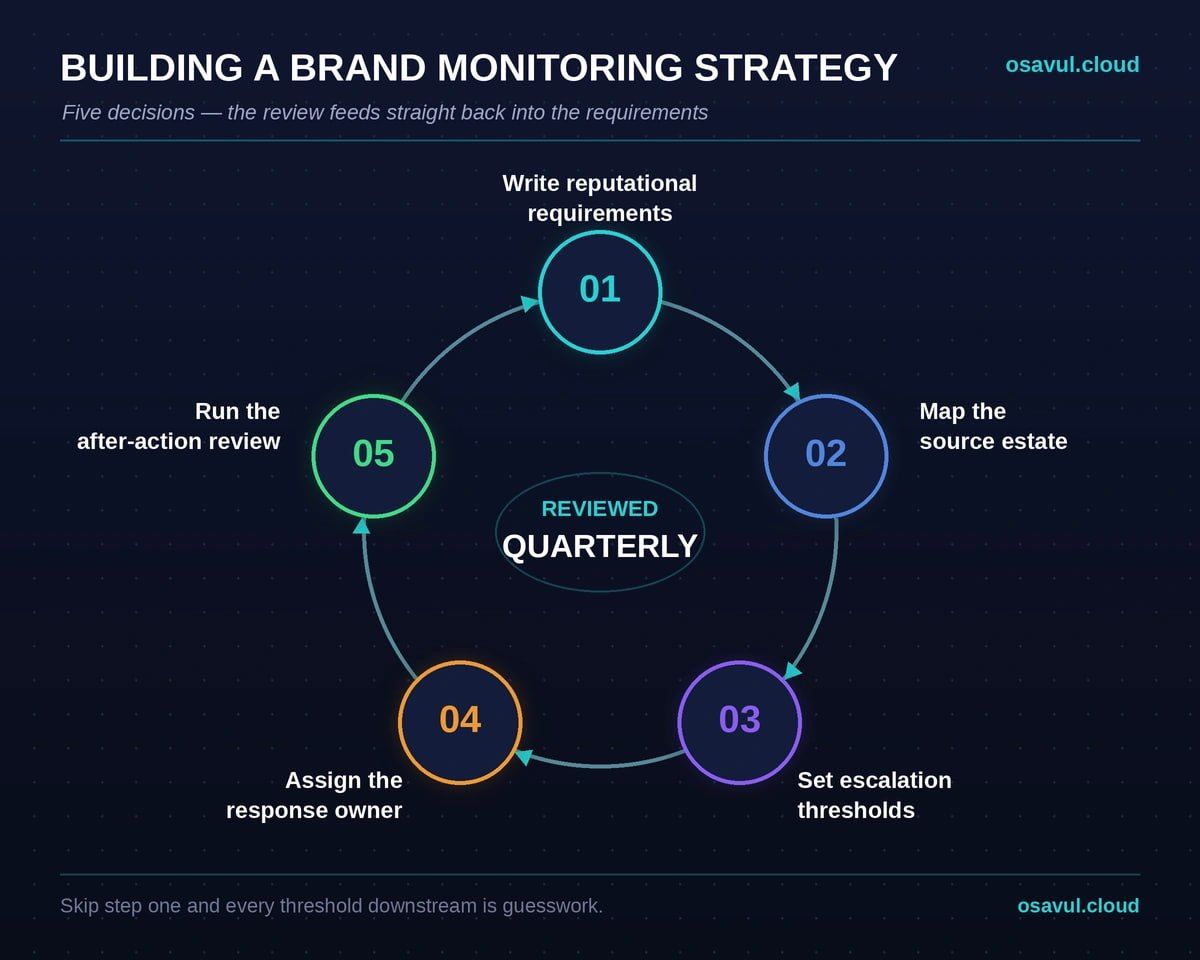
A working brand monitoring strategy is defined by decisions, not by tooling. The sequence below is the one we walk new clients through, and step one is where most programs quietly go wrong.
- Write your reputational intelligence requirements. Borrow the discipline from threat intelligence: what specific decisions will this program inform, and who makes them? "Track our brand" is not a requirement. "Detect coordinated claims about product safety in our top eight markets, fast enough for the regional GM to pre-brief regulators" is. Everything downstream — sources, thresholds, staffing — derives from this list.
- Map the source estate against your actual exposure. A B2B industrial supplier and a consumer app do not share a threat surface. Rank the platforms your customers, regulators and critics actually use, market by market, then check which of the five layers your current tooling reaches. The gap analysis usually fits on one page and usually embarrasses someone.
- Set escalation thresholds before you need them. Covered below, because this is where programs live or die.
- Assign the response owner per scenario. Not a committee. A named person for impersonation takedowns, a named person for regulatory-adjacent claims, a named person who can authorise public response outside business hours. We have watched a well-instrumented program lose two days because nobody was sure whether legal or comms owned the first move. The playbook side of this is in our guide to defending against information attacks.
- Run the after-action review on every escalation, including false ones. False positives are training data for your thresholds. Skipping the review is how a program accumulates alerts nobody trusts.
Setting Escalation Thresholds That Don't Cry Wolf
Good thresholds are compound, not volumetric. A single volume trigger will fire on your own product launch and stay silent through a slow-burn attack, which is the worst pairing of errors available.
The condition we recommend combines four factors:
| Factor | Question | |
| Velocity | Is spread accelerating relative to this narrative's own baseline? | High |
| Source anomaly | Is it appearing in channels this topic never uses? | |
| Coordination score | What share of accounts show automation indicators? | |
| Content severity | Does the claim touch safety, legality or executive conduct? | Critical override |
Severity acts as an override for a reason. A safety allegation with twelve mentions warrants a look; a competitor comparison with twelve thousand usually does not.
Tuning these takes about a quarter of live data, and the target is a shape rather than a number: enough alerts that analysts stay calibrated, few enough that escalation still feels serious. Programs built around forward-looking indicators rather than reaction — the logic behind early warning monitoring and our pre-emptive analysis module — end up with fewer alerts and better ones.
Choosing a Brand Monitoring Platform: An Evaluation Checklist
The questions that separate vendors are not on the feature comparison page. Every brand monitoring platform claims global coverage, AI analysis and real-time alerts. The differences show up when you ask how each claim is implemented.
| Ask this | Weak answer | |
| How do you collect from Telegram and closed communities? | "We partner with a data provider." | Named collection method, channel counts, how new channels get discovered |
| What happens to non-English content? | "We translate everything." | |
| How is a narrative defined in your system? | Keyword group | |
| How do you distinguish coordination from popularity? | Sentiment drop | Specific account-level and timing indicators, scored |
| What is your median detection lag on emerging platforms? | No answer | A number, with the measurement method |
| Can I see a false positive from a real deployment? | Refusal | A walked-through example |
| Who reviews low-confidence output? | "The model handles it." | A defined analyst workflow |
Two structural questions matter as much as the technical ones. First: does the vendor sell you a tool or an outcome? Pure-software purchases fail when the buyer has no analyst capacity, which is why blended brand monitoring services — platform plus a named analyst — tend to survive their first year better in teams under ten people.
Second: can the same system answer both the marketing question and the security question? Running separate stacks for share of voice and for threat detection means two collection bills, two blind-spot maps, and a handoff delay at exactly the wrong moment. The value of consolidated online brand monitoring is that the anomaly and the context sit in the same view.
One practical test before signing anything: hand the vendor a real incident from your own history — one you have already investigated — and ask what their system would have surfaced, and when. Vendors who can reconstruct it against archived data will show you. Vendors who cannot will change the subject to roadmap.
The coverage gap this test usually exposes is the emerging-media one. Bill Byrne and our team went through several versions of it in this session on brand risk across emerging platforms, and the recurring pattern is a stack that performs beautifully on the platforms where nothing dangerous starts.
Metrics That Prove the Program Works
Report on four numbers, not forty. Impressions and mention counts describe activity; these four describe whether the program is doing its job.
Time to detection. Hours between first appearance of a claim anywhere in your source estate and the moment an analyst flags it. This is the master metric — every other improvement eventually expresses itself here. Measure it retrospectively after each incident by tracing the claim back to its earliest instance, including in channels you were not watching. The uncomfortable version of this number is the one that includes misses.
Escalation precision. Of the alerts escalated to a human decision-maker, what share warranted the escalation? Below about 30% and the exec team starts ignoring the channel. Above 90% and your thresholds are almost certainly set too high, which means the slow attacks are passing underneath.
Share of voice under contested conditions. Standard share of voice is a marketing metric. The defensive version measures your share within the specific narrative being contested — if a safety claim is circulating, what proportion of that conversation carries your account of events? This is the number that tells a communications lead whether a response landed.
Narrative half-life. How long a hostile narrative takes to decay to half its peak daily volume, tracked across incidents. Rising half-life means the narrative found a durable host community and will resurface. Falling half-life across a year is the clearest evidence that brand reputation monitoring and response are working together rather than sequentially.
Two things are worth measuring even though they resist clean quantification: whether the same claim keeps returning in new packaging, and whether your own audiences repeat it back to you in customer service tickets and sales calls. That second signal — an attack narrative surfacing in a renewal conversation — is the point at which reputational risk becomes revenue risk, and it rarely appears in any dashboard.
Edelman's Trust Barometer puts a defensible figure on the underlying stake, and the trend it tracks is why boards now ask for these numbers unprompted. For the response-side counterpart to this measurement work, our guide to online reputation management for large brands covers what teams do once the metric moves.
Where Brand Monitoring Programs Break
Three failure patterns account for most of the programs we are asked to rescue. None of them is a tooling problem, which is why replacing the platform rarely fixes them.
The orphaned dashboard. Someone bought a capable system, configured it during onboarding, and nobody has adjusted a query since. Two years later the keyword list still misses a product line launched in 2024 and three markets the company entered last year. The system is running. It is monitoring a company that no longer exists. The fix is a scheduled configuration review — quarterly, thirty minutes, tied to the requirements list from step one.
The unowned alert. Detection works, escalation fires, and the alert lands in a shared inbox that four people read and nobody owns after 6pm. We have reviewed incident timelines where the flag existed eleven hours before anyone acted on it, which converts a technical win into an operational loss. Detection without a named owner is a very expensive way to generate a paper trail proving you knew.
The severed comms-security split. Communications sees the narrative, security sees the infrastructure, and the two never compare notes. So the impersonation domain gets taken down while the narrative it seeded keeps running, or the narrative gets rebutted while the account network that carried it stays live and simply starts again next month. Attacks that blend cyber and information activity punish this split specifically — the reasoning behind treating corporate cognitive security as one function rather than two.
The pattern underneath all three is the same: monitoring got treated as a subscription rather than a practice. A practice has an owner, a review cadence and a memory of past incidents. A subscription just renews.
If you are auditing your own setup against this list, the practical starting point is the response side — how to protect a brand online walks through the containment steps that a detection program is supposed to trigger, and working backwards from those steps tends to expose which of the three failures you actually have.
Frequently Asked Questions
How often should a brand monitoring program run?
Collection should run continuously; human review should run on a tiered cadence. In practice that means always-on ingestion, automated triage against your thresholds, a daily analyst pass over flagged clusters, and a weekly narrative-level review that looks at trends rather than incidents.
The tiering matters more than the frequency. Teams that try to review everything daily burn out in a quarter. Teams that review weekly miss the window on fast-moving impersonation. Splitting the two — machine-continuous, human-tiered — is what makes the workload sustainable at a realistic headcount.
Can brand monitoring detect a coordinated attack before it reaches the press?
Yes, if your collection reaches the seeding layer. Coordinated campaigns almost always rehearse in messengers and small communities before scaling, which creates a detection window measured in days rather than hours.
The honest qualifier: this only works for source layers you actually cover. A program limited to mainstream social and press will detect the attack at roughly the same time the journalists do, which is not detection so much as confirmation. The lead time comes from layer three, and nowhere else.
Who should own brand monitoring — communications or security?
Jointly, with communications owning the response and security owning the analysis. The split that works assigns detection, attribution and technical takedown to the security or threat intelligence function, and messaging, stakeholder briefing and public response to communications.
What fails is either function owning it alone. Security-only programs produce accurate attribution nobody translates into public action. Comms-only programs respond fast to things that did not need a response and miss the coordinated activity underneath. If your organisation cannot support both, the shared-service model behind our platform exists partly because mid-size teams genuinely cannot staff two functions.
Does brand monitoring cover AI chatbot answers about my company?
Only if the vendor explicitly samples them — most legacy platforms do not. This is a distinct collection task: it means running a fixed set of prompts about your brand, products and executives against the major assistants on a schedule, then tracking how the answers and their cited sources change.
It is worth starting now, even crudely. A false claim that has settled into the retrieval layer is far harder to dislodge than a post, because there is no publisher to contact and no takedown to request. The correction path runs through the sources the model cites, which means finding them first.
What is a realistic budget for enterprise brand monitoring services?
Enterprise brand monitoring services generally run from roughly $30,000 to $250,000 a year, depending on source depth, language coverage and whether analyst time is included. Messenger and short-video collection is the single largest cost driver, because it cannot be bought as a cheap API feed.
The more useful budgeting question is what the alternative costs. One mishandled narrative attack against a listed company — a week of trading noise, a regulatory letter, an emergency agency retainer — typically clears the annual cost of the program on its own. That comparison is easier to make with a specific past incident than with an industry average, so run it against something that actually happened to you.
The Takeaway
The programs that work are not the ones with the biggest source counts. They are the ones where somebody can answer three questions without checking: which claims about us are currently circulating, which of them are being pushed rather than shared, and who moves first if one of them accelerates tonight.
Everything in this guide serves those three answers. Source depth exists so the first question can be answered honestly rather than partially. Coordination scoring exists for the second. Named ownership and pre-set thresholds exist for the third.
The uncomfortable part is that most of the work is organisational. You can buy collection. You can buy clustering, translation and alerting. You cannot buy the decision about who wakes up at 2am, or the quarterly half-hour spent checking that your queries still describe the company you are today.
Start with your last incident. Trace it back to its earliest appearance anywhere, note what you were not watching, and count the hours between that moment and the one when someone in your building first heard about it. That number is your real baseline, and it is usually worse than the dashboard suggests.