What Is Media Monitoring? A Working Definition for 2026
Media monitoring is the systematic tracking of news sites, social platforms, messengers, and broadcast sources for mentions of a topic, organization, or narrative you care about. Fine as far as it goes. But if you’ve actually run monitoring for an organization lately, you know the textbook definition misses most of what the work has become.
Here’s what changed. A decade ago the end product was a clipping report — headlines, a rough sentiment score, maybe a chart if someone was feeling ambitious. Nobody’s career depended on it. Now we regularly sit with comms teams who found out about a hostile narrative from a journalist’s phone call, not from their monitoring stack, and that gap is exactly the problem the discipline has to solve.
So the honest 2026 definition is wider: continuous collection and analysis of your information environment — mentions, yes, but also the accounts spreading them, whether those accounts move in coordination, and which larger narrative a spike is feeding. One of our analysts puts it bluntly: a mention count tells you something happened. It never tells you who made it happen, or why now.
Why Media Monitoring Moved From PR Function to Security Discipline
Media monitoring became a security function because the threats it catches stopped being reputational and started being operational. A bad review cycle hurts your brand. A coordinated narrative attack — fabricated documents, botnet-driven spread, timed leaks — can move your stock price, trigger regulatory scrutiny, or get your staff harassed within a news cycle.
We saw this shift up close tracking narrative attacks in Eastern Europe: the same playbooks built for state propaganda started showing up against banks, energy companies, and NGOs. The attackers didn’t care that the target had a PR department instead of a threat intel team. The PR department, meanwhile, had tools built to count mentions — not to spot forty accounts posting the same claim within a six-minute window.
That’s why the vocabulary is changing. Practitioners now talk about cognitive security — defending how audiences perceive your organization — the way they once talked about network security. Monitoring is the sensor layer of that defense. Without it, every response is late by definition.
What Media Monitoring Actually Covers
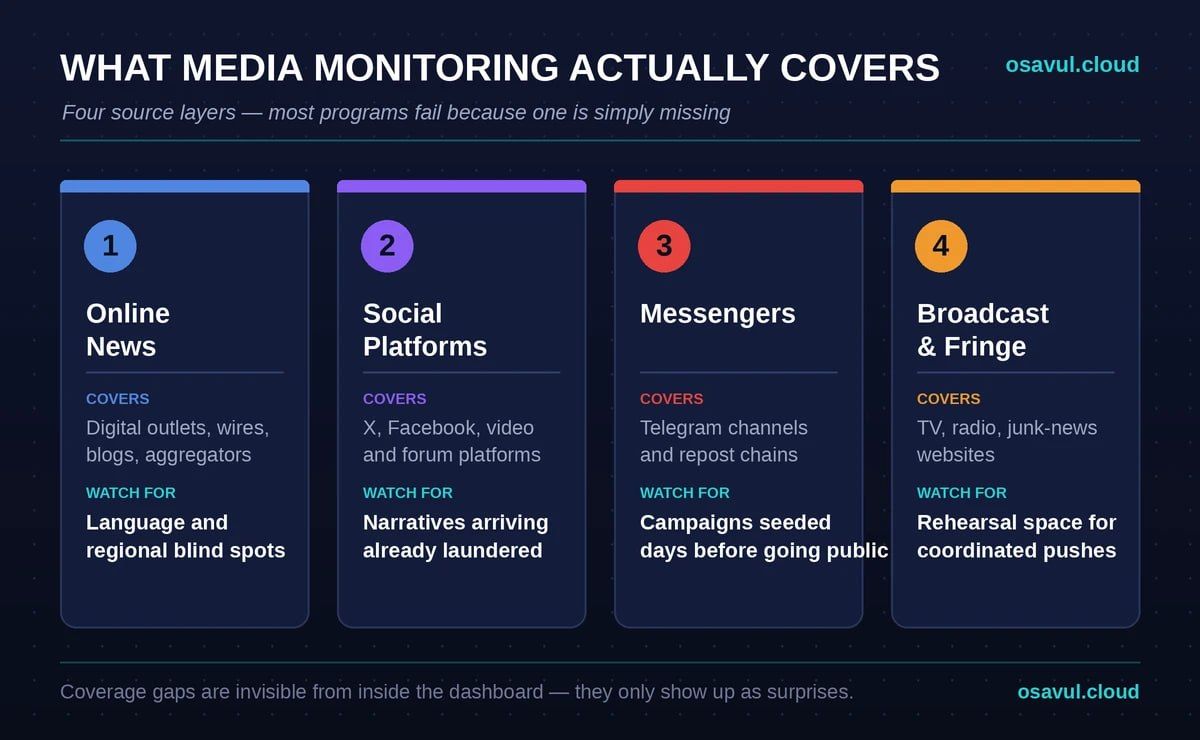
Media monitoring covers four broad source layers: online news, social platforms, messengers, and broadcast — plus the fringe outlets that sit between them. Most programs fail not because the analysis is weak but because one of these layers is simply missing.
News and Online Media Monitoring
Online media monitoring tracks digital news outlets, wire services, blogs, and aggregators — usually the easiest layer to cover and the one most tools handle well. The catch is language and geography. If your monitoring reads English and your adversary publishes in Romanian, Serbian, and Georgian, your coverage map has holes exactly where the attacks start. We’ve watched narratives incubate for days in small regional outlets before any English-language source picked them up.
Social Platforms and Messengers
Social coverage means the major platforms plus the messengers where narratives actually originate — and in most regions we track, that means Telegram first. Public channels there function as both source and distribution network: a claim gets seeded in a channel with 800 subscribers, reposted through a chain of larger ones, and lands on X or Facebook already looking organic. Miss the messenger layer and you only ever see the final, laundered version.
Broadcast and Fringe Sources
Broadcast monitoring — TV and radio — still matters because in many countries television remains the top news source, especially for audiences that never see the online debate. Add fringe websites and “junk news” outlets to this layer. Individually they’re noise. In aggregate, they’re where coordinated campaigns rehearse messaging before pushing it mainstream.
Media Monitoring vs. Social Listening vs. Media Intelligence
Media monitoring tracks mentions across every media type; social listening only analyzes conversations and mood on social platforms; media intelligence takes the output of both and answers the harder question — who is driving this, and what happens next.
Honestly, vendors deserve most of the blame for the confusion here. We’ve sat in procurement calls where three products with three different labels did roughly the same thing, and one where two “media intelligence platforms” had nothing in common except the price tag. So ignore the labels and check what a tool actually does:
| Media monitoring | |||
| Sources | News, social, messengers, broadcast, print | Social platforms | Everything monitoring covers |
| Who mentioned us, where? | |||
| Alerts, mention feeds, reports | |||
| Typical owner | Comms / PR | Marketing | Security, StratCom, executive team |
One pattern we see over and over: a team buys monitoring, gets comfortable, then hits an incident where the mention feed shows a spike and nobody can say whether it’s forty angry customers or forty coordinated accounts. That’s usually the day they discover the difference between counting mentions and media intelligence — and the budget conversation changes fast after it.
How an AI-Driven Media Monitoring Process Works
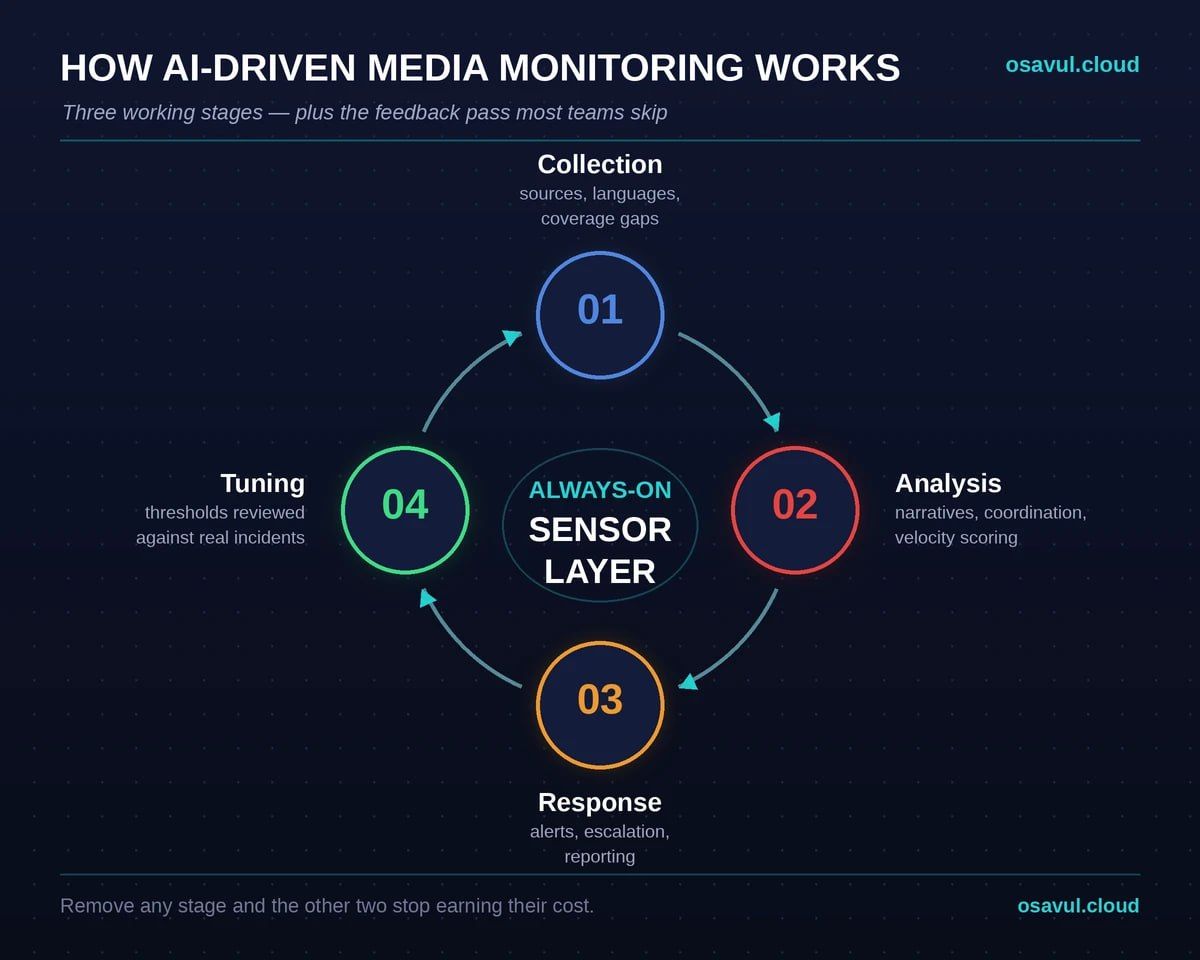
An AI-driven media monitoring process runs in three stages: collection pulls raw content from thousands of sources in real time, analysis turns that stream into ranked signals, and response routes what matters to the people who can act on it. Remove any stage and the other two stop earning their cost.
Collection: Sources, Languages, Coverage Gaps
Collection quality is decided by three things: how many sources you ingest, how many languages you process natively, and how fast new sources get added when the conversation moves. That last one gets underestimated. When a narrative jumps to a platform you don’t cover, the time it takes your vendor to add it is time you’re blind. Ask about it before you sign, not during an incident.
Analysis: From Mention Counting to Narrative Detection
Modern media monitoring analysis uses AI to do what human analysts can’t at scale: cluster thousands of messages into narratives, flag coordinated posting patterns, and score which storylines are gaining velocity. A human reads maybe 300 messages in an hour, with fading attention. A model clusters 300,000 and hands the analyst ten narratives worth reading closely. The analyst still makes the judgment call — the machine just decides what’s worth judging.
Response: Alerts, Escalation, Reporting
Response is where monitoring programs quietly die. If every spike pings the whole team, people mute the channel within a month — we’ve seen it happen by week three. The fix is boring but works: severity tiers agreed in advance, one named owner per tier, and alert thresholds tuned quarterly against what actually mattered last quarter.
Building a Media Monitoring Report Teams Actually Read
A useful media monitoring report contains five things: the period’s key narratives, mention volume with context against baseline, sentiment shifts that actually moved, the sources and accounts driving reach, and a short “so what” section with recommended actions. Everything else is decoration.
The most common failure we see isn’t missing data — it’s missing hierarchy. A report that opens with forty charts gets skimmed once and archived. A report that opens with three sentences an executive can repeat in their next meeting gets forwarded. Write the top of the report for the person with ninety seconds, and the appendix for the analyst with an hour.
Two habits separate reports that survive budget reviews from ones that don’t. First, always compare against baseline: “1,400 mentions” means nothing; “1,400 mentions, four times our Tuesday average, driven by two Telegram channels” means everything. Second, track your own past calls. When last month’s report flagged a narrative as likely to escalate and it did, say so. Nothing builds trust in a monitoring program faster than a visible track record.
Using Media Monitoring to Detect Disinformation and Coordinated Campaigns
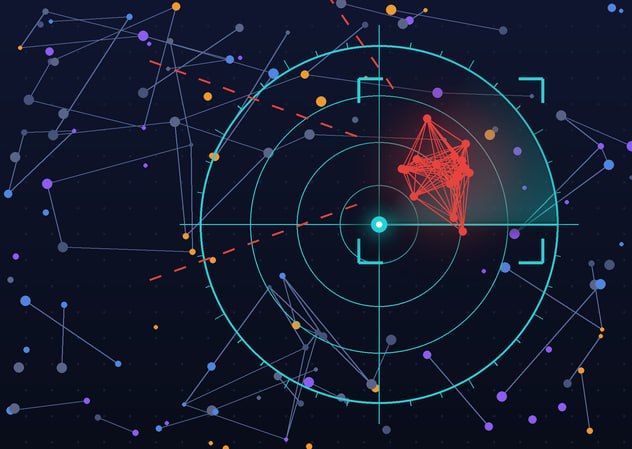
Yes — media monitoring can detect disinformation, but only if it’s built to analyze behavior, not just content. A false claim and a true one look identical to a keyword filter. What gives a campaign away is coordination: identical phrasing across unrelated accounts, synchronized posting windows, new accounts reviving old narratives, engagement patterns that don’t match organic spread.
This is where standard monitoring stacks hit their ceiling. Counting mentions of a fabricated story tells you it’s spreading; it doesn’t tell you the first 200 shares came from a botnet warmed up two weeks earlier. Platforms built for information environment assessment, like Osavul, approach this differently — mapping the actors and networks behind a narrative, scoring coordination probability, and tracking how storylines mutate as they move between platforms and languages.
Two techniques from our own casework are worth stealing regardless of your tooling. First, treat narratives, not keywords, as your unit of analysis — we’ve written about narrative analysis vs. thematic analysis and why the distinction changes what you catch. Second, monitor upstream: most campaigns we’ve traced in Eastern Europe rehearsed on Telegram days before surfacing anywhere else, which is why Telegram OSINT tools have become standard kit for investigators.
How to Choose Media Monitoring Tools and Software
Choose media monitoring software by testing it against your last real incident, not a vendor demo. Take the worst week your team had in the past year and ask: would this tool have caught it earlier, explained it faster, or routed it better? If the answer is no three times, the feature list doesn’t matter.
Beyond that test, the criteria that separate media monitoring tools in practice:
| What to verify | |
| Source coverage | Messengers (especially Telegram), regional outlets, and broadcast — not just mainstream news and X |
| Native analysis in your risk languages, not translation bolted on top | |
| Can it flag inauthentic networks, or only count mentions? | |
| Alert quality | Tunable severity tiers; ask for false-positive rates, not screenshots |
| Analyst workflow | How many clicks from alert to evidence you can put in a report? |
| Data access | API and export rights — your data shouldn’t be hostage to the interface |
One more thing on media monitoring services versus self-serve tools: managed services suit teams without a dedicated analyst, but ask who does the analysis and in which time zone. A 9-to-5 service watching a 24-hour information space is coverage theater — the gap always lands at 3 a.m.
FAQ
What is media monitoring and how does it work?
Media monitoring is the continuous tracking of news, social platforms, messengers, and broadcast sources for mentions and narratives relevant to your organization. It works in three stages: automated collection, AI-assisted analysis, and alert-based response.
What’s the difference between media monitoring and social listening?
Monitoring covers all media types and asks “who mentioned us, where”; social listening covers only social platforms and asks “what does the audience feel.” Most mature teams run both, feeding into a media intelligence layer.
What should a media monitoring report include?
Key narratives, mention volume against baseline, meaningful sentiment shifts, the sources driving reach, and recommended actions — in that order, with the executive summary written first.
Can media monitoring detect disinformation?
Yes, if it analyzes behavior rather than just content: coordinated posting patterns, synchronized boosting, and cross-platform narrative movement are the signals that expose campaigns keyword tools miss.
How do you choose media monitoring software?
Test candidates against your last real incident, then verify source coverage, native language depth, coordination detection, alert quality, and data export rights before price enters the conversation.