TikTok Is Not Just a Marketing Channel Anymore
Three years ago, a major European food brand watched a single 40-second TikTok video erase 11% of its stock value in 72 hours. The video was fabricated. The outrage was real. And the brand’s crisis team wasn’t even monitoring TikTok at the time.
That scenario is no longer an edge case. Understanding how narrative attacks influence brands on TikTok is now a baseline competency for any CMO operating in a market where consumers under 35 form opinions at scroll speed.
TikTok reaches over 1.5 billion active users monthly, and its content discovery model operates differently from every other platform — which is exactly what makes it a preferred vector for coordinated disinformation operations targeting brand equity.
What Makes TikTok Uniquely Dangerous for Brand Reputation
The short answer: TikTok’s For You Page (FYP) doesn’t require an audience. That architectural decision — designed to make content discovery frictionless — removes the friction that protects brands on follower-dependent platforms like Instagram or LinkedIn.
An account with zero followers can post damaging content about your product at 2 AM, and by 9 AM it can have 400,000 views if the algorithm’s engagement signals fire correctly. On Twitter/X, you need a follower base or a retweet cascade. On TikTok, you just need the first 500 viewers to watch past the 15-second mark.
The Algorithm That Turns Rumors Into Reach
TikTok’s recommendation engine optimizes for watch time and re-watch rate, not accuracy. Content that triggers emotional arousal — outrage, disgust, fear — consistently outperforms neutral content on these metrics. This creates a structural advantage for negative brand narratives.
In tracking disinformation campaigns across Eastern European markets over the past 18 months, our analysts at Osavul documented a consistent pattern: a negative brand claim wrapped in an emotional hook (a mother’s health scare, a workers’ rights violation, an environmental disaster) reliably achieves 3–7x the organic reach of the brand’s own corrective messaging, even when the correction is posted faster.
Anonymous Creators and Coordinated Amplification
Most TikTok narrative attacks don’t originate from high-profile accounts. They’re seeded by networks of anonymous micro-accounts — often created weeks or months in advance to establish credibility — that coordinate amplification through comment sections, duets, and stitches. By the time a brand’s social monitoring team flags the originating video, the narrative has already branched into dozens of derivative pieces of content that each carry independent algorithmic momentum.
The Anatomy of a TikTok Narrative Attack Against a Brand
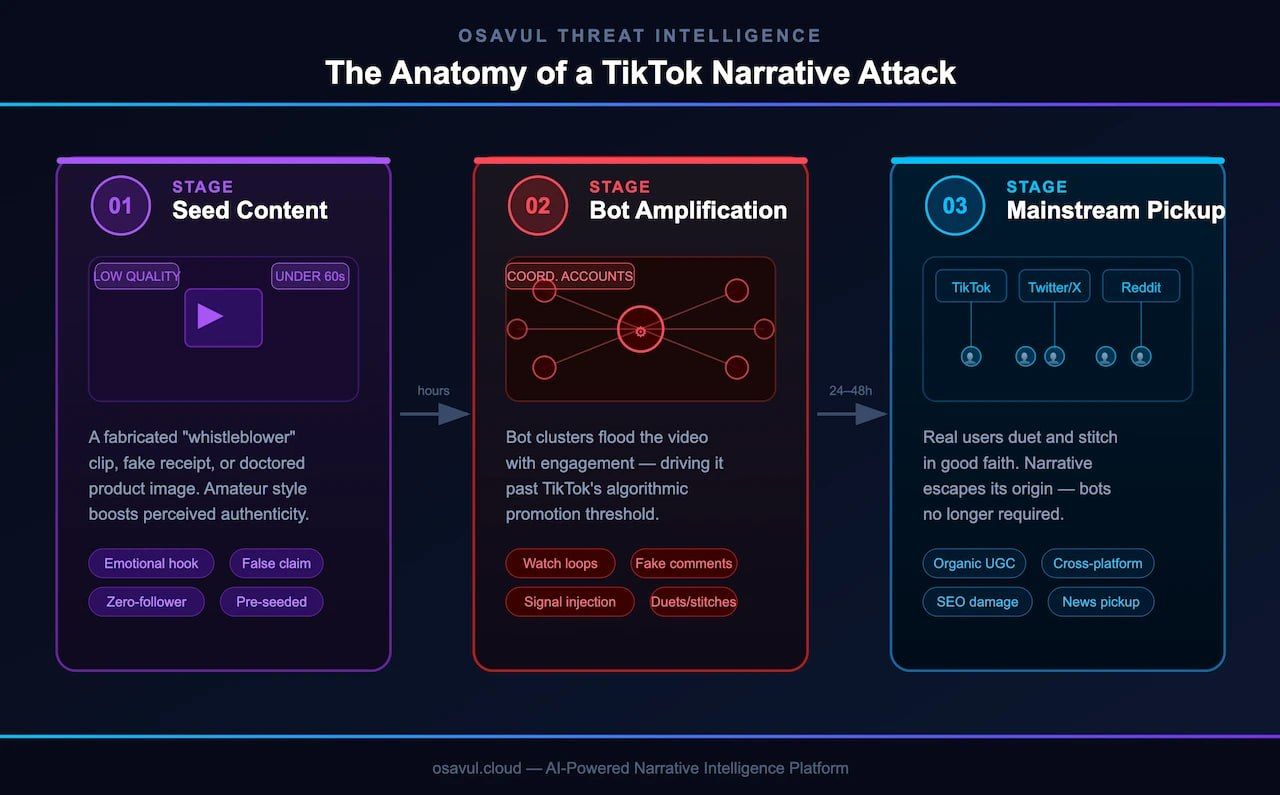
Narrative attacks on TikTok rarely happen spontaneously. The ones that cause real damage — the kind that lands in board meetings and triggers investor calls — follow a recognizable operational pattern. Knowing the stages helps brands understand where detection is possible and where the window for intervention closes.
Stage 1: Seed Content
The attack begins with a single piece of content, usually under 60 seconds, designed to establish an emotionally compelling false premise. It might be a “whistleblower” claiming insider knowledge, a fabricated receipt showing exploitative labor practices, or a doctored product image paired with health-scare framing. The production quality is deliberately low — amateur aesthetics increase perceived authenticity on TikTok, where polished content reads as corporate.
Stage 2: Bot-Driven Amplification
Within hours of posting, coordinated bot accounts drive the video’s initial engagement metrics above TikTok’s threshold for algorithmic promotion. This is the most technically sophisticated phase of the attack. The bots don’t just like and share — they post semantically consistent comments that reinforce the narrative and bait real users into responding. Each comment reply generates additional engagement signals, compounding the algorithmic momentum.
Stage 3: Mainstream Pickup
Once organic viewers begin dueting or stitching the original content, the narrative escapes its coordinated origin point and enters genuine user discourse. At this stage, the attack no longer requires bot support. Real users are now producing derivative content in good faith, each iteration adding surface area that’s effectively impossible to suppress. By the time the story migrates to Twitter/X and Reddit — which it usually does within 24–48 hours — the brand is fighting a multi-platform information fire.
The Real Effect of Narrative Attacks on Brands
The effect of narrative attacks on brands extends well beyond a bad news cycle. Our monitoring of 40+ brand-targeted disinformation campaigns since 2022 shows three categories of measurable damage.
Revenue and Stock Price Volatility
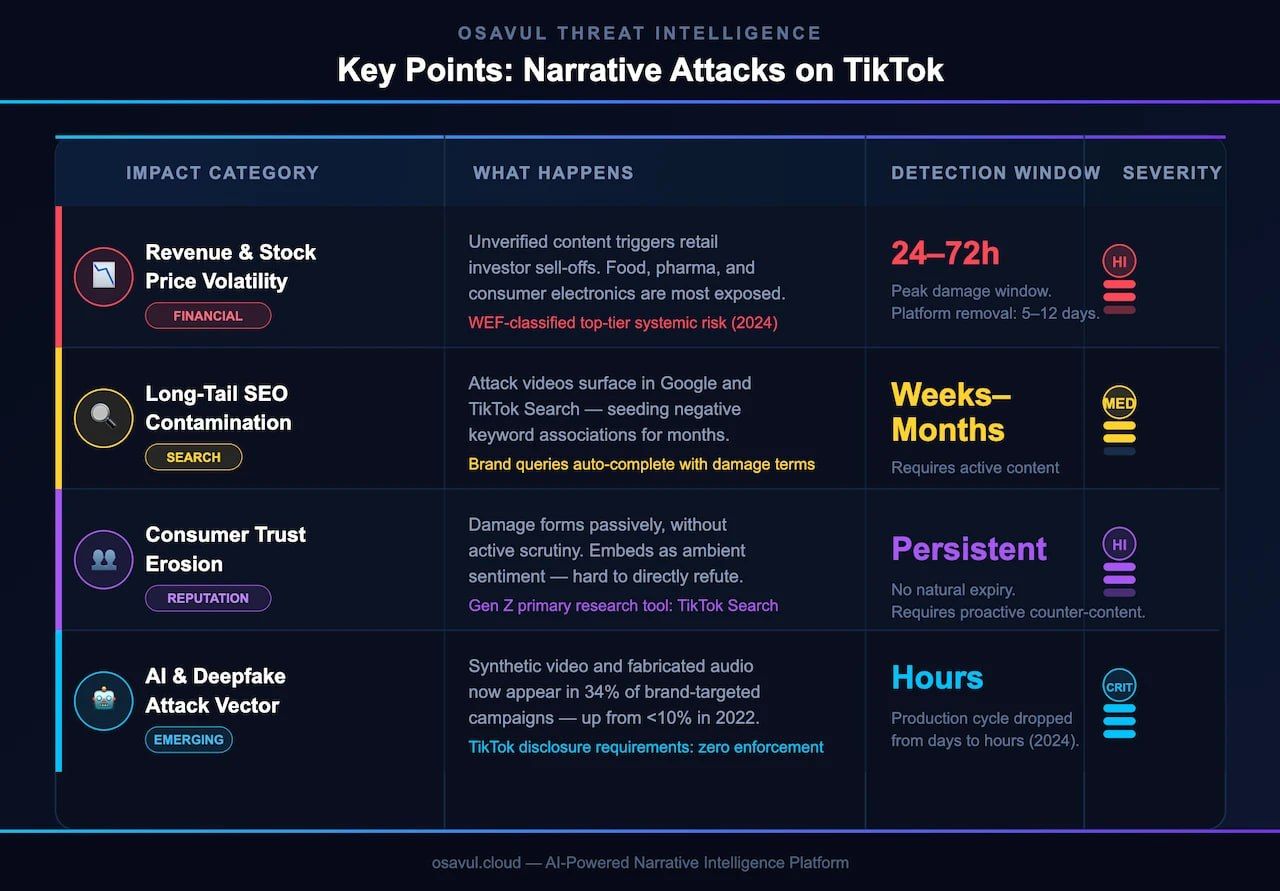
Publicly traded companies absorb the sharpest short-term hit. A 2026 analysis by the World Economic Forum identified coordinated disinformation as a top-tier systemic risk, partly because of its demonstrated capacity to trigger retail investor sell-offs based on unverified social media content. Brands in food, pharma, and consumer electronics are particularly exposed — categories where trust and safety perceptions are load-bearing.
Long-Tail SEO Contamination
Less discussed but equally damaging: TikTok videos now surface in Google Search results, and TikTok’s own search engine is the primary research tool for Gen Z consumers. A successful narrative attack doesn’t just damage sentiment in the moment — it seeds the keyword landscape with negative associations that take months of content production to displace. Brand queries start auto-completing with damage terms, and the corrective content the brand produces competes against the attack content for the same search real estate.
Consumer Trust Erosion at Scale
Trust damage from TikTok narrative attacks is particularly sticky because the content is consumed passively — users encounter it while scrolling, not while actively researching the brand. This means the negative impression is formed without the critical scrutiny that a deliberate search implies. It embeds as ambient sentiment rather than a specific belief that can be directly refuted.
AI, Deepfakes, and the Next Generation of Brand Attacks
The threat model shifted in late 2023. Before generative AI became widely accessible, fabricating convincing visual evidence required either technical skill or significant resources. That barrier is gone.
Today, a bad actor can produce a synthetic video of a brand executive making damaging statements, a deepfake “product review” showing falsified test results, or AI-generated “internal documents” that look credible at thumbnail resolution — the only resolution most TikTok users will ever see. The production cycle for this content has dropped from days to hours.
Can AI and deepfakes be used in narrative attacks against brands on TikTok? They already are. In our analysis of brand-targeted campaigns in Q1 2025, synthetic media appeared in 34% of identified operations — up from under 10% in 2022. The most effective variants aren’t photorealistic deepfakes that fool forensic tools. They’re “plausibly real” composites: real footage of a real facility with AI-generated voiceover, or a genuine executive interview with subtitles manipulated to reverse the speaker’s position. These pass the casual scrutiny of a viewer mid-scroll.
TikTok’s AI-generated content labeling policy requires creators to disclose synthetic media, but enforcement is reactive and disclosure compliance among bad-faith actors is, unsurprisingly, zero.
How TikTok’s Own Policies Fall Short
TikTok publishes regular transparency reports documenting content removals and account takedowns. The numbers are large — hundreds of millions of removed videos per quarter — but the methodology is optimized for volume, not precision. Coordinated inauthentic behavior targeting specific brands occupies a gray zone: the content often doesn’t violate community guidelines on its face, and the coordination happens in channels TikTok’s systems don’t monitor.
Brand teams that have submitted takedown requests for demonstrably false content targeting their products report average resolution times of 5–12 days. In a narrative attack cycle that peaks within 48–72 hours, that response window is operationally irrelevant. By the time the original content is removed, the derivative ecosystem has long since made it redundant.
The implication is that brands cannot rely on platform enforcement as a primary defense mechanism. They need independent detection capability.
Detecting Narrative Attacks Before They Escalate
Early detection is where the intervention window actually exists. The goal isn’t to catch the attack at peak virality — it’s to identify coordinated activity at Stage 1, before organic amplification takes over and the narrative becomes self-sustaining.
What Narrative Attack Detection Software Actually Does
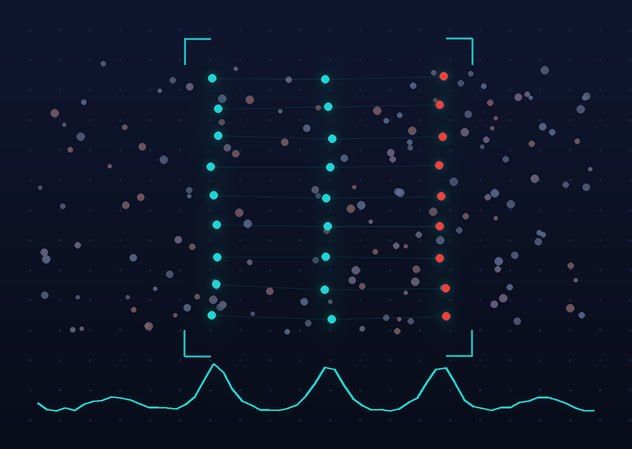
Narrative attack detection software for brands monitors TikTok (and cross-platform channels simultaneously) for coordinated behavioral signals that precede visible virality: abnormal posting frequency from account clusters, semantic consistency across ostensibly unrelated accounts, sudden spikes in comment activity on low-follower videos, and the linguistic fingerprints that indicate templated content generation.
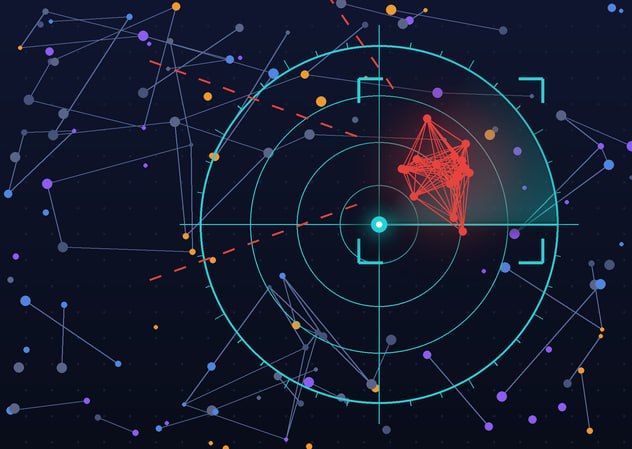
The platform built by Osavul approaches this as a media forensics problem rather than a content moderation one. Instead of flagging specific videos for policy violations, the system maps narrative propagation networks — identifying who is amplifying what, how fast, and with what degree of coordination. This gives brand protection teams an actionable intelligence picture rather than a list of URLs to report.
AI-powered narrative detection at this level operates on signals that are invisible to manual monitoring: the gap between a video’s creation timestamp and its first coordinated engagement wave, the network topology of accounts that engage within the first hour, and cross-lingual semantic analysis that catches the same attack narrative running simultaneously in multiple markets under different framing.
A Practical Defense Protocol for Brand Teams
Detection without response capacity is an early warning system with no alarm. The brands that contain TikTok narrative attacks most effectively have pre-built response infrastructure that activates on detection signals, not on confirmed viral damage.
Build a Rapid Content Response Unit
Most brand crisis playbooks were designed for traditional media cycles — hours or days, not minutes. TikTok requires a dedicated content response unit with authority to publish without multi-layer approval chains. The corrective content format matters: text statements don’t perform on TikTok. Counter-narratives need to be delivered in the platform’s native language — short video, creator-style framing, emotional rather than legal register.
Pre-Authenticate Your Brand Narrative
Before an attack happens, seed TikTok with high-quality owned content that establishes baseline credibility on the topics most likely to be targeted: supply chain practices, product safety, workforce conditions, environmental impact. This content serves two functions — it builds audience trust that acts as inoculation against false claims, and it occupies search real estate that an attacker would otherwise own uncontested.
Establish Cross-Platform Monitoring Coverage
TikTok narrative attacks don’t stay on TikTok. A detection posture that monitors only the originating platform will always be reactive to the secondary spread on Reddit, Twitter/X, and news aggregators. Effective cognitive security for brands requires unified monitoring across the full information environment, with escalation thresholds calibrated to the speed of each platform’s spread mechanics.
Run Regular Threat Simulations
Quarterly narrative attack simulations — red team exercises where internal or external analysts attempt to construct a plausible disinformation campaign against the brand — surface vulnerabilities before attackers do. These exercises consistently identify gaps in monitoring coverage, response authorization chains, and counter-content production capacity. Brands that run them regularly report significantly faster containment times when real attacks occur.
Frequently Asked Questions (FAQ)
What exactly is a narrative attack on TikTok?
A narrative attack on TikTok is a coordinated disinformation operation that uses the platform’s recommendation algorithm to spread false or misleading content about a brand at scale. Unlike organic criticism or a single viral complaint, a narrative attack involves deliberate seeding of fabricated or manipulated content, often amplified by bot networks, with the goal of damaging brand reputation, consumer trust, or stock price. The attack is defined by its coordination and intent, not just its content.
Can AI and deepfakes be used in narrative attacks against brands on TikTok?
Yes — and with increasing frequency. Generative AI tools now allow bad actors to produce synthetic video, fabricated audio, and falsified documents that are convincing enough to spread virally before fact-checking catches up. The most operationally effective deepfakes in brand attacks aren’t technically perfect — they’re “good enough” to survive the passive viewing context of a mid-scroll encounter. TikTok’s disclosure requirements for AI-generated content have no enforcement mechanism against bad-faith actors.
How can brands proactively defend themselves against TikTok-based disinformation?
Proactive defense requires three things operating in parallel: early detection capability that identifies coordinated activity before it reaches organic amplification; pre-built response infrastructure with the authority and content capacity to respond at platform speed; and owned content that pre-occupies the narrative territory most likely to be targeted. Relying on TikTok’s platform enforcement as a primary defense is not operationally viable — response times are measured in days, and the attack cycle peaks in hours. Independent AI-powered narrative detection is the only way to close that gap.