Ask five analysts what the OSINT Framework is, and you'll get two camps. One points to a specific website with a clickable tree of tools. The other describes a discipline: a repeatable method for turning public data into intelligence someone can act on. Both answers are correct, and that split confuses newcomers more than any other topic we cover in analyst training sessions.
This guide covers both meanings, then goes deeper into the one that matters for professional work — the methodology. Because a bookmarked list of tools has never solved an intelligence problem. A structured process has.
What Is the OSINT Framework?
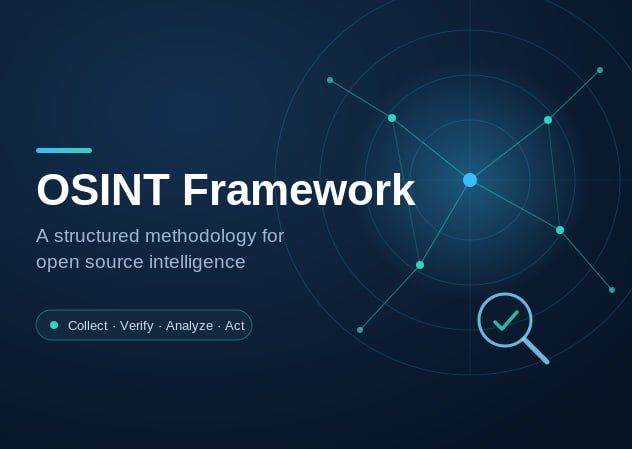
The OSINT Framework — sometimes written out as the open source intelligence framework — is a structured methodology for collecting, processing, analyzing, and acting on open source intelligence: information gathered from publicly accessible sources without unauthorized access or legal violations. It defines how raw public data (social media posts, corporate records, satellite imagery, forum chatter) moves through a disciplined cycle and becomes verified, decision-ready intelligence.
The term also refers to osintframework.com, a free directory that organizes hundreds of investigative tools by category. We'll separate the two in the next section.
What makes OSINT distinct from other intelligence disciplines is the source, not the technique. SIGINT intercepts communications. HUMINT recruits people. OSINT works entirely with what's already public: no hacking, no social engineering, no privileged access. That constraint is also its strength — findings can be shown to a court, a regulator, or a journalist without exposing collection methods.
The catch is volume. Public data is effectively infinite, and most of it is noise. In our work tracking coordinated influence operations, a single narrative attack can generate tens of thousands of posts across Telegram, X, and fringe platforms within hours. Without a structured method, an analyst doesn't do intelligence work — they scroll. The OSINT Framework exists to prevent exactly that.
One Name, Two Meanings: Directory vs. Methodology
Is the OSINT Framework a tool or a methodology? It's both, depending on who's talking. The website osintframework.com, created by Justin Nordine, is a directory — a branching visual map that starts with what you have (a username, an email, a domain) and expands into tools that can dig further. The methodology is something else entirely: the discipline of running collection and analysis as a managed process with defined requirements, validation steps, and outputs.
The directory deserves its popularity. Handed a lone email address at 2 a.m. during an incident response, an analyst can walk the tree and find a dozen enrichment options in minutes. It's free, community-maintained, and genuinely useful for discovering tools you didn't know existed.
But here's what we see go wrong in practice. Teams treat the directory as if it were the process. They collect from twenty sources because the tree offered twenty branches — not because any requirement called for them. The result is a folder of screenshots, no analysis, and a report deadline that arrives anyway. Tool sprawl masquerading as rigor.
A quick comparison makes the distinction concrete:
| Directory (osintframework.com) | ||
| What it is | Categorized catalog of tools and resources | Repeatable process for producing intelligence |
| “What tool can check this data point?” | ||
| An artifact: username, IP, phone number | ||
| Output | Leads and raw data | Verified, attributed, decision-ready reporting |
| Failure mode | Tool sprawl, unfocused collection | Rare — the process forces prioritization |
Our position: keep the directory bookmarked, but run the methodology. The rest of this article covers how.
The Five Stages of the OSINT Cycle
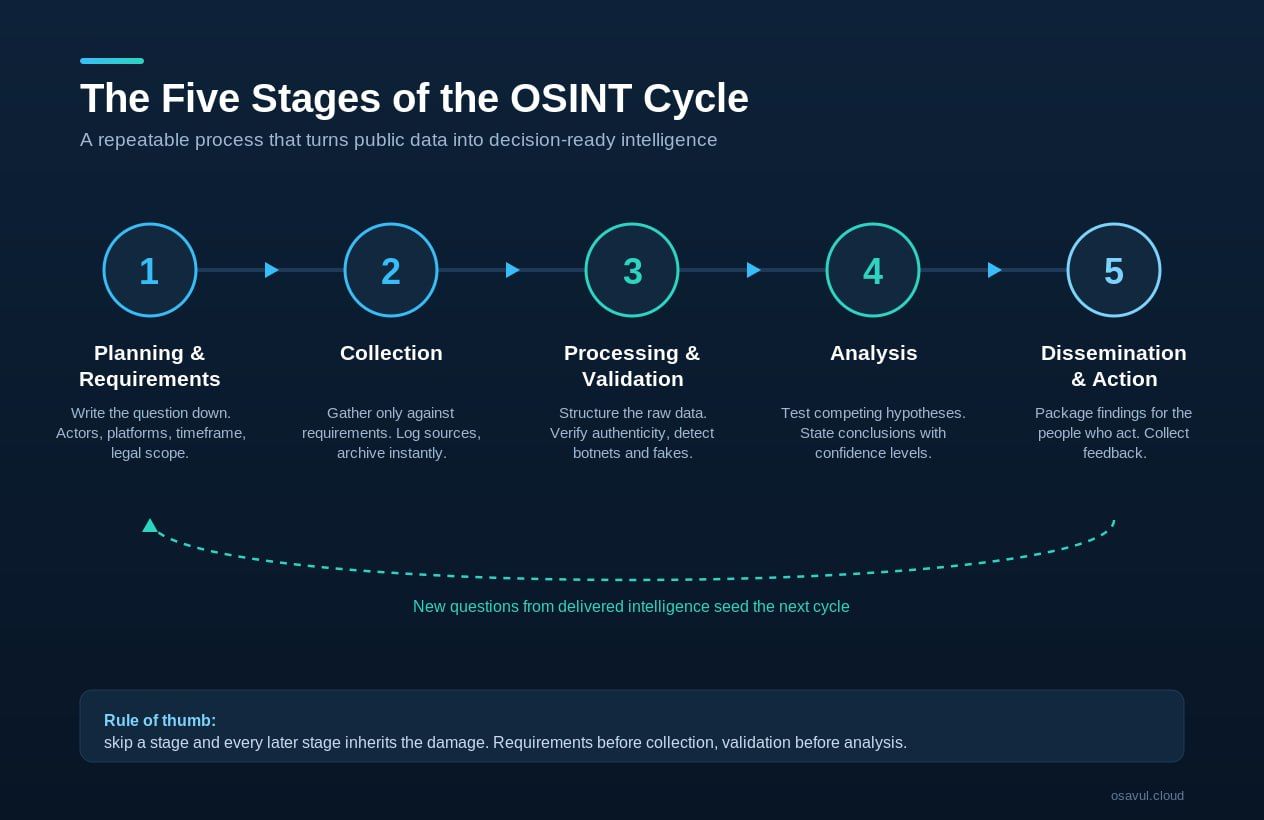
The OSINT cycle consists of five stages: planning and requirements, collection, processing and validation, analysis, and dissemination. Each stage feeds the next, and the cycle repeats as new questions emerge from delivered intelligence. This is the OSINT methodology in its working form — a close cousin of the broader threat intelligence lifecycle, adapted to purely open sources.
Planning and Requirements
Every failed OSINT investigation we've audited shared one trait: nobody wrote down the question. Planning means converting a stakeholder's vague concern (“are we being targeted?”) into specific, answerable intelligence requirements — which actors, which platforms, what timeframe, what would count as evidence. This stage also sets legal scope and defines what “done” looks like. Skip it and every later stage inherits the ambiguity.
Collection
Collection is the disciplined gathering of data against those requirements — and only those requirements. Sources range from social platforms and messaging apps to corporate registries, DNS records, leaked-then-published datasets, and state media. OSINT techniques vary by source, but two habits separate professionals from hobbyists here: logging every source with timestamps for later attribution, and using sock-puppet or isolated research accounts so the investigation doesn't tip off its subject.
Processing and Validation
Raw collection is unusable. Processing turns it into structured, comparable material: translating foreign-language posts, extracting metadata, deduplicating, converting screenshots into searchable records. Validation runs alongside — checking whether that “leaked document” is doctored, whether the account amplifying a claim is a real person or part of a botnet, whether three “independent” sources all trace back to one origin. Media forensics lives at this stage.
Analysis
Analysis answers the original requirement. The analyst weighs validated evidence, tests competing hypotheses, and states conclusions with explicit confidence levels — “we assess with moderate confidence” beats false certainty every time. This is where isolated data points become findings: a cluster of accounts becomes a coordinated network, a recurring phrase becomes a narrative attack with a traceable origin.
Dissemination and Action
RIntelligence that reaches no one is a hobby. Dissemination packages findings for the people who act on them — a two-page brief for leadership, an indicators list for the SOC, an evidentiary annex for legal. The best reports end with a feedback loop: did this answer the requirement, and what new questions did it raise? Those questions seed the next cycle.
Mapping OSINT Sources: Where the Data Lives
OSINT sources fall into five broad categories: social platforms, technical infrastructure data, public records, traditional media, and gray-zone spaces like fringe forums and leaked-data mirrors. The map matters because each category punishes a different kind of carelessness — and rewards a different kind of patience.
Here's the thing nobody tells you when you start: the categories are boring on their own. A Telegram channel pushing a suspicious narrative is just... a channel. There are thousands. What made one particular network click for us last year was a dull technical detail — its posting schedule tracked a state broadcaster's editorial calendar almost to the minute, and its domain shared an SSL certificate with two supposedly independent “news” sites in different countries. None of those three facts meant much alone. Together they were the finding.
So treat single-source discoveries as leads, nothing more. The intelligence lives in the overlap.
And archive everything the moment you collect it, not the week you write the report. Channels get deleted mid-investigation. APIs close without warning. Every analyst learns this exactly once, usually the hard way, usually on the one case where it mattered.
Choosing OSINT Tools Without Drowning in Them
How do you choose OSINT tools for an investigation? Start from the requirement, not the tool list. Pick the smallest set that covers your collection needs, verify each tool's data handling before feeding it anything sensitive, and test it against a case where you already know the answer. Everything else is procurement theater.
That answer sounds obvious. Almost nobody follows it. The OSINT Framework tools directory alone lists hundreds of options, new ones launch weekly, and analyst forums treat tool collecting like a competitive sport. We've watched teams spend a full quarter evaluating platforms while the actual influence operation they were hired to track quietly rebranded and moved on.
A few selection criteria that have held up in our practice:
Does it show its work? A tool that returns “this account is 87% likely a bot” without exposing why is useless the moment findings face scrutiny. Court, regulator, editor — someone will eventually ask how you know.
Who sees your queries? Free tools are rarely free. Some log searches; some are honeypots. Before a sensitive investigation touches any third-party service, know where the query data goes.
Does it survive contact with scale? Manual tooling works beautifully for one target. It collapses at five hundred. The honest comparison of AI threat intelligence versus manual OSINT isn't about which is “better” — it's about which stage of the cycle you're automating and which judgment calls stay human.
Will it exist next year? OSINT tooling has brutal churn. Build your process around the methodology, keep tools swappable, and no single shutdown can stall an investigation.
The pattern worth internalizing: strong teams run lean toolkits they know deeply. Weak teams run sprawling toolkits they know shallowly. Tool count correlates with insecurity, not capability.
Legal and Ethical Boundaries of OSINT Investigation
Is OSINT collection legal? Yes — by definition. OSINT works exclusively with publicly accessible information, gathered without unauthorized access, deception that crosses legal lines, or violation of platform terms that carry statutory weight. The moment an investigator bypasses a password, poses as someone's friend to unlock a private account, or buys stolen data, the work stops being OSINT and starts being a liability.
The boundary sounds clean in principle. In practice, it has edges that cut. A leaked database published by a third party is technically “accessible” — but accessing it may still violate data protection law depending on jurisdiction and purpose. Scraping public profiles is legal in some contexts and litigated in others. GDPR doesn't stop applying just because a data subject posted something publicly; purpose limitation and proportionality still bind any European investigation.
Our internal rule of thumb: if a finding couldn't be shown to a judge along with a full account of how it was obtained, it doesn't go in the report. This standard has an official form — the Berkeley Protocol on Digital Open Source Investigations, developed with the UN Human Rights Office, which sets professional standards for collection, preservation, and chain of custody. If your team does OSINT work that might ever face legal scrutiny, it's the single most useful document you can adopt.
Ethics runs past legality. Doxxing is often technically legal. Publishing a private citizen's location history assembled from public posts may break no law. Professional OSINT practice draws its own lines: minimize collection on uninvolved individuals, distinguish public figures from private ones, and weigh whether publication itself creates the harm you set out to document.
Common Failure Points in OSINT Work
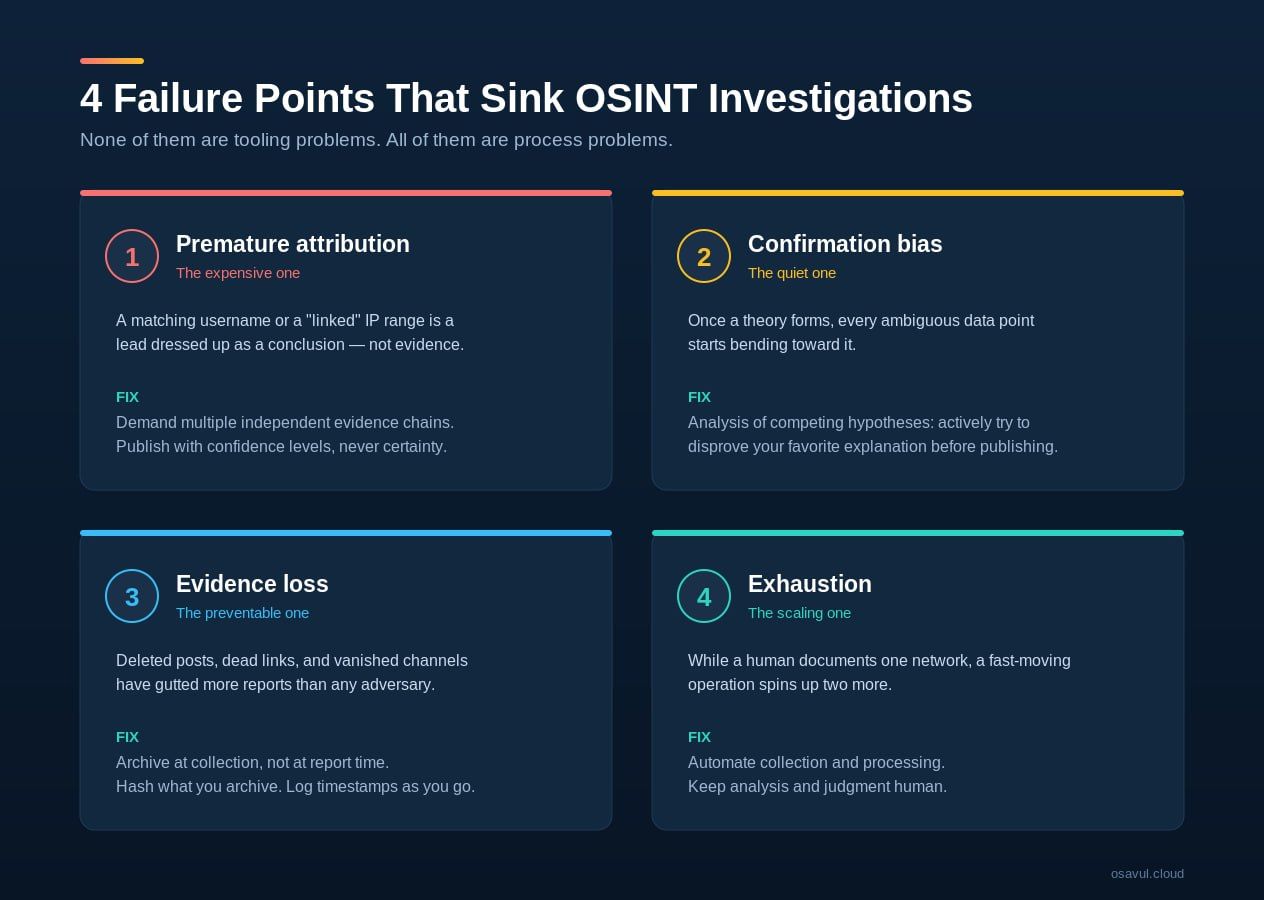
The three failures that sink OSINT investigations most often are premature attribution, confirmation bias, and evidence loss. None of them are tooling problems. All of them are process problems — which is exactly why the methodology exists.
Premature attribution is the expensive one. An IP range “linked to” a government, a username matching one seen in an old forum leak, a writing style that feels familiar — each is a lead dressed up as a conclusion. Real attribution demands multiple independent evidence chains, and even then it arrives with confidence levels attached, not certainty. The investigators at Bellingcat have built an entire public methodology around this discipline, and their published case work is the best free education available on how attribution is actually earned.
Confirmation bias is quieter. Once an analyst forms a theory, every ambiguous data point starts bending toward it. The structural fix is borrowed from classic intelligence tradecraft: analysis of competing hypotheses, where you actively try to disprove your favorite explanation before you publish it. One question we've made standing practice: what evidence would make this conclusion wrong — and did anyone go look for it?
Evidence loss is the embarrassing one, because it's fully preventable. Deleted posts, dead links, and vanished channels have gutted more reports than any adversary. Archive at collection, hash what you archive, and log timestamps as you go.
There's a fourth failure worth naming: exhaustion. Manual OSINT against a fast-moving information operation is a losing race — by the time a human documents one network, the operation has spun up two more. Which brings us to scale.
Scaling the Methodology: From Analyst Craft to Cognitive Security
Everything covered so far assumes a human analyst can keep pace with the data. Increasingly, they can't — and that's not a criticism of analysts. A coordinated narrative attack can move through thousands of accounts across a dozen platforms in the time it takes to write one collection log. The methodology doesn't break at scale; the manual execution of it does.
This is where the discipline has been heading for years: away from OSINT as individual craft, toward cognitive security — the systematic defense of information spaces against manipulation. The cycle stays identical. What changes is which stages get automated. Machine collection across platforms, automated botnet detection, narrative clustering that surfaces coordinated messaging a human would need weeks to find — these compress the collection and processing stages from days to minutes. Analysis and judgment stay human. That division of labor is the entire point.
Teams at the intersection of this shift — government units tracking foreign influence operations, brands facing coordinated attacks, newsrooms verifying claims mid-crisis — increasingly run the OSINT cycle on platforms built for it. It's the problem Osavul was built around: applying AI to the collection, validation, and narrative analysis stages so analysts spend their hours on judgment instead of scrolling. The same logic applies whether the mission is national security or media monitoring that goes deeper than mention counting.
None of this retires the fundamentals. A platform running a bad methodology just produces wrong answers faster. Requirements still come first. Validation still gates analysis. The Berkeley Protocol still applies. Scale amplifies the process you already have — for better or worse.
Key Takeaways
The OSINT Framework names two things: a useful tool directory and an essential methodology. Confusing them is the most common beginner mistake — and the directory is the lesser of the two. What separates professional open source intelligence from sophisticated scrolling is the cycle: requirements before collection, validation before analysis, dissemination that reaches someone who can act.
A few principles worth keeping within reach. Write the intelligence requirement down before touching a single tool. Treat single-source findings as leads and multi-source correlation as intelligence. Archive at the moment of collection, because the internet forgets fastest exactly when you need it to remember. Hold every finding to the standard of a courtroom, whether or not it will ever see one. And when the data outruns your team — it will — automate collection and processing, never judgment.
The sources are public. The discipline is what you bring to them.