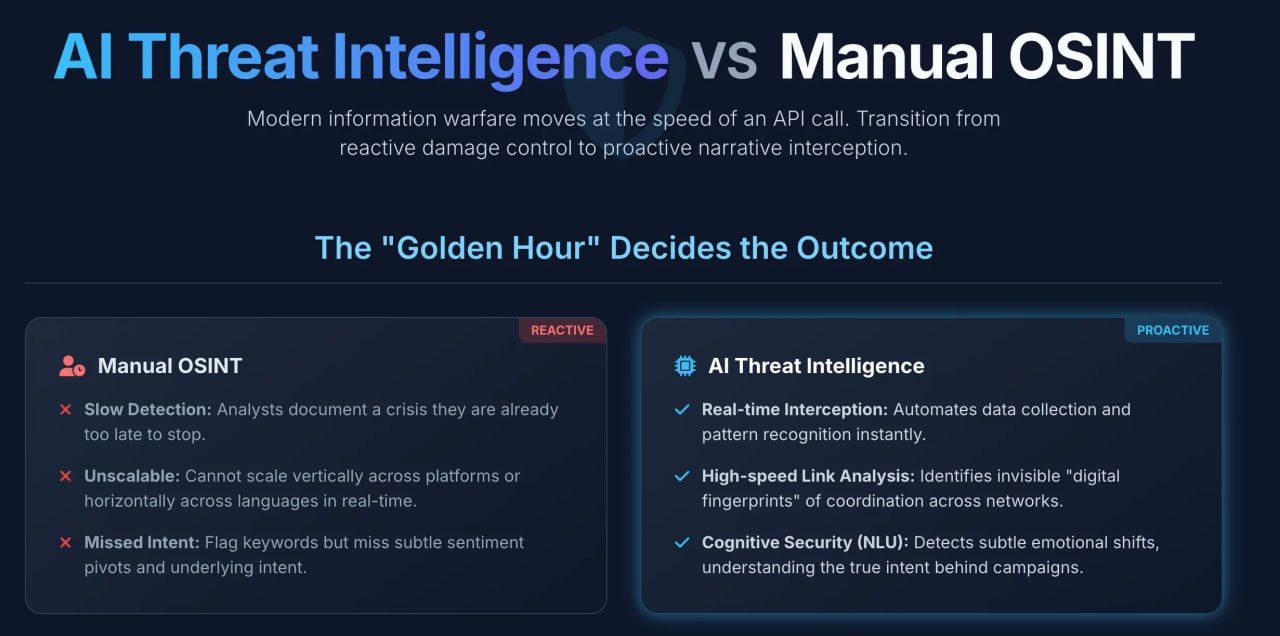
Information warfare now moves at the speed of an API call. Most security teams, though, still monitor the way they did five years ago — by hand. And when a state-sponsored narrative attack hits your brand or your country, you get maybe 60 minutes before the story locks in. We've watched analysts spend those golden hours pivoting between tabs, only to finish with a neat report on a crisis nobody stopped. This is where AI threat intelligence earns its keep: the machines handle the grunt work of data collection and pattern matching, and your people spend that hour deciding what to do about the attack — not proving it happened.
Why Manual OSINT Fails Against Modern FIMI Campaigns
Manual OSINT fails for a simple reason: one analyst cannot be on every platform, in every language, at the same time. A researcher might burn half a day pivoting from Telegram to X, copying timestamps into a spreadsheet, trying to trace a botnet back to its source. Solid work — but by the time the coordination pattern is visible, the narrative has already reached millions of users across Germany, India, or the USA. AI threat intelligence closes that gap with high-speed link analysis, surfacing the “digital fingerprints” of coordination that no human eye can catch across ten platforms at once.
There's a subtler failure too. Traditional monitoring tools flag keywords, but keywords aren't intent. When we tracked synchronized narrative shifts in Ukraine, the adversaries didn't recycle the same phrases — they shifted the emotional register of the conversation within minutes, and every keyword alert stayed silent. Platforms that apply AI threat intelligence use Natural Language Understanding to catch these sentiment pivots as they happen. That's the layer of cognitive security a manual keyword search was never built to provide.
The Technical Advantage of AI-Powered Threat Intelligence
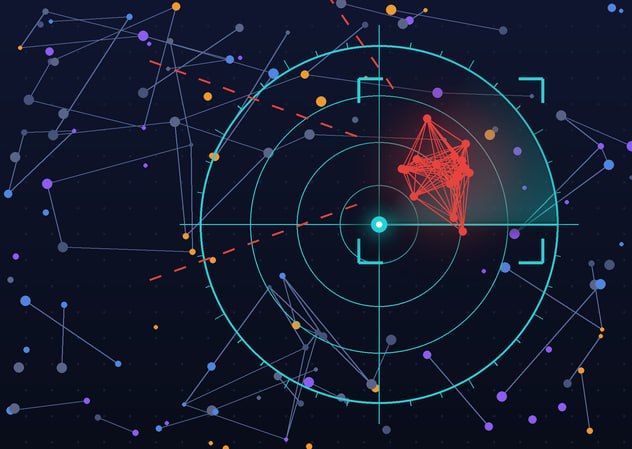
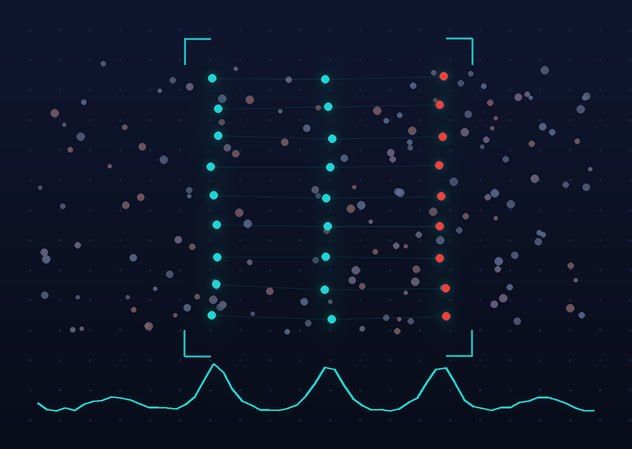
How do AI and ML actually help here? Mostly by spotting behavior no human would think to look for. Machine learning models pick up burst-frequency posting, synthetic engagement, accounts that move in lockstep — the tells of a modern influence operation. An analyst could check account creation dates one by one for a week; an AI threat intelligence system flags a cluster of accounts acting in choreographed fashion across Taiwan and the EU before lunch. Once you can see the cluster, you can isolate the attack's epicenter.
The other advantage is graph analysis — mapping how a story travels. A human sees three unrelated news sites running the same piece. A tool like Janus sees that all three sit on the same hosting infrastructure and share identical tracking IDs. That forensic depth changes the analyst's job description: less data collector, more strategic decision-maker — someone who knows how to ask the right questions when using AI models to defend their digital perimeter.
Media Forensics: Identifying the DNA of a Narrative Attack
Every manufactured campaign leaves technical residue. Identical metadata across “unrelated” images, mirrored HTML structures, reused tracking artifacts — the DNA of coordination. A manual OSINT practitioner reads what a post says; AI threat intelligence reads what the post is made of. An AI-powered media forensics API can run that check across thousands of posts automatically, which is exactly the kind of rapid attribution modern threat hunting demands.
We saw this play out during a smear campaign against energy infrastructure in Germany. The software didn't just flag the disinformation — it caught the specific seeding pattern the botnet was using. The same synthetic images kept surfacing through distinct IP clusters, and that repetition became the evidence that got the network taken down before it touched public policy. That's the real shift: from reading posts to analyzing them, which is what separates modern threat intelligence services from monitoring dashboards.
How AI Risk Simulations Outpace Manual Red-Teaming
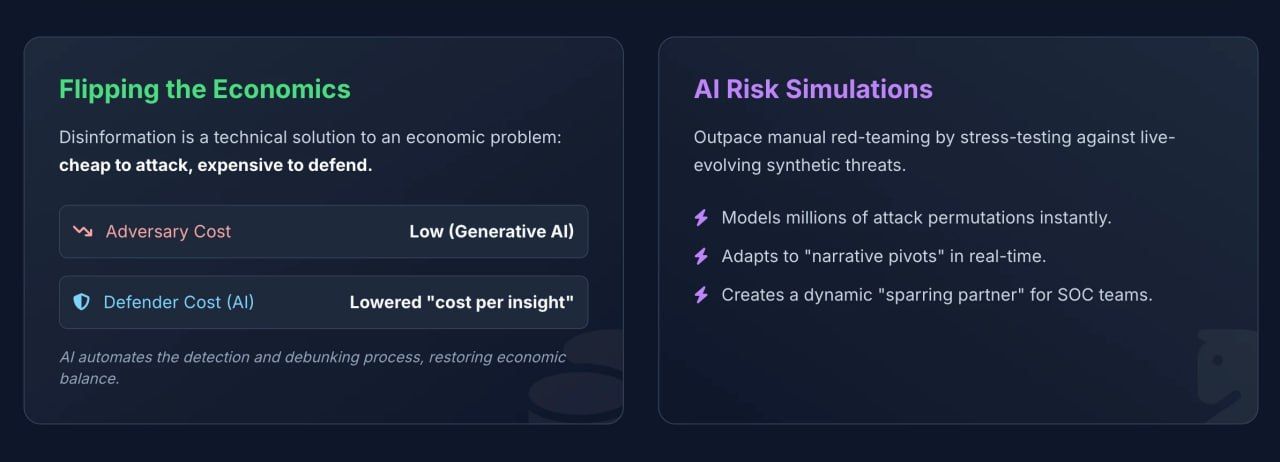
Manual red-teaming has a pacing problem. A human team plans its injects for weeks, runs the exercise, writes it up — and the scenario is static the whole way through. AI risk simulations don't wait. They model millions of attack permutations, including coordinated narrative drops across multiple time zones, at a scale no human team can match. For security leaders, that means stress-testing the information environment against synthetic threats that shift mid-exercise. A sparring partner that actually hits back hardens your defenses long before a real FIMI event tests them.
Working with StratCom officials in the USA, we kept running into the same bottleneck: the narrative pivot. When a botnet changes its talking points mid-campaign, a manual team typically needs 24 hours to re-adjust the simulation. With AI threat intelligence in the loop, those pivots happen automatically — the defensive team suddenly has to respond to live shifts in machine-generated disinformation, exactly the way they would during a real attack.
Protecting Platform Integrity: A CISO’s Guide to Narrative Risk
Narrative attacks have become a working vector for corporate sabotage, which puts them on the CISO's desk — not just the PR team's. The trouble is that narrative risk targets perception, the trust people place in your platform, so nothing in the firewall logs ever looks wrong. The practical answer is to fold AI threat intelligence into the existing risk management stack, so the infrastructure behind an information attack gets identified before the narrative reaches the stock price.
Here's the scenario we see most often: a sudden surge of negative sentiment about a product's safety. To a PR tool, it reads as organic outrage. Run it through AI threat intelligence, and the “outrage” turns out to be 500 accounts with overlapping IP signatures. That forensic layer is the difference between managing a PR crisis and responding to a verified security incident — and only one of those belongs in an incident report.
Comparative Analysis: Manual OSINT vs. AI-Driven Intelligence
Frequently Asked Questions (FAQ)
Can AI countermeasures evolve fast enough to stop AI-generated disinformation?
That depends on what the defensive model was trained on. General-purpose LLMs are usually the ones creating the poison, and they make a poor antidote. A defensive system keeps pace only when it's trained on adversarial datasets — data built to expose the logic gaps and technical artifacts that generative AI leaves behind.
What should I choose between AI-driven intelligence and manual threat analysis?
In practice, you don't pick one. Use AI threat intelligence for what machines do well — monitoring at scale, cross-platform correlation, real-time detection — and keep human analysts where judgment matters: context, verification, and the final call on attribution. Teams that go fully manual drown in volume; teams that go fully automated miss what the data means. The working setup is AI doing the collection and triage, humans making decisions.
Is AI a technical solution to what is essentially an economic problem?
Yes — because disinformation is an economics game. Attacking is cheap; defending is expensive. An adversary can generate 10,000 unique, localized narratives for the price of a coffee. The only way to stay solvent on defense is to drive down your own cost per insight, and that's precisely what AI threat intelligence does by automating detection and debunking.
How effective are AI "Risk Simulations" (Red-Teaming) compared to manual exercises?
Considerably more effective, because they run millions of permutations instead of one scripted scenario. Manual red-teaming leans on static injects planned weeks ahead; AI simulations pit your team against synthetic threats that change tactics mid-exercise — much closer to how a real campaign behaves.