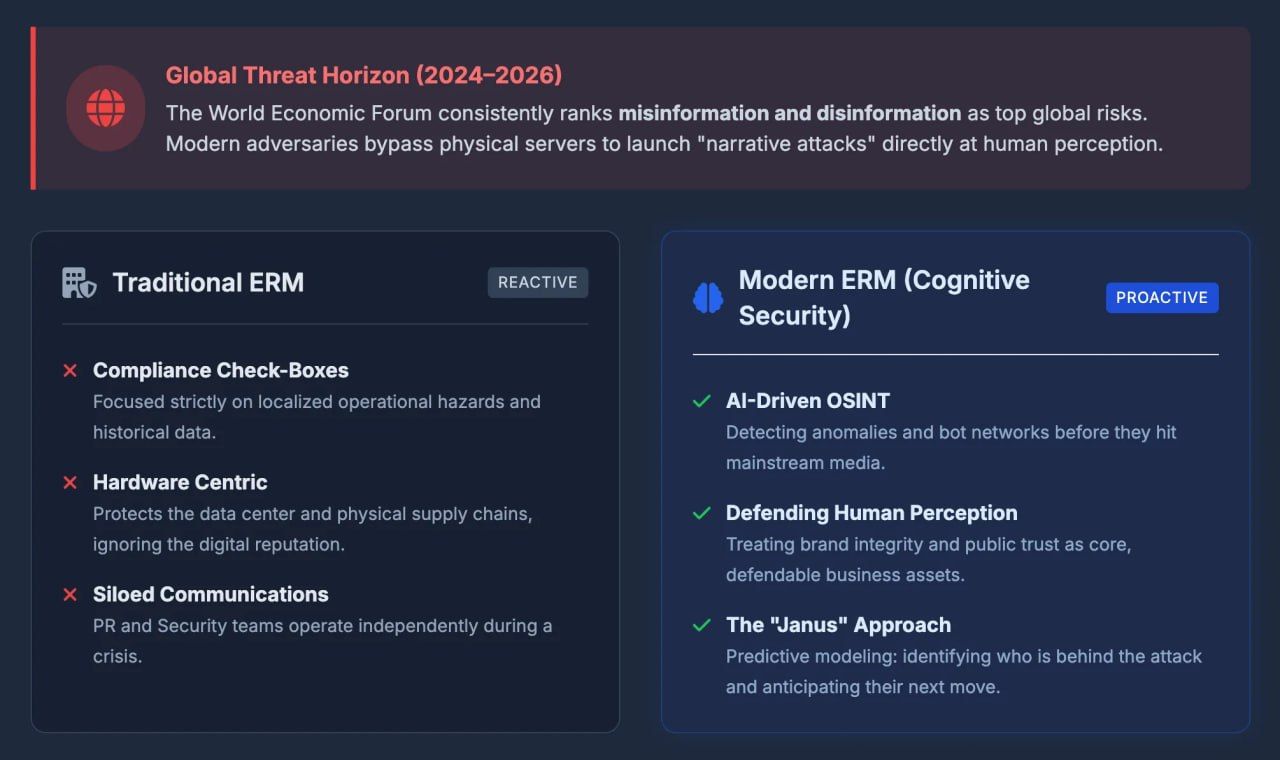
Traditional risk frameworks, heavily indexed on finance, supply chain logistics, and physical security barriers, are no longer sufficient to protect a global brand. We keep seeing the same flashing red light in our security briefings. The World Economic Forum hasn't minced words: for the 2024–2026 window, misinformation and disinformation are consistently dominating the global risk landscape. But here’s the reality we face when analyzing legacy defense structures: corporate protocols are still heavily indexed on physical or network breaches, leaving them alarmingly blind to the digital manipulation of human perception.
Right now, modern enterprises aren't just fending off hackers; they are actively bleeding from "narrative attacks". We track these cognitive threats daily—highly coordinated campaigns leveraging generative AI, automated bot swarms, and hyper-realistic deepfakes. The attackers' goals are precise: to artificially tank stock prices, permanently scar brand reputation, or paralyze fragile supply chains.
This is the new, invisible frontline of corporate warfare. You can't simply issue a software patch for compromised public perception. Defending against these intangible yet devastating vectors demands a radical tear-down and evolution of how organizations execute strategic planning and baseline risk assessment.
What is Enterprise Risk Management (ERM)?
So, what is enterprise risk management (ERM) in this hostile climate? Historically, it has served as the comprehensive structural framework an organization leans on to identify, evaluate, and buffer against potential threats that might derail core operations and overarching business objectives. But as we’ve learned from countering modern information operations, relying solely on that textbook definition is a dangerous vulnerability.
You can review the foundational enterprise risk management definition to understand its historical roots. The traditional definition centers on minimizing negative operational impacts while securing financial stability.
However, we must move quickly past the textbook definition of ERM to focus on Information Integrity as a Core Business Asset. What is an ERM in today's hyper-connected, algorithmically driven digital ecosystem? It is no longer just a financial ledger of potential losses. A robust enterprise risk management system must act as a dynamic shield. The most critical upgrade to any modern framework involves cognitive security: integrating the defense of the "human mind" (both employees and customers) into the ERM framework.
Why Traditional Frameworks Fail: The Convergence of Cyber and Reputation
Chief Risk Officers (CROs) and CISOs are facing a critical structural blind spot. Leaders who need to expand their security budgets must now cover "Information Operations" and "FIMI" (Foreign Information Manipulation and Interference). When a coordinated bot network launches a synthetic media campaign claiming a specific business unit is utilizing unethical labor practices, the resulting financial damage occurs in hours, not weeks.
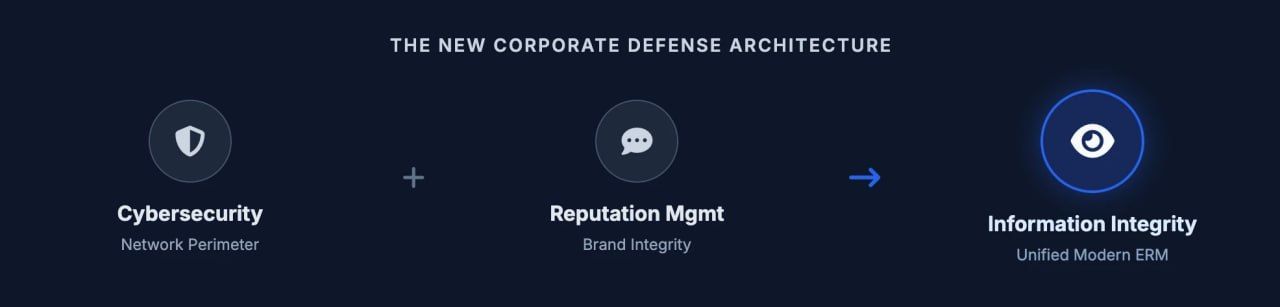
The underlying context of this shift is the rapid convergence of cybersecurity and reputation management. In our ongoing threat analyses, we see a dangerous disconnect in how organizations allocate their defense budgets. Standard cybersecurity risk management does an excellent job of protecting the physical hardware and locking down the data center. But that is only half the battle. Cognitive security steps into the void to actively defend your brand's perception in the unforgiving open market. Adversaries are highly pragmatic. When malicious actors realize they cannot brute-force their way past your enterprise firewalls, they don't just give up and go home.
They pivot. They bypass the server rack entirely and target public perception instead. They understand the mechanics of a modern digital crisis: a precisely timed, successful narrative attack can trigger immediate regulatory scrutiny, panic your institutional investors, and alienate loyal customer bases before a single piece of malware is ever deployed. This is the reality check we constantly bring to corporate leadership.
Board Members and Executives—the leaders directly shouldering fiduciary duties and the mandate for "Brand Integrity"—can no longer delegate this solely to the PR department. They must urgently understand why targeted disinformation isn't just a communications headache; it is a severe, bottom-line risk that demands a permanent seat within the risk assessment framework.
Upgrading Your Enterprise Risk Management System: Key Focus Areas
To effectively update your organization's risk profile and safeguard strategic initiatives, Osavul is moving ERM from a "reactive" compliance-based check-box to a "proactive" situational awareness strategy. A modern ERM risk management protocol requires mastery over several key focus areas:
- AI-Driven Situational Awareness: Analysts must transition to using OSINT (Open Source Intelligence) to detect external threats before they hit the mainstream media or financial markets.
- Cognitive Security: Integrating the defense of the "human mind" (employees and customers) into the ERM framework ensures that psychological manipulation vectors are monitored as closely as malware.
- Quantifying the Intangible: Organizations must develop methodologies to measure the financial impact of narrative risks and disinformation within an ERM model, translating digital whispers into concrete financial risk metrics.
- The "Janus" Approach: Referencing Osavul's proprietary technology, security teams must move from simply identifying what happened to predicting who is behind it and how it will evolve.
Tactical Execution and Cross-Departmental Alignment
Effectively executing these strategies requires dismantling operational silos. Corporate Security Directors are actively seeking modern tools, like AI and OSINT, to upgrade their traditional risk monitoring systems. However, technology alone cannot solve organizational fragmentation.
Strategic Communications Teams, including PR and crisis management leads, need to align closely with the risk department to handle narrative-driven crises. If a deepfake video targeting a CEO gains traction on alternative social platforms, the PR team cannot wait for traditional media outreach to formulate an action plan. Real-time threat intelligence must flow seamlessly between the CISO's desk and the communications department to ensure rapid, unified decision-making.
Integrating Intelligence into Your Action Plan
To effectively shield the enterprise, business leaders must embed information integrity directly into their core strategic initiatives. This involves redefining what constitutes a vulnerability.
Table: Expanding the Enterprise Risk Profile
By mapping out these overlapping vulnerabilities, leadership can deploy an enterprise risk management framework that accurately reflects the realities of the modern information space.
Frequently Asked Questions (FAQ)
What is enterprise risk management (ERM)?
When executives ask us to define ERM during security audits, we often tell them to throw out the old compliance playbooks. At its core, enterprise risk management (ERM) functions as a holistic strategy designed to identify, assess, and aggressively mitigate risks across your entire organizational footprint. But in practice, we see it as something much more dynamic. Unlike isolated, siloed risk approaches, modern ERM aligns comprehensive risk assessment directly with your overarching business objectives. Crucially, this framework must now evolve beyond standard financial or operational hazards to encompass the severe cognitive threats and disinformation vectors we track daily.
What is enterprise risk management software?
Think of enterprise risk management software as the central nervous system for your corporate defense. It serves as a centralized digital platform utilized to relentlessly monitor, analyze, and report on diverse organizational risks. In our field deployments, we’ve found that legacy monitoring tools simply create data noise. The advanced platforms we rely on integrate sophisticated AI and OSINT capabilities to cut through that noise. This provides the proactive situational awareness necessary to detect the faint, early signals of narrative attacks long before they breach mainstream awareness and trigger a public crisis.
What are the benefits of enterprise risk management?
The return on investment for a properly calibrated defense framework is immediate and tangible. The primary benefits of enterprise risk management include vastly improved decision-making under pressure, highly optimized resource allocation, and a transparent, unified view of an organization's true risk profile. However, the real payoff happens during an active threat cycle. By proactively anticipating complex, asymmetric threats—such as coordinated narrative attacks—businesses effectively protect their brand equity and ensure continuous operational stability when competitors would otherwise stumble.
How does enterprise risk management differ from traditional risk management?
This is the exact point where we see the most significant operational pivot in modern corporate security. Traditional risk management is notoriously reactive, often functioning merely as a compliance-based check-box. Historically, it has focused strictly on localized physical hazards or insurable financial losses confined within specific operational departments. ERM fundamentally differs by operating as a proactive and systemic shield. It forces leadership to evaluate how interrelated, dynamic threats—specifically the critical convergence of cybersecurity and reputation management that we consistently monitor—impact the entire enterprise simultaneously.
Final Thoughts
Navigating today's threat landscape demands far more than maintaining high-walled network perimeters. When the primary battleground shifts to human perception, your defense mechanisms must aggressively adapt. Integrating AI-driven OSINT and cognitive security measures into your ERM framework isn't just an operational upgrade; it is a fundamental survival mechanism for the modern corporate entity.