In our security audits, we’ve seen a recurring, dangerous pattern: organizations treat media monitoring as a peripheral PR function while their financial gates remain wide open to narrative-driven sabotage.
Many businesses still treat early warning media monitoring as an optional luxury rather than a core financial shield. While a CFO would never leave a physical warehouse uninsured, the digital "warehouse" of corporate reputation is often left unguarded against undetected disinformation.
Modern warfare isn't always about weapons; it’s about the erosion of trust. For a Chief Financial Officer (CFO) or an institutional investor, a single coordinated narrative attack can be more devastating than a localized data breach. We aren't just talking about "fake news"—we are talking about calculated media manipulation designed to trigger sell-offs and destabilize market capitalization.
Defining the Cost of Reputational Damage in the Age of AI
The cost of reputational damage is no longer a "soft" metric or a vague marketing concern. In the current financial landscape, it is a quantifiable liability that manifests through increased capital costs, lost revenue, and plummeting stock valuations. When misinformation enters the bloodstream of the public market, the reaction is often instantaneous and unforgiving.
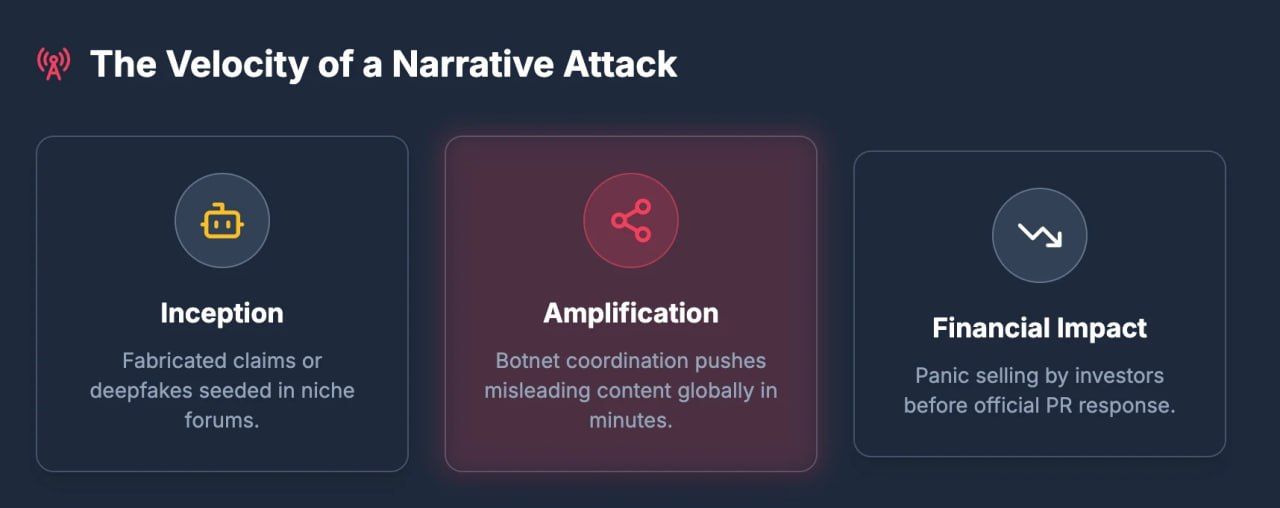
To understand the cost of disinformation for businesses, we must look at the velocity of modern social media. A misleading content piece—perhaps a deepfake of a CEO or a manipulated content report on "fabricated supply chain issues"—can circulate globally in minutes. By the time a human analyst identifies the threat, the financial damage is often already irreversible.
Case Studies: When Undetected Rumors Become Financial Reality
Undetected disinformation acts like a slow-growing cancer in an organization’s digital presence. We’ve noticed a curious trend in disinformation campaigns where attackers use "low-frequency, high-impact" rumors to bypass traditional keyword alerts.
Consider the impact of fabricated supply chain issues. In one instance, a coordinated network began spreading misleading content regarding a major manufacturer's inability to source raw materials. Because the company lacked predictive analytics, they didn't see the narrative building in niche forums. Within 48 hours, institutional investors began offloading shares, resulting in a 4% dip in market cap before a single official statement could be issued.
Another example involves false bankruptcy claims. These narratives often target high-growth tech firms or banks, leveraging the inherent volatility of the sector. This isn't just "unfortunate" content; it is a weaponized media manipulation strategy designed to benefit short-sellers.
Can Disinformation Be Used as a Weapon by Competitors?
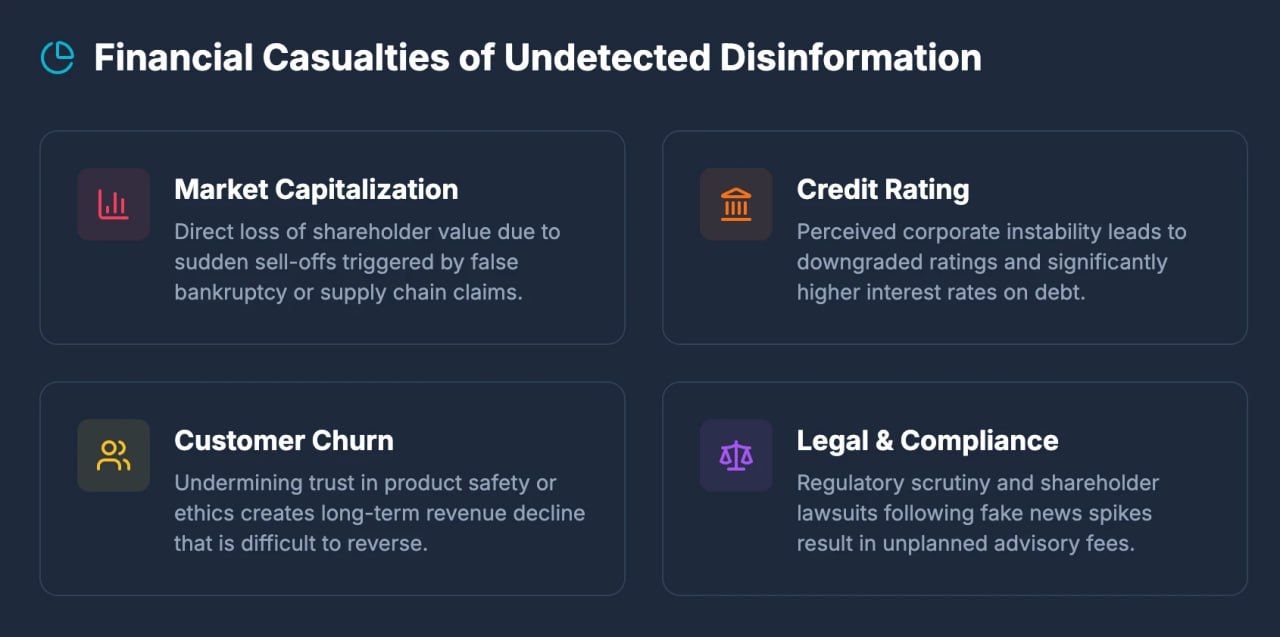
Yes, disinformation is increasingly used as a strategic weapon by competitors to gain an unfair market advantage. In our experience, competitive narrative attacks don't look like blatant lies; they look like "leaked" internal memos or concerns about "executive misconduct" that force a company into a defensive crouch. By the time the victim proves the documents are manipulated content, the competitor has already poached key clients or talent.
The misinformation threat to corporates is now a standard part of the "gray zone" of business competition. This makes critical thinking and robust social media verification tools essential for survival.
Predictive Analytics: The Ultimate Insurance Policy
Analysts often overlook this specific vulnerability: the gap between a rumor’s birth and its mainstream explosion. Highlighting predictive analytics as the ultimate insurance policy for enterprise stability is no longer an exaggeration.
By using a social media monitoring tool, organizations can transition from reactive PR to proactive defense. Modern tools like Nebula allow security teams to detect the "botnet coordination" and "narrative attacks" before they reach the desks of institutional investors. This is the essence of undermining trust prevention—stopping the spark before it becomes a forest fire.
The ROI of Pre-empting a Narrative Crisis
We will break down the exact ROI of pre-empting a narrative crisis. The ROI is calculated by comparing the cost of a predictive subscription to the potential loss of a 2% market cap fluctuation. For a billion-dollar enterprise, a 2% fluctuation is $20 million. Investing in a "core financial shield" of information security is, therefore, one of the most cost-effective decisions a CISO can make.
The threat of misinformation to corporates is now recognized by legal and financial bodies as a material risk. If a company fails to monitor for fake news and manipulated content, it may even face shareholder lawsuits for negligence.
How to Recover: The Path to Reputation Restoration
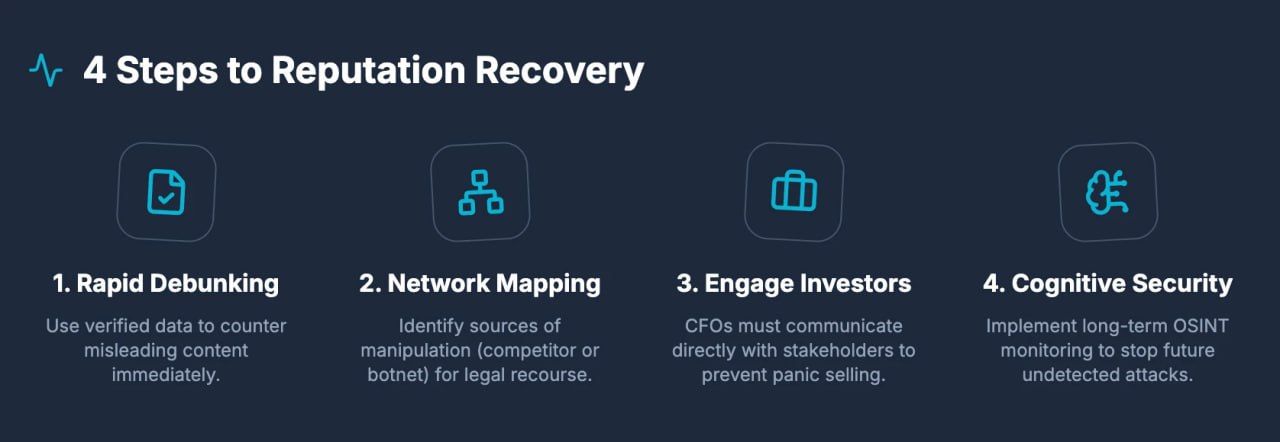
What are the best ways for "reputation recovery" after a disinformation attack?
- Rapid Debunking with Evidence: Transparency is the only antidote to misleading content. Use verified data to counter the specific narrative.
- Network Mapping: Identify the sources of the media manipulation. Knowing if the attack was a botnet or a competitor helps in legal recourse.
- Engaging Institutional Investors: CFOs must communicate directly with major stakeholders to prevent panic-selling.
- Strengthening Cognitive Security: Move beyond simple PR and implement long-term OSINT (Open Source Intelligence) monitoring to ensure undetected disinformation doesn't return.
Conclusion: Securing the Digital Frontier
The cost of reputational damage is the new frontier of corporate risk management. As North Korea propaganda and other global actors have shown, the ability to affect the world through digital narratives is a potent power. Businesses must adapt by treating their information environment with the same rigor they apply to their physical infrastructure.
Whether it is Telegram OSINT tools or AI-driven predictive analytics, the tools for defense are available. The question for CFOs and CISOs is no longer "if" a narrative attack will happen, but whether they will have the shield ready when it does. In the high-stakes game of global finance, undermining trust is the greatest threat of all.