The Blind Spot in Your Perimeter: Why Telegram Evades Corporate Brand Monitoring
Standard corporate brand monitoring fails on Telegram because legacy scrapers rely on open web protocols that cannot access closed, encrypted channels or authenticate within restricted chat groups where modern adversaries operate. This leaves an organization's external attack surface exposed to credential trades and targeted fraud that never register on traditional security dashboards.
During our recent tracking of narrative attacks in Eastern Europe, our threat analysts identified a network of threat actors using spoofed financial support handles. They did not post on public forums or indexed social media accounts. Instead, they operated entirely through temporary chat groups, pulling targets in via targeted direct messages and single-use invite links. Legacy digital brand protection in Telegram completely missed the threat because the entire operation lived behind an authentication barrier.
Security teams frequently mistake public web visibility for complete perimeter coverage. Monitoring a chat application built specifically to resist data collection requires tools that interact directly with the platform's core architecture. Relying on basic string matching on a platform engineered for absolute anonymity guarantees critical security blind spots.
The Architectural Problem: API Limitations and Private Channels
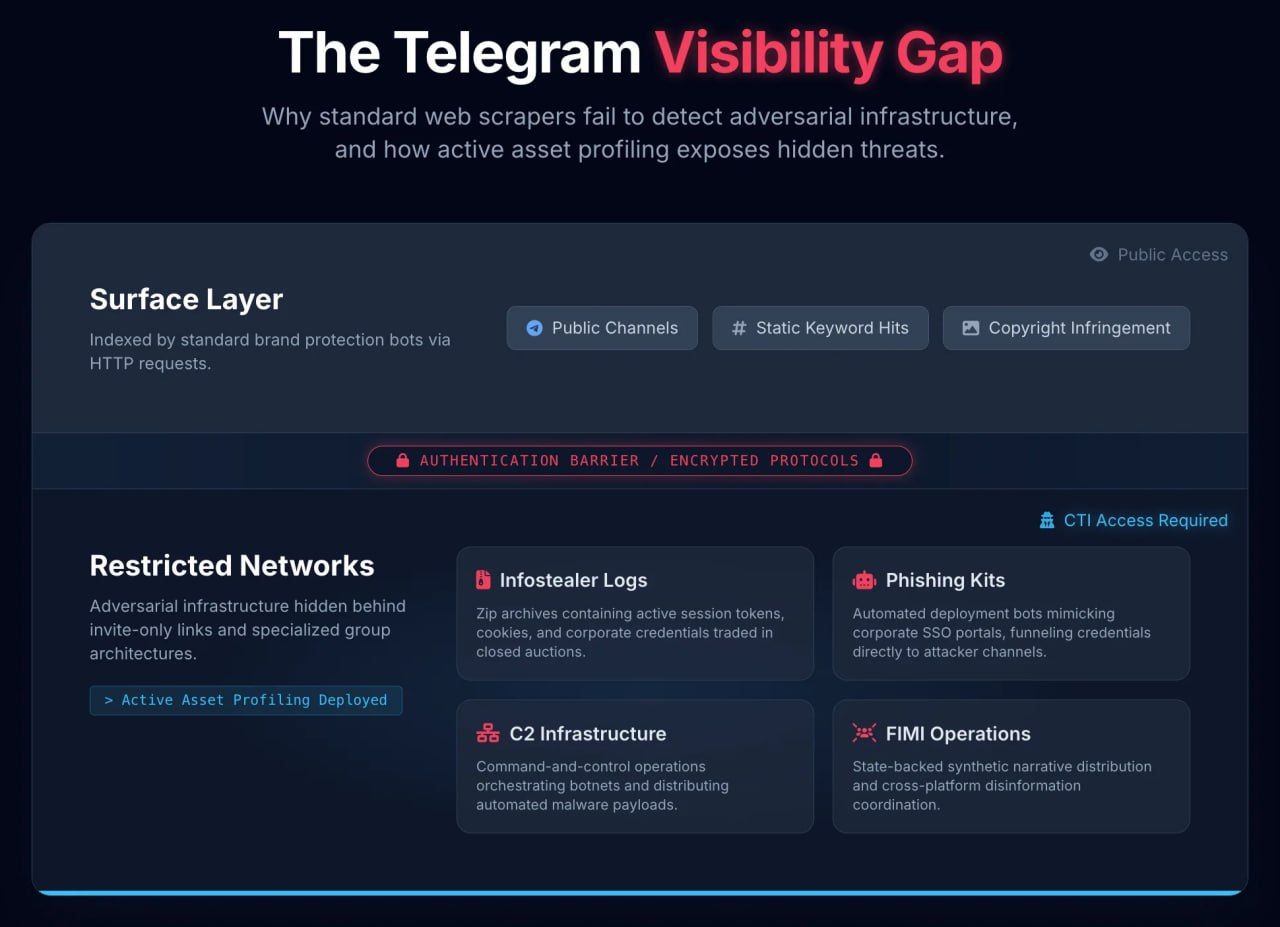
The technical reason Telegram evades standard monitoring is its native API architecture, which restricts bulk data extraction and enforces strict rate limits on unauthenticated accounts attempting to view group metadata. Without active session management and specialized technical infrastructure, automated tools only see a small fraction of public text strings.
Security teams often apply the same scanning logic to chat applications that they use for standard websites.
This approach collapses immediately. While a typical crawler indexes static HTML, Telegram brand monitoring requires maintaining persistent, secure communication nodes within the platform. Understanding the mechanics and importance of Telegram monitoring makes it clear that visibility requires deep protocol-level integration, not just surface scraping.
When threat actors set up operations, they exploit this exact barrier. They use public groups as a initial funnel, then immediately migrate high-value targets to private chats to distribute malicious payloads, ensuring your standard perimeter alerts remain completely blind to the transaction.
Why Web Crawlers Can't Access Closed Ecosystems
Generic web crawlers cannot access closed messaging systems because they lack the ability to handle mobile session states, execute cryptographic handshakes, or bypass manual invite confirmations required by restricted chat groups.
When a SOC manager relies on a standard external risk dashboard, they are only viewing cached data from public-facing web previews. The real operational danger—such as distributed phishing infrastructure or active credential auctions—occurs inside segmented chat rooms that require human or programmatic authentication.
This gap creates a false sense of security. Your dashboard shows zero hits for your core intellectual property, while an attacker is actively selling access to your corporate VPN inside a restricted group. Transitioning to active Telegram threat intelligence is the only method for penetrating these communication layers and establishing a real defensive posture.
The Evolution of Adversarial Tactics: From Reputation Risk to Infrastructure Weaponization
Threat actors have shifted from simple corporate identity theft to advanced infrastructure weaponization, using Telegram to host automated malware distribution channels, command-and-control servers, and fully managed financial fraud networks. This turns an identity problem into a direct threat to internal networks.
We recently analyzed how adversarial groups coordinate data leaks after an initial compromise. They no longer rely on slow, highly monitored dark web marketplaces to find buyers. Instead, they use automated chat channels to leak sample datasets, verify buyer identities via encrypted chat bots, and coordinate cryptocurrency payments within seconds.
Behind the Scenes of Brand Abuse on Telegram: Infostealer Logs and Phishing Kits
Brand abuse on Telegram occurs through the automated distribution of infostealer logs containing active session tokens and the deployment of pre-packaged phishing repositories designed to mimic corporate Single Sign-On pages.
When an employee accidentally executes malware on a corporate device, the infostealer extracts browser credentials, cookie files, and active session tokens. Attackers collect these files into massive zip archives known as stealer logs, which are then posted directly to dedicated channel repositories. Other criminals purchase these logs to hijack internal accounts without needing to bypass multi-factor authentication.
The market for telegram phishing detection is dominated by automated configuration kits. Attackers deploy specific bots that generate identical clones of your company's login page. When an unsuspecting user enters their data, the bot immediately packages the username and password and sends a direct message to the attacker's private channel, completely bypassing standard email filters.
Tracking Telegram Brand Impersonation and Fake Takedowns
Tracking Telegram brand impersonation requires security teams to analyze cross-channel forwarding networks and administrator user IDs to map the core operational cluster, rather than sending isolated abuse reports for individual channels.
Fraudulent networks frequently use counter-reporting tactics. Attackers execute fake Telegram channel takedowns, using fraudulent copyright strikes to disable legitimate corporate accounts. Once the real corporate channel is removed, the spoofed channels take over the search results, capturing all incoming user traffic. Identifying these coordinated attacks requires advanced Telegram OSINT tools to conduct online investigations and track the technical signatures of the administrators.
The Difference Between Digital Brand Protection and Cyber Threat Intelligence
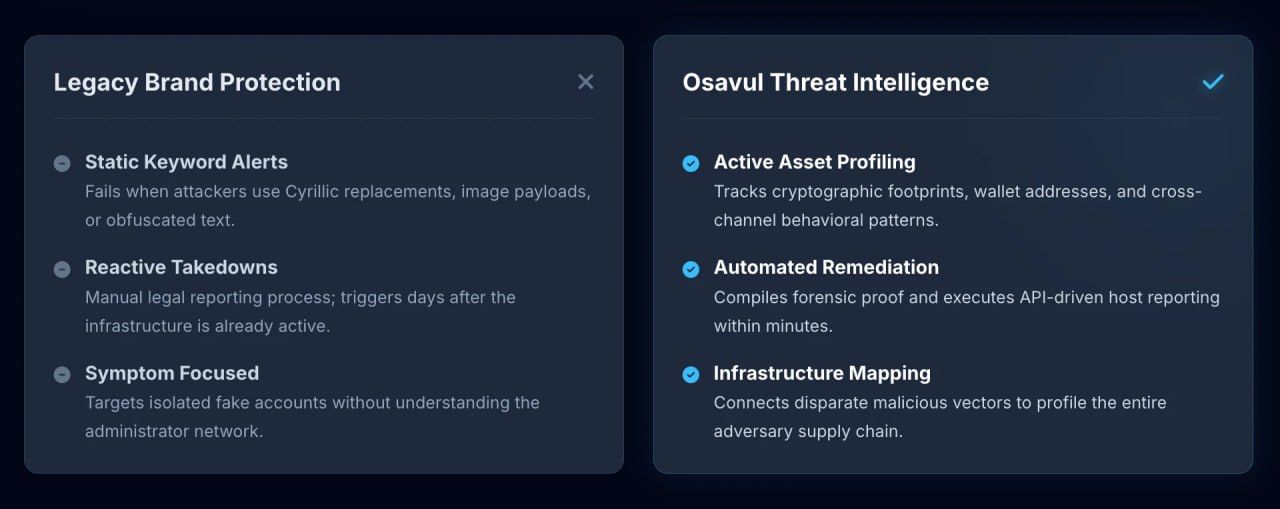
The functional difference between digital brand protection and cyber threat intelligence is that brand protection reacts to visible trademark violations after they occur, whereas threat intelligence uncovers the underlying attack infrastructure, developer profiles, and deployment vectors before a campaign begins.
Basic brand protection treats the incident as an isolated copyright issue. It identifies a fake logo and submits a standard abuse ticket. Cyber threat intelligence (CTI) telegram analysis views the incident as a coordinated campaign. It looks at threat actor profiling data to determine which specific malware strain was used to collect the stolen data and where those credentials are being sold.
Legacy Keyword Alerts vs. Active Asset Profiling
Legacy keyword alerts fail because they miss any malicious content hidden inside images, audio files, or intentionally altered text strings, whereas active asset profiling tracks behavioral indicators and cryptographic footprints across multiple private groups.
If an attacker alters your corporate name by replacing letters with Cyrillic characters, a static keyword alert remains completely blind. Active profiling focuses on behavioral patterns. We track the unique developer signatures of phishing bots, monitor the movement of funds across known hacker cryptocurrency wallets, and watch user migration patterns between underground groups. This converts passive data collection into actionable defensive intelligence.
Implementing Telegram Threat Intelligence: A Proactive Defense Framework
Implementing Telegram threat intelligence requires deploying specialized data collection infrastructure that connects directly to the platform's messaging protocol, allowing security teams to monitor both public and unindexed chat groups simultaneously.
When we assisted a retail organization facing a massive credential stuffed attack, our analysts didn't wait for internal systems to trigger brute-force alerts. We identified the preparation phase by tracking an active discussion inside an underground group where hackers were configuring a custom checking tool tailored specifically to the company's login API. This gave the internal network team a twelve-hour window to modify rate limiting rules and block the attacking IP blocks before the campaign even launched.
This proactive approach completely alters the security dynamic. Instead of cleaning up after a data breach, your security operations center can identify threat indicators while the adversary is still configuring their tools.
Overcoming Access Barriers: OSINT and Telegram Brand Exposure Management
Overcoming Telegram access barriers requires combining open-source intelligence methods with automated session management to map invite links, track user handles, and extract data from restricted spaces without alerting the group operators. This forms the basis of modern Telegram threat exposure management.
The primary difficulty is navigating the hidden connections between separate malicious groups. Attackers constantly close old groups and launch new ones to evade security researchers. To maintain visibility, security teams must deploy specialized ingestion tools. For organizations looking to automate this capability, the Nebula Telegram monitoring solution provides the continuous data collection required to track malicious actors through private networks.
Automating this ingestion allows teams to maintain an active history of threat mentions. This replaces slow, manual validation with a continuous data stream, ensuring you catch corporate leaks the moment they hit the platform.
Identifying Dark Web Telegram Groups and Malicious Vectors
Security teams identify dark web Telegram groups by tracking invitation hashes posted on underground forums, indexing references within deep web marketplaces, and tracing the redistribution of malicious payloads across cross-platform chat rooms.
When an adversary sets up a clearinghouse for corporate data, they use these chat environments to advertise their inventories to specialized buyers. By analyzing the metadata attached to these advertisements, security analysts can trace the supply chain back to the original network intrusion.
Moving Beyond Monitoring: Automated Telegram Remediation and Takedowns
Automated Telegram remediation is the programmatic collection of forensic evidence, asset verification, and instantaneous submission of structured abuse payloads to platform hosts and network registries to neutralize malicious channels.
Manual remediation approaches cannot compete with automated attack infrastructure. By the time a corporate legal team manually confirms a phishing channel and contacts a hosting provider, the attacker has already compromised hundreds of users and backed up their data to an alternate group. Automated systems eliminate this delay by compiling real-time cryptographic proof of the violation and filing immediate takedown requests via automated APIs.
For security operations handling broader information warfare or state-backed narrative campaigns, remediation requires connecting local intelligence with international standards. Cross-referencing your threat vectors with the EEAS framework on Foreign Information Manipulation and Interference (FIMI) ensures your defense metrics match global security baselines.
SOC Continuous Monitoring: Integrating Chat Ecosystem Intelligence into Your SIEM
SOC continuous monitoring requires formatting parsed Telegram data packets into structured syslog logs or JSON payloads and ingesting them directly into your internal SIEM to cross-reference external chat threats with internal network traffic.
When our engineering team deployed an automated telemetry feed for an enterprise client, we avoided simple dashboard alerts. We built an active pipeline that routes verified threat indicators—such as active phishing domains and malicious administrator user IDs—directly into their internal logging infrastructure. Within days, the system flagged an internal endpoint attempting an outbound connection to an IP address that had been identified as a command-and-control node inside an underground channel just hours prior.
Treating data from messaging networks with the same engineering discipline as standard endpoint logs allows analysts to build automated correlation rules. This converts external chat monitoring into early-stage internal detection before an attacker can deploy stolen network access tokens.
Frequently Asked Questions (FAQ)
Why is standard brand monitoring ineffective on Telegram?
Standard brand monitoring is ineffective on Telegram because traditional web scrapers rely on public HTML indexing and HTTP requests, which cannot penetrate Telegram’s proprietary protocol, automated invite-only walls, and private communication spaces where threat actors distribute stolen corporate data and configuration files.
How to detect brand impersonation on Telegram dark web channels?
To detect brand impersonation on Telegram dark web channels, security teams must implement active asset profiling to trace cross-platform invitation links from underground forums, monitor specialized metadata changes, and analyze file hashes of distributed phishing tools rather than searching for basic text strings.
How do threat actors bypass Telegram moderation?
Threat actors bypass Telegram moderation by utilizing heavily obfuscated text strings, image-based payloads to evade automated keyword filters, and private, multi-layered channel architectures that redirect targets from public spaces to unmoderated, invite-only environments.
What is the difference between digital brand protection and cyber threat intelligence?
The difference between digital brand protection and cyber threat intelligence is that brand protection focuses reactively on surface-level copyright infringements and basic channel removals, while cyber threat intelligence maps the underlying infrastructure, technical indicators, and adversarial profiles driving the attack campaigns.