Here’s a scenario we see more often than brand managers expect: a company notices an unusual spike in TikTok mentions on a Thursday afternoon. By Friday morning, a fabricated clip has 1.2 million views. By Saturday, journalists are calling for comment. The brand’s TikTok team had zero protocol for this. Their social media threat monitoring covered Twitter and Reddit. TikTok was treated as a publishing channel, not a risk surface.
That single blind spot cost them three weeks of reactive damage control.
TikTok is where reputations break faster than anywhere else right now. Not because the platform is uniquely hostile, but because its architecture rewards emotional, high-engagement content — and nothing drives engagement like outrage directed at a recognizable brand. This guide breaks down the threat types brand managers actually face, the signals to watch for, and the protocols that make a difference when minutes matter.
Why TikTok Is a Different Kind of Battlefield
TikTok threatens brand reputation differently than other platforms because its discovery engine doesn’t require a social graph. A user with zero followers can post a damaging video at midnight and wake up to 800,000 views — not because their audience shared it, but because the For You Page decided it was engaging. That single structural difference changes everything about brand risk.
The Algorithm as an Amplifier
On most platforms, a hostile post needs network density to spread. It needs followers, shares, or a paid push to break out. TikTok’s For You Page cuts that requirement entirely. Watch time, replays, comments — these engagement signals trigger distribution. Emotionally charged, outrage-inducing content about your brand gets the highest organic reach precisely because it provokes reaction.
Tracking brand incidents across 2023–2024, we found that TikTok posts critical of a brand consistently outperformed that brand’s official response content by 4 to 12x in view count — within the same 48-hour window. The platform isn’t neutral terrain. It actively disadvantages measured corporate communication.
Speed Asymmetry: How Attacks Outpace Responses
Traditional crisis comms operates on a 2–4 hour response window. On TikTok, that window is a fantasy. The viral threshold can be crossed in under 90 minutes — especially when mid-tier creators (100K–2M followers) stitch or duet the original content and push it to their own audiences.
By the time your legal team has reviewed a draft response, the narrative has already been shaped by hundreds of user reactions. That framing — not the incident itself — is what most viewers encounter first. Real-time social media threat monitoring on TikTok means detecting the threat in its first 15 to 30 minutes. Anything later and you’re already playing catch-up on someone else’s storyline.
The Threat Taxonomy: What Brand Managers Are Actually Facing
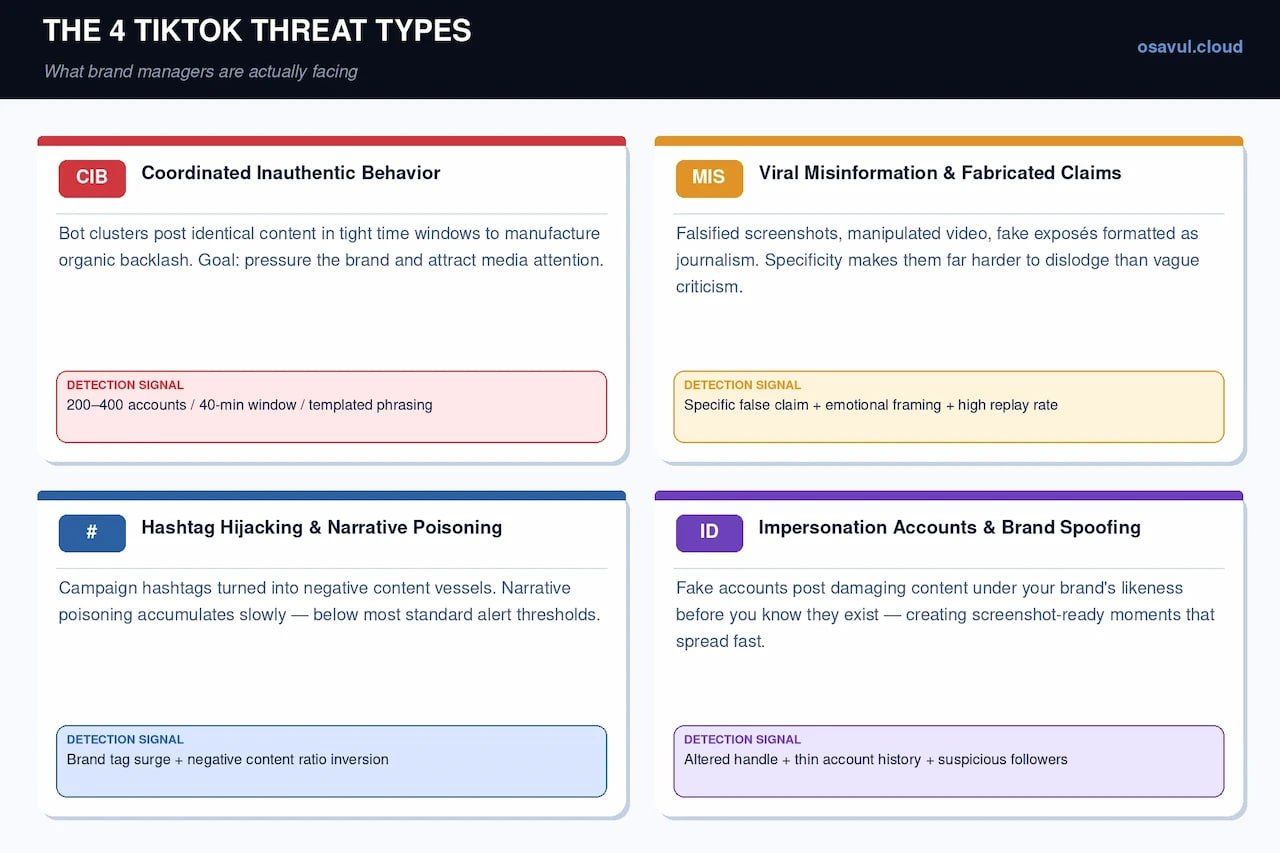
Not all TikTok threats work the same way, and treating them as one undifferentiated “reputation risk” is why so many response efforts miss the mark. The type of attack determines the correct counter-strategy. A coordinated botnet campaign requires a different playbook than a viral piece of user-generated misinformation — and confusing the two wastes critical response time.
Coordinated Inauthentic Behavior (CIB) and Botnet Campaigns
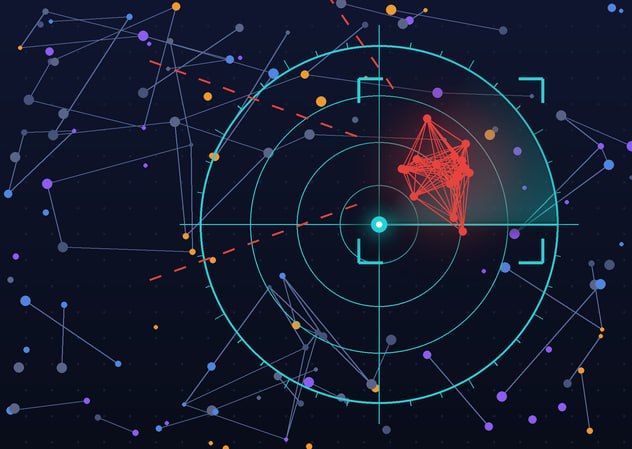
Coordinated inauthentic behavior on TikTok looks like spontaneous public anger but follows detectable patterns. Accounts posting in tight time clusters, using near-identical phrasing, with abnormally low follower counts and no prior content history — these are the fingerprints. The goal is to manufacture the appearance of organic backlash at a scale that pressures the brand and attracts media attention.
We’ve tracked CIB campaigns where the initial wave of 200–400 accounts all posted within a 40-minute window, using the same three hashtags and variations of the same sentence structure. The content wasn’t original — it was templated. Detecting that pattern early is exactly what separates brands that contain the damage from those that spend a week explaining themselves. Stanford’s Internet Observatory has documented how these campaigns continue to evolve across platforms, migrating to new channels whenever content is removed — which is why brand monitoring can’t be limited to a single platform or time window.
Viral Misinformation and Fabricated Claims
This category is the most publicly visible and, often, the most damaging. A falsified screenshot of an internal memo. A deceptively edited video that strips context from a real event. A fake “exposé” formatted to look like investigative journalism. As researchers at the Australian Institute of International Affairs have documented, TikTok’s video format makes misleading content particularly potent because viewers engage emotionally before critical evaluation kicks in — and by the time fact-checks appear, the original post has already shaped how most viewers understand the story.
The specificity of the claim matters. Vague criticism is easy to dismiss. A detailed, false-but-plausible narrative — “this brand’s supplier uses child labor in [specific country]” — is far harder to dislodge. By the time a rebuttal is published, the original claim has accumulated enough social proof (likes, shares, concerned comments) that many viewers assume there’s substance to it.
Hashtag Hijacking and Narrative Poisoning
Brand hashtags are an under-protected asset. When a company runs a campaign under a branded hashtag, that tag becomes a vessel — and hostile actors can fill it with negative content, effectively turning the brand’s own marketing real estate against it. We’ve seen product launch hashtags taken over within hours of campaign launch, with the first page of results dominated by critical or mocking content before the campaign had a chance to build momentum.
Narrative poisoning is a slower variant: seeding negative associations with a brand term over days or weeks, so that search results and For You Page content start returning a distorted picture of the brand. It’s harder to detect because no single post goes viral. The damage accumulates gradually, under the threshold of most monitoring alert systems.
Impersonation Accounts and Brand Spoofing
Fake accounts mimicking a brand’s official TikTok presence serve two purposes: deceiving consumers and damaging the brand’s reputation through the content they post. A spoofed account posting offensive content under a brand’s name — before the brand even knows the account exists — creates exactly the kind of screenshot-ready moment that spreads across platforms.
The tell is usually small: a slightly altered handle, a logo with minor distortion, follower counts that are implausibly high for a new account. But casual viewers don’t scrutinize handles. They see what looks like official brand content and react accordingly. Proactive monitoring for brand impersonation on TikTok is one of the most consistently overlooked elements of brand safety programs.
Warning Signs: How to Spot a Threat Before It Goes Viral
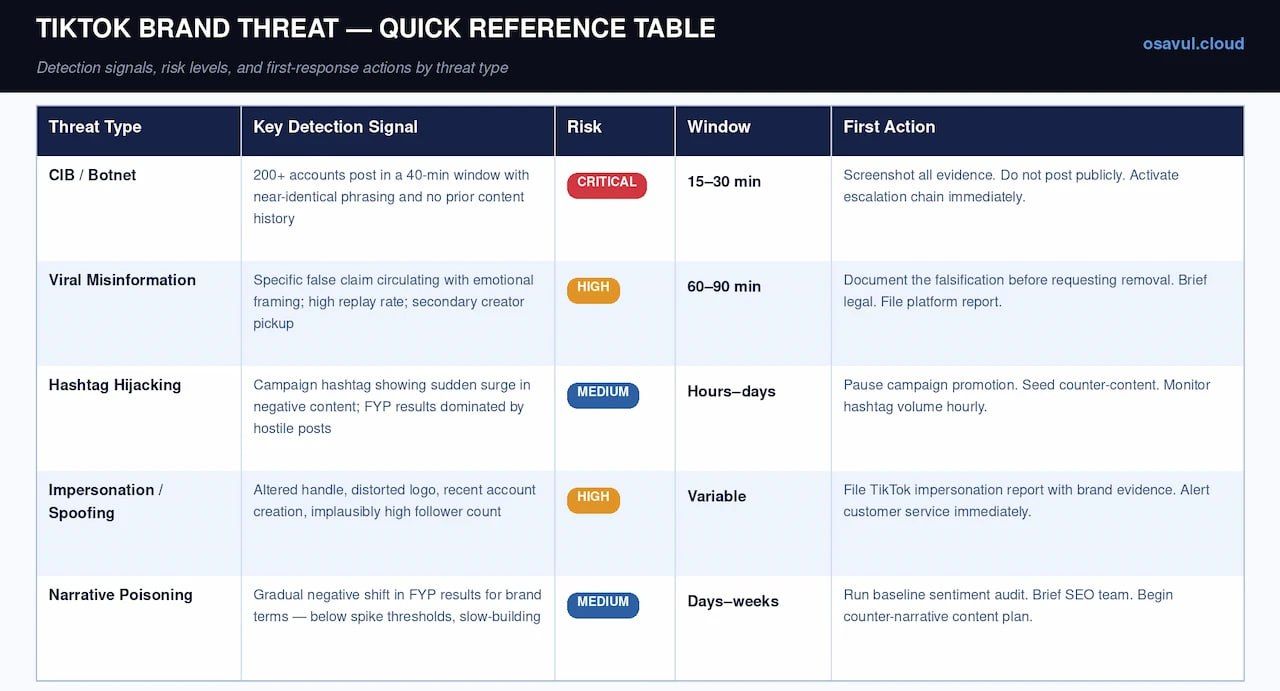
Brands that contain TikTok threats quickly rarely do it because they responded faster. They do it because they saw it earlier. In most cases we’ve analyzed, the attack had clear, readable signals in the first 20–30 minutes — spikes, linguistic patterns, account behavior — that went unnoticed because no one was watching for them. The monitoring infrastructure wasn’t there, or the alert thresholds were set too high to catch early-stage coordination.
Abnormal Spike Patterns in Brand Mentions
The first signal is almost always quantitative: a sudden increase in brand mentions that has no correlation with campaign activity, a press release, or a product launch. A brand averaging 100 TikTok mentions per day that sees 500 in a 90-minute window is already mid-incident, even if no single post has gone viral yet.
Volume alone isn’t the tell. Sentiment composition is. When 75–80% of a sudden mention spike is negative and concentrates around a single claim or hashtag, you’re not looking at organic frustration. Genuine consumer anger distributes across topics — product complaints, delivery issues, pricing. Claim-specific negativity appearing simultaneously across dozens of accounts is a coordination fingerprint.
Linguistic Markers of Coordinated Posting
People expressing real frustration phrase things differently. Coordinated actors don’t. One of the clearest forensic markers we look for is lexical similarity — the same unusual phrasing appearing across accounts with no plausible reason to share vocabulary.
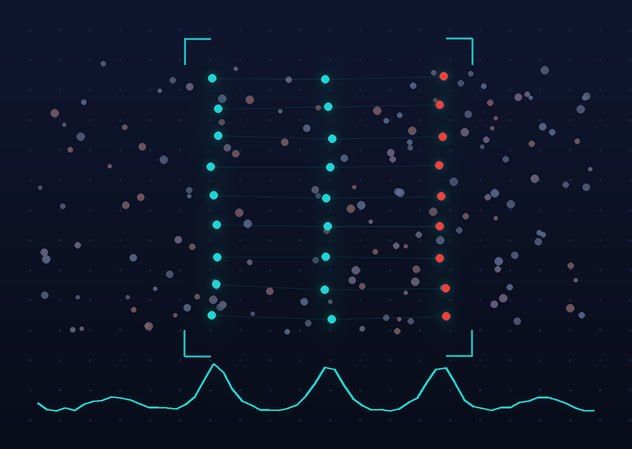
In practice: identical sentence openers across 15+ accounts within 30 minutes, the same deliberate misspelling in multiple posts (a classic tell of templated content), synchronized adoption of a hashtag that had zero prior association with your brand, comment waves where the negative-to-positive ratio is inverted relative to your baseline. Each signal is explainable in isolation. When three or more appear together in the same window, you’re almost certainly looking at something organized.
The Role of Social Media Threat Monitoring Tools
Manual review at TikTok speed isn’t a real option. By the time a human analyst has worked through a batch of flagged posts, that content has already been stitched, dueted, and pushed to new audiences by secondary creators. The response window closes fast.
What actually works is automated detection with configurable thresholds — systems that process mention data in real time, apply sentiment and entity recognition, and surface anomalies before content crosses the viral threshold. The capability that matters most isn’t a mention count dashboard. It’s anomaly detection measured against your own historical baseline, paired with cross-account pattern recognition. Tools built for media intelligence, like Osavul, are designed around exactly this — flagging coordinated narrative behavior early, not just tallying brand tags after the fact. That’s what creates the 15–30 minute window where a response can still shape the story.
Anatomy of a TikTok Brand Attack: A Real-World Pattern
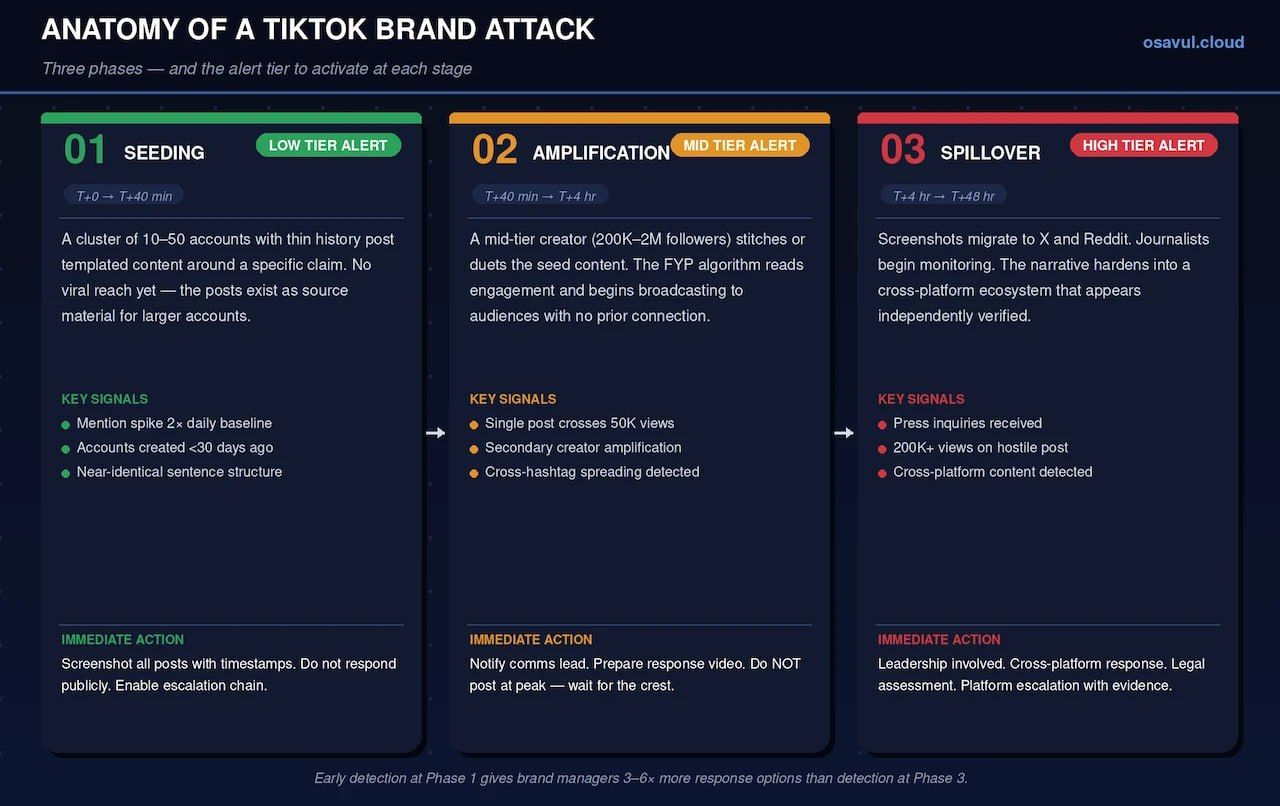
Understanding the threat types is one thing. Seeing how they sequence in practice is another. Most TikTok brand attacks don’t arrive as a single viral post — they unfold in phases, each building on the last. Brand managers who recognize which phase they’re in can calibrate their response accordingly. Those who can’t tend to treat a Phase 1 seed as either a non-event or a full-blown crisis — both of which make things worse.
Phase 1 — Seeding
The attack almost always starts quietly. A small cluster of accounts — often 10 to 50 — posts content around a specific claim or narrative. These accounts typically have thin history, few followers, and post at unusual hours relative to the brand’s primary market timezone. The content is designed not to go viral on its own but to exist as source material: something that can be screenshot, clipped, or referenced by larger accounts later.
At this stage, automated social media threat monitoring is the only reliable detection method. Human review rarely catches seeding activity because no individual post has significant reach. The pattern only becomes visible in aggregate. A 2025 study published at the ICWSM conference analyzed 1.35 million TikTok videos and found that coordinated accounts consistently posted within tightly bounded time windows — a statistical signature invisible at the individual post level but unmistakable in aggregate. That's exactly what machine-driven anomaly detection is built to surface.
Phase 2 — Amplification
This is where the attack becomes visible to most brand managers — and where it’s already partially out of control. A mid-tier creator (typically 200K–2M followers) picks up the seed content, frames it with their own commentary, and publishes a stitch or duet. Their audience engages. The For You Page algorithm reads that engagement as a signal and starts distributing the content to broader audiences who have no prior relationship with the original accounts.
What makes Phase 2 particularly difficult is that the amplifying creator often isn’t a bad actor — they’re a genuine user who encountered the seeded content and found it credible or interesting. Responding aggressively to them backfires. The correct read at this stage is: the seed worked, the narrative is now moving, and counter-messaging needs to start immediately — not after legal review.
Phase 3 — Cross-Platform Spillover
By Phase 3, TikTok is no longer the only battlefield. Screenshots and clips have migrated to X, Reddit threads are cataloguing the “controversy,” and mid-level journalists covering brand news have started monitoring the story. The narrative has hardened. Users who encounter it now find a cross-platform ecosystem of content that all points in the same direction, which creates the impression of independent verification — even when the original source was a coordinated handful of accounts.
This is the phase that generates press inquiries and investor concern. Effective social media reputation management at Phase 3 means working across platforms simultaneously, correcting the record where the secondary coverage lives — not just on TikTok — while the forensic record of the original coordination is documented for potential platform escalation or legal action.
Can Small Brands Be Targeted?
A common assumption among smaller brands is that coordinated attacks are reserved for corporations with enough public profile to make the effort worthwhile. That assumption is wrong, and it leaves smaller brands dangerously underprepared.
Targeted attacks on small and mid-sized brands are more common than reported, precisely because those brands lack the monitoring infrastructure to document them properly. A regional food company, a DTC skincare label, a boutique hotel chain — all have faced coordinated TikTok campaigns driven by competitor actors, disgruntled former employees, or ideologically motivated groups. The difference is that small brands often misread the attack as organic sentiment, never identify the coordination behind it, and absorb the reputational damage without understanding what actually happened.
There’s also a targeting logic specific to TikTok’s creator economy. Smaller brands with active TikTok presences often have more engaged, passionate communities — which means a credible-sounding attack generates proportionally more emotional response from followers. That emotional velocity is exactly what the For You Page amplifies. A mid-sized brand with 80K followers can face the same viral attack dynamics as a multinational. The scale of the audience is different. The mechanism is identical.
The practical implication: brand safety planning on TikTok is not a resource question. A small brand with a clear monitoring protocol and pre-defined escalation thresholds is better protected than a large brand with a reactive social team and no early-warning system. The investment required is in process, not headcount.
Building a Pre-Crisis Monitoring Framework
Every brand manager we’ve talked to who handled a TikTok threat well says some version of the same thing: “We’d set this up months before it happened.” The speed of their response wasn’t improvisation — it was preparation made invisible. Building the framework after an attack starts isn’t crisis management. It’s damage absorption.
What to Track and How Often
The obvious starting point is direct brand mentions: your brand name, product names, executive names, campaign hashtags. But here’s what most monitoring setups miss — misspellings. Coordinated actors deliberately use altered spellings of brand names to slip past keyword filters while still reaching the same audiences. If your monitoring doesn’t catch the three most common misspellings of your brand name, it has a gap that bad actors will eventually find.
The less obvious layer is category-level sentiment. A food brand should be watching food safety discourse on TikTok even when the brand isn’t named. A fintech should be tracking scam and fraud conversations in their vertical. Threats frequently start as category narratives before they attach to a specific brand — and catching that early gives you days of lead time instead of minutes.
On cadence: real-time alerting for branded terms is non-negotiable. Weekly category sentiment reviews are a solid baseline. During product launches or active campaigns — when your TikTok surface area is at its largest — daily briefings from your monitoring platform should be the default, not a special measure.
Setting Escalation Thresholds
One of the most common mistakes we see is binary escalation: either everything gets flagged or nothing does. Both extremes fail. Over-alerting trains teams to ignore notifications. Under-alerting means real threats arrive at the communications director’s desk via a journalist’s call.
The fix is a tiered threshold system defined in advance. A low-tier alert triggers when mention volume hits 2x your daily baseline with negative sentiment above 40% — worth a look, not worth waking anyone up. A mid-tier alert triggers at 5x baseline or when a single hostile post breaks 50K views — the social lead needs to know now. A high-tier alert — the one that pulls in communications leadership — triggers at 200K views on a hostile post, detection of cross-platform spillover, or amplification by a verified or high-follower account. These numbers need to be calibrated to your specific baseline. A brand that normally generates 500 daily mentions has a very different 2x threshold than one generating 50.
Tools and Stack Recommendations
The core requirement is a media intelligence platform with real-time TikTok ingestion, cross-platform tracking, and anomaly detection against your historical baseline — not just a mention counter. Osavul is built for exactly this layer, with specific depth in detecting coordinated behavior and mapping how narratives migrate from TikTok to X, Reddit, and news coverage.
Beyond the platform: a dedicated Slack or Teams alert channel, a named on-call rotation so someone is accountable outside business hours, and a pre-approved response template library so your team isn’t writing from scratch at 11pm on a Friday. None of this requires a large budget. It requires decisions made before the pressure hits.
Response Protocols When an Attack Hits
Brands that handle TikTok attacks well rarely had better instincts in the moment. They had decisions already made. When a threat lands at 11pm on a Sunday, the worst possible time to figure out your escalation chain is 11pm on a Sunday. What looks like a calm, coordinated response from the outside is almost always a pre-built protocol running under pressure — not someone thinking clearly in a crisis.
The First 6 Hours
The single most counterintuitive thing we tell brand managers: your first move is probably not a public statement. Posting a response on TikTok in the first hour of an attack is often the worst thing you can do. It signals to the algorithm that the original hostile content is worth engaging with — and TikTok reads that engagement signal as a reason to push the content further. You can inadvertently extend the reach of an attack by responding to it too publicly, too fast.
What the first hour actually looks like: screenshot everything. Account handles, post timestamps, view counts, comment samples, the amplification chain. That forensic record is your leverage — for platform escalation, for legal action, for internal reporting. It disappears if content gets deleted. Capture it before you do anything else.
Then answer the question that controls everything: is this coordinated or organic? A botnet campaign and genuine consumer backlash look similar on the surface and require completely different responses. Treating one like the other is where most crisis responses go sideways.
Platform-Specific Counter-Messaging on TikTok
When a public response is the right call, forget the written statement. TikTok audiences read corporate text as corporate text — and they respond to it accordingly, usually in the comments section, usually not kindly. What actually moves sentiment is a direct-to-camera video from someone credible inside the company. Not produced. Not scripted. Something that reads as a real person addressing a real situation.
We’ve watched polished, agency-produced response videos get ratio’d into irrelevance while a low-fi phone-camera video from a founder or product lead landed well. Authenticity isn’t a brand value on TikTok — it’s a survival mechanism. The algorithm rewards watch time, and watch time follows genuine human communication, not PR.
On timing: don’t post your response at the peak of the attack. You’ll be buried. Wait for the hostile content’s engagement to start declining — usually 12 to 18 hours after the initial spike — then post into that quieter window where your content has space to reach people who haven’t already formed an opinion.
When to Escalate to Legal or Platform Support
Two situations require immediate escalation beyond your comms team. If the attack involves fabricated evidence — manipulated video, forged documents, false quotes attributed to your executives — you have both platform reporting grounds and potential defamation exposure. Document the falsification in detail before requesting removal. Removal kills the evidence. You need the evidence.
If forensic analysis shows coordinated inauthentic behavior, report it to TikTok’s trust and safety team — but report it specifically. Platforms act on evidence, not complaints. Submit account handles, posting timestamps, the linguistic patterns showing coordination, and the engagement anomalies. A precise, documented report gets actioned. A general “we’re being attacked” request sits in a queue.
TikTok Brand Safety Settings: What They Do (and Don’t) Cover
Brand managers running paid campaigns on TikTok have access to a set of built-in brand safety controls — inventory filters, content category exclusions, adjacency settings. These tools are worth using. They’re also frequently misunderstood as protection against the threats described in this guide. They aren’t, and conflating the two creates a dangerous false sense of security.
TikTok’s native brand safety settings are ad placement controls. They determine where your paid content appears — preventing your ad from running next to videos flagged for violence, adult content, or misinformation. That’s a legitimate and useful function. What they don’t do is monitor what’s being said about your brand, detect coordinated attacks targeting your reputation, or flag impersonation accounts. A brand can have every TikTok safety filter enabled and still wake up to a botnet campaign that’s been running for six hours.
This distinction matters because brand safety in the advertising sense and brand safety in the reputation sense are managed by completely different systems. The first lives inside TikTok Ads Manager. The second requires external social media threat monitoring infrastructure — a media intelligence platform, alert thresholds, and a response protocol. Brands that invest in the former and assume it covers the latter are exposed in exactly the ways this guide describes.
There’s also a gap in what TikTok’s content moderation catches in real time. The platform’s policies prohibit coordinated inauthentic behavior, harassment campaigns, and deliberate misinformation — but enforcement is reactive and imperfect. By the time a coordinated attack is removed by TikTok’s trust and safety team, it may have already accumulated millions of views and spawned dozens of secondary pieces of content that the original removal doesn’t touch. Relying on platform moderation as your primary defense is a bet on someone else’s timeline in a situation where your timeline is the one that matters.
What TikTok brand safety settings genuinely protect: your ad spend from appearing in contexts that could generate negative associations by proximity. Use them. Set inventory filters, exclude content categories that conflict with your brand values, enable the adjacency controls for sensitive topics. But treat them as one layer of a broader system — not as the system itself.
Distinguishing Coordinated Attacks from Organic Backlash
This is the question brand managers get wrong most often — and the consequences of misreading it run in both directions. Treating genuine consumer anger as a coordinated attack produces a dismissive, defensive response that alienates real customers and makes a bad situation worse. Treating a botnet campaign as authentic public sentiment leads to a genuine customer service response that never addresses the actual problem. Getting this right is foundational to everything else in the response protocol.
The clearest diagnostic is account history. Genuine consumers complaining about a brand have posting histories — varied content, personal context, followers who are real people. Coordinated actors frequently operate accounts with thin or non-existent history: accounts created recently, posting only on the target topic, with follower lists that don’t hold up to scrutiny. Pull a sample of the accounts driving the negative content and look at what they posted three months ago. If the answer is nothing, or content that has no relationship to the current narrative, that’s a signal.
Sentiment language is the second diagnostic. Organic backlash is specific and personal. “I waited six weeks for my order and customer service ignored three emails” is a real person. “This company exploits its workers and doesn’t care about its customers” repeated across 40 accounts in the same phrasing is a template. The emotional register of genuine frustration tends to be idiosyncratic — people complain about their specific experience in their specific voice. Coordinated content is structurally similar across posts because it originates from the same source.
Timing patterns are the third signal. Organic negative sentiment builds gradually as more people encounter a problem or news event and independently decide to post. Coordinated attacks spike — a tight cluster of posts appearing within minutes of each other, often outside the peak posting hours of the target market’s timezone. A burst of 80 negative posts between 3am and 4am local time is not how organic consumer frustration behaves.
None of these signals is individually conclusive. Taken together — thin account history, templated language, abnormal timing — they form a pattern that distinguishes coordination from coincidence with reasonable confidence. When the pattern points to coordination, the response strategy shifts entirely: away from customer service mode and toward forensic documentation, platform reporting, and legal assessment. The faster that diagnostic runs, the more options the brand has.
Frequently Asked Questions (FAQ)
What types of threats can brands face on TikTok?
The four we track most closely: coordinated inauthentic behavior (where botnet clusters manufacture the appearance of organic backlash), viral misinformation built around fabricated claims or manipulated video, hashtag hijacking that turns a brand’s own campaign real estate against it, and impersonation accounts posting damaging content under a brand’s likeness. In practice these rarely arrive in isolation. A botnet campaign seeds a false claim, a genuine mid-tier creator picks it up assuming it’s real, and suddenly you’re dealing with both a coordination problem and an amplification problem at the same time — with completely different response requirements for each.
How fast can a reputation attack spread on TikTok compared to other platforms?
In our experience tracking these incidents: faster than any brand manager’s current playbook was designed for. TikTok’s For You Page can push a hostile post to hundreds of thousands of users within 90 minutes — from an account with zero followers — purely on the basis of early engagement signals. On other platforms that kind of reach requires an existing audience or paid distribution. On TikTok it requires someone to watch the video to completion and leave a comment. The 2–4 hour response window that crisis comms teams were trained on doesn’t exist here. By hour two, the narrative has usually been framed by secondary creators and is spreading on its own momentum.
What signals indicate a coordinated narrative attack versus organic negative sentiment?
Three things, read together. First, account history — genuine consumers have posting lives that predate your incident. Coordinated accounts are often thin, recently created, or posting exclusively on the attack topic. Second, language patterns — real frustration is personal and specific. Templated content is structurally similar across posts in ways that no group of independent people would naturally produce. Third, timing — organic sentiment builds gradually as people independently encounter a story. Coordination spikes, often in tight clusters outside peak hours for the target market’s timezone. None of these signals alone is definitive. When all three align, you’re almost certainly looking at something organized.
Can small brands be targeted, or only large corporations?
Small brands get hit more often than the public record shows — because they get hit successfully. Without early-warning monitoring, smaller teams misread coordinated attacks as organic sentiment, respond with customer service protocols that don’t address the actual problem, and absorb reputational damage without ever understanding its source. There’s also a TikTok-specific targeting logic at work: engaged communities around smaller brands generate proportionally intense emotional reactions to credible-sounding attacks. That emotional charge is exactly what the algorithm amplifies. The protection gap isn’t a budget problem. It’s a process problem — and process is fixable at any company size.
What tools and processes should brand managers set up before a TikTok crisis hits?
The non-negotiables: a media intelligence platform with real-time TikTok monitoring and anomaly detection calibrated to your own baseline (not industry averages), tiered escalation thresholds defined before anyone is under pressure, a named on-call owner outside business hours, and pre-approved response templates your team can actually use at 11pm on a Saturday. The platform is the critical dependency — everything downstream of detection only works if you catch the threat early enough to have options. Set this up during a quiet period, stress-test the alert thresholds against real historical data, and run at least one tabletop exercise before the real thing arrives.
Key Takeaways for Brand Managers
TikTok is not a one-way publishing channel for brands that take it seriously. It’s a risk surface — one with specific attack vectors, a distribution architecture that actively favors hostile content over measured corporate response, and timelines that make traditional crisis comms frameworks look dangerously slow.
The brands we’ve seen handle TikTok threats well share a few things. They built their monitoring infrastructure before they needed it. They defined escalation thresholds when no one was under pressure. They trained their teams on the difference between coordinated attacks and organic sentiment before that distinction mattered at 2am. None of this is sophisticated in concept. All of it requires discipline to do before the incident that makes it obviously necessary.
A few things worth carrying from this guide. Threat detection on TikTok is a speed problem before it’s a strategy problem — the first 15 to 30 minutes determine how many options you have. The For You Page is structurally asymmetric: attack content spreads faster than brand responses, by design. Coordinated attacks and genuine backlash look similar on the surface and require completely different responses — getting that diagnostic right is the most important judgment call in any TikTok crisis. Native brand safety settings in TikTok Ads Manager protect your ad placements, not your reputation. And small brands are targeted more often than reported, with less infrastructure to absorb the impact.
The monitoring layer is where this all starts. Without real-time visibility into what’s being said about your brand — across accounts, across platforms, against your own historical baseline — everything else in this guide is theory. Platforms built for narrative intelligence, like Osavul, exist precisely because the gap between what brands can see manually and what’s actually happening on TikTok is where most attacks succeed. Closing that gap is the foundational step. Everything else follows.