What Brand Protection Actually Means in 2026
Brand protection is the practice of finding, analysing and disrupting misuse of a company's name and identity across public and semi-closed digital channels. It lives between security operations, legal, and communications — and it breaks when it gets filed permanently under just one of them.
The definition matters because the job moved. Ten years ago this was paperwork: trademarks, defensive domains, a notice when someone listed fakes on a marketplace. Now an adversary stands up forty impersonation accounts on a Friday evening, drops them into three Telegram groups, and by Monday there's a fabricated product-recall story running in two languages with screenshots better than your actual press kit. We watched almost exactly that hit a mid-sized payments company last spring. Legal did everything right. They were playing a different sport.
Why Legal Takedowns Stopped Being Enough
Takedowns are a remedy, not a control — they remove artefacts after the damage has travelled. Across coordinated campaigns we tracked against financial and energy brands in Eastern Europe, the median gap between the first seeded post and visible pickup by unaffiliated accounts was under nine hours. A platform takedown, even through a priority trust channel, almost never closes that fast.
None of which makes takedowns optional. They just stop being the plan. There's also a quieter cost to the delete-and-move-on habit: every removed asset carries information — registration dates, posting rhythms, language tics, the phone number reused across six accounts. Clear the artefact without keeping the pattern and you discard your only map of where the next wave starts.
Brand Protection vs. Brand Monitoring vs. Reputation Management
These three get swapped around freely in vendor decks, and the confusion costs real money at budget time.
| Core question | |||
| Brand monitoring | Who is talking about us, and in what tone? | Mention volume, sentiment | Marketing / PR |
| Is perception shifting, and why? | |||
| Who is misusing our identity, and are they coordinated? |
The split is behavioural, not semantic. Brand monitoring counts mentions. Brand protection asks whether two hundred of those mentions came from accounts registered inside the same week, posting in matching fifteen-minute windows, repeating the same three misspellings. One platform can feed all three. The failure mode is buying a sentiment tool and discovering, at the worst possible moment, that counting volume and detecting coordination are not the same measurement.
The Modern Brand Attack Surface
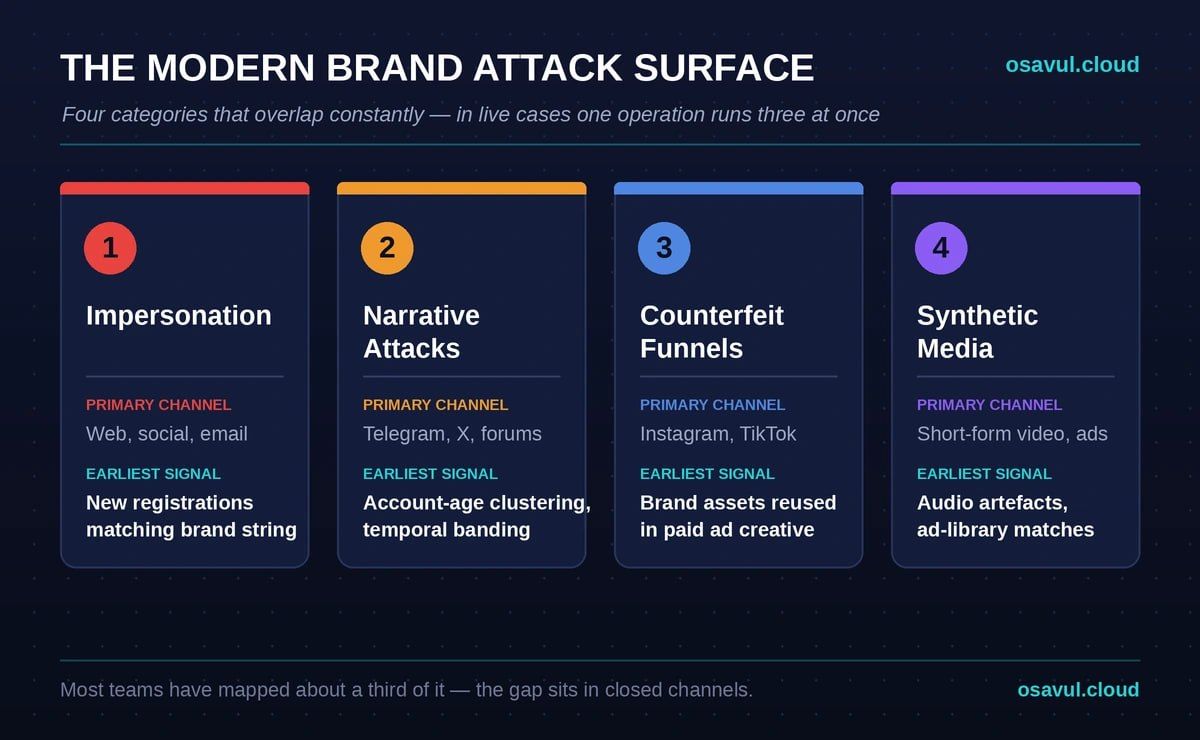
A brand's attack surface is every place its identity can be reproduced without permission — domains, social profiles, marketplace listings, closed messaging channels, app stores, ad networks, and now the outputs of generative models. Most teams have mapped a third of it.
Impersonation: Domains, Profiles, and Executives
Impersonation is the reproduction of a brand's identity by an unauthorised party to extract money, credentials or credibility. Highest volume, clearest financial trail.
The FBI's 2025 Internet Crime Report logged $3.04 billion in business email compromise losses, averaging over $122,000 per complaint — and BEC is executive impersonation with a payment instruction attached. That's the version with a receipt. The version without one is the fake support account replying to your customers on X within ninety seconds, harvesting logins from people who think they're being helped.
Narrative Attacks and Coordinated Inauthentic Behaviour
A narrative attack is a deliberate effort to attach a damaging story to a brand and push it until unaffiliated people repeat it. It differs from ordinary bad press in one measurable way: the early distribution is manufactured.
We look for three tells. Account age clustering — profiles created within days of each other. Temporal banding — posts landing in tight repeating windows that suggest scheduling rather than humans reacting. Phrasal reuse — the same odd construction appearing verbatim across accounts claiming no connection. Any one can be innocent. All three, in a conversation about your recall policy, is a botnet coordination signature. By the time journalists arrive the manufactured origin is invisible; the evidence lived in the first six hours.
Counterfeit Funnels That Start on Social, Not Marketplaces
Counterfeit operations increasingly acquire customers on social platforms and only route them to a storefront at the point of sale — inverting the old detection model that watched marketplaces and waited.
The OECD and EUIPO put global trade in counterfeit goods at USD 467 billion, or 2.3% of world imports, with clothing, footwear and leather goods making up 62% of seizures. Rising fastest are the categories that hurt people — automotive parts, medicines, cosmetics. If your monitoring covers only the big marketplaces, you're watching the exit and ignoring the entrance.
Synthetic Media: Voice Clones and Fabricated Endorsements
Synthetic media attacks use AI-generated audio, video or images to place a brand or its executives in statements they never made. The FBI recorded 22,364 complaints with an AI nexus in 2025 and adjusted losses above $893 million — small against the total, growing fast against itself.
Attack Type, Channel, Signal, Owner
| Primary channel | |||
| Domain and profile impersonation | Web, social, email | New registrations matching brand string; photo hash matches | Security ops |
| Email, LinkedIn, WhatsApp | |||
| Telegram, X, forums | |||
| Instagram, TikTok, Telegram | |||
| Synthetic media | Short-form video, paid ads | Audio artefacts; ad-library matches; geo-odd engagement | Threat intelligence + Comms |
A Five-Layer Brand Protection Model
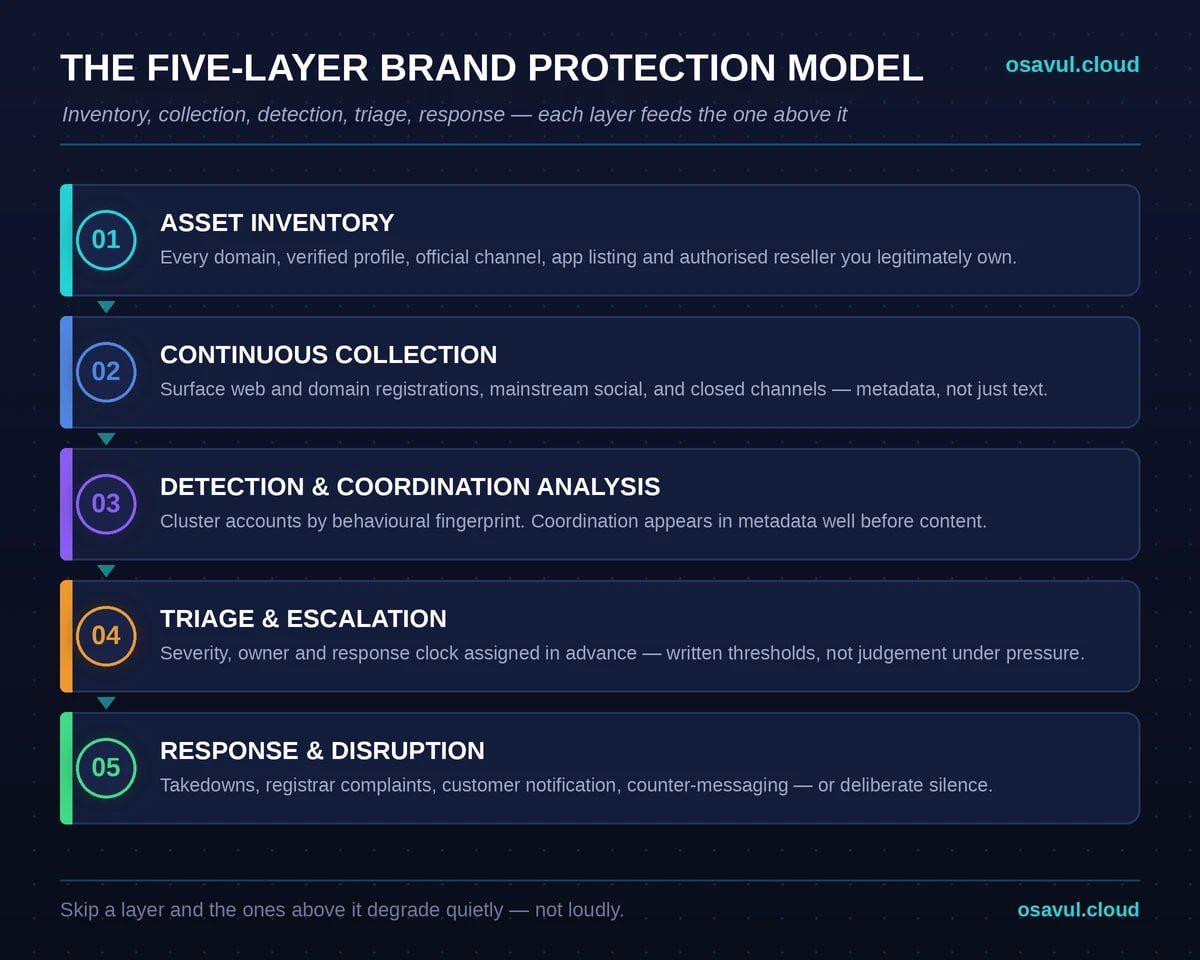
An effective program runs as five stacked layers: inventory, collection, detection, triage, response. Skip one and the layers above it degrade quietly rather than failing loudly — which is why most broken programs look fine on a dashboard.
Layer 1: Asset Inventory and Attack Surface Mapping
Inventory is the record of every legitimate asset carrying your identity — domains, verified profiles, official channels, app listings, authorised resellers, executive accounts. Without it you can't tell impersonation from something your Brazilian distributor launched last quarter.
Least glamorous layer, most often skipped. Two questions expose it: how many verified social accounts do you operate globally, and who can name them? We've sat with six-figure security budgets where nobody could answer either.
Layer 2: Continuous Collection Across Surface, Social, and Closed Channels
Collection is the ingestion of content and metadata from channels where your brand can be misused, running continuously rather than on request. Three tiers matter: surface web and domain registrations, mainstream social, and closed channels like Telegram and Discord.
That third tier is where the gap almost always sits, and teams treating it as optional find campaigns after mainstream pickup, never before. Collect metadata, not just text: text alone gives you sentiment, while creation dates, timestamps, media hashes and forwarding chains give you coordination.
Layer 3: Detection and Coordination Analysis
Detection separates ambient noise about a brand from behaviour indicating an organised operation. Volume thresholds don't achieve this. Network structure does.
The analytical question never changes: are these accounts independent? Independence looks like scattered creation dates, irregular rhythms, diverse phrasing, unremarkable follower overlap. Coordination looks like the opposite, and shows up in metadata well before content. Clustering millions of posts by behavioural fingerprint isn't something an analyst does by eye, which is why platforms built for it — Osavul's social media monitoring tool among them — score coordination as a property of the network rather than counting mentions and colouring them by sentiment.
Layer 4: Triage, Attribution, and Escalation Thresholds
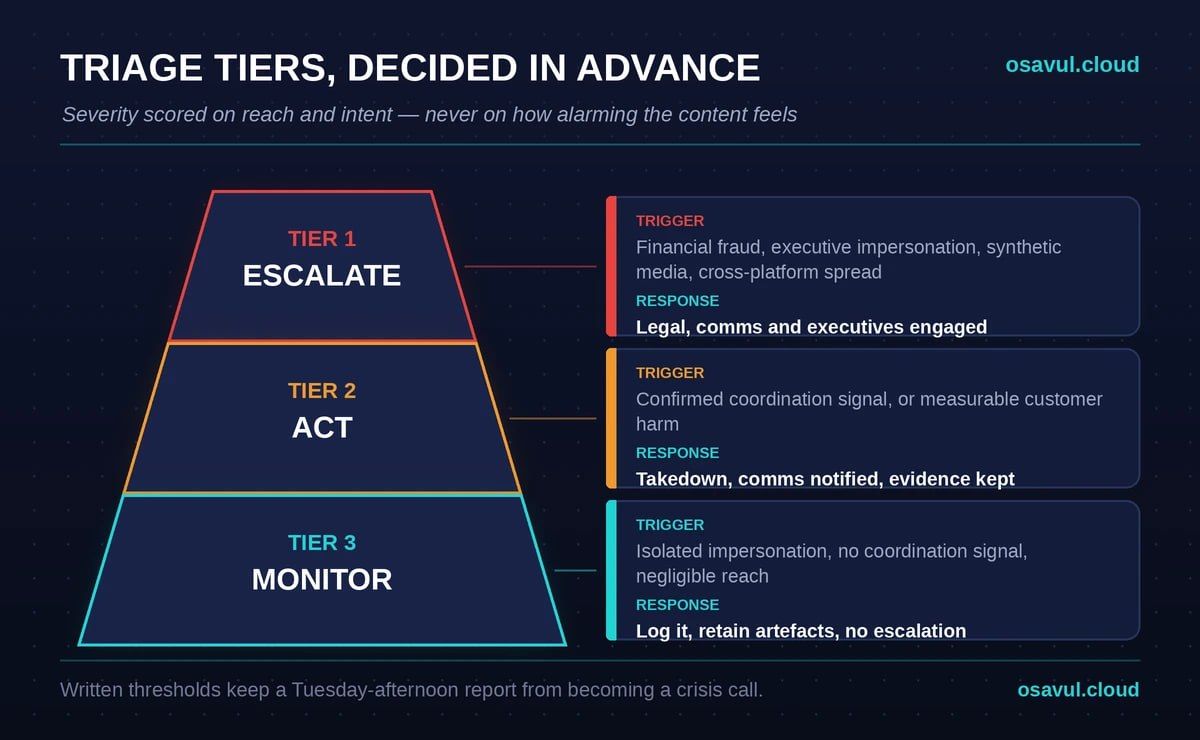
Triage assigns each confirmed case a severity, an owner and a response clock — before the incident, not during it. Define the tiers by reach and intent rather than by how alarming the content feels:
- Tier 3 — Monitor. Isolated impersonation, no coordination signal, negligible reach. Log it, keep the artefacts, no escalation.
- Tier 2 — Act. Confirmed coordination or measurable customer harm. Takedown initiated, comms notified, evidence package opened.
- Tier 1 — Escalate. Financial fraud, executive impersonation, synthetic media, or cross-platform spread. Legal, comms and executives engaged inside a defined window.
Attribution sits inside triage. Naming a state actor you can't defend in writing is worse than "unattributed, infrastructure consistent with prior activity."
Layer 5: Response, Takedown, and Counter-Messaging
Response is the set of actions taken to disrupt an operation: takedowns, registrar complaints, customer notifications, public correction — and sometimes nothing at all, the underused option, because answering a low-reach fabrication introduces it to an audience that never saw it.
Respond to the substance, never to the account. Arguing with an inauthentic network is how a small operation gets the reach it was engineered to want.
Where the Signals Live: Channel-by-Channel Priorities
Prioritise channels by where attacks originate rather than where they trend. The origin channel holds both the evidence and the early warning.
Telegram and the Closed-Channel Problem
Telegram matters because it's where a large share of coordinated operations are staged before surfacing anywhere public: semi-closed groups, forwarding at scale, and a moderation posture slow enough that operators treat it as reliable infrastructure.
The staging pattern is consistent — built and tested in a small channel, forwarded through aggregators, then pushed onto open platforms once the phrasing settles. A team watching only X and Instagram sees step three. A team with Telegram coverage sees step one and gains a day, usually the difference between disruption and cleanup. We covered the collection mechanics in our guide to Telegram threat intelligence for brand monitoring.
Short-Form Video and the Speed of Escalation
Short-form video compresses the timeline between a fabricated claim and mass exposure to a few hours, because distribution is algorithmic rather than follower-based. An account with eleven followers can reach two million people, which breaks every heuristic built around audience size.
On X, a post from a low-follower account is usually safe to monitor. On TikTok it's a coin flip. Score severity on velocity and first-hour engagement rate, not on the poster's reach — a distinction we unpack in the brand manager's guide to TikTok threats.
Search, Domains, and the Long Tail of Typosquatting
Domain impersonation is the most automatable part of the attack surface, so it should be the most automated part of your monitoring. Certificate transparency logs and registration feeds surface lookalike domains within hours of creation, often before content is hosted. Watch the standard permutation set: character substitution, homoglyphs, hyphen insertion, service words like -support or -login, alternate TLDs. CISA's guidance on spoofed sites and phishing is a fair baseline for what your customers are told to look for. Most lookalikes never get used; the ones that do activate weeks later, and the registration record is your only early warning.
Building the Program: People, Cadence, Tooling
Settle three things before any tool gets purchased: who owns each decision, how often the work happens, and what the tooling is for. Buy first and organise later, and you end up with an expensive feed nobody reads.
Who Owns What
Ownership disputes are the most common reason a detected threat sits untouched for days. Write it down once and put it where the on-call analyst can find it at 11pm.
| Responsible | |||
| Asset inventory upkeep | Brand / Marketing ops | CISO | Legal, regional teams |
| Threat intelligence | |||
| Threat intelligence | |||
| Takedown execution | Legal / Trust & Safety | General Counsel | Threat intelligence |
| Public response | Communications | CCO | Legal, TI |
| Program metrics | Brand protection lead | CISO | Finance |
Legal is accountable for takedowns and consulted on analysis — not the reverse. Invert it and you get lawyers doing pattern recognition and analysts drafting notices, both below their actual ability. On cadence: continuous collection, daily triage, weekly pattern review, quarterly inventory refresh.
Selecting Brand Protection Software Without Buying a Dashboard
Brand protection software should be evaluated on what it can prove about coordination, not on how many sources it claims to cover. Source counts are marketing arithmetic. Ten platforms with metadata beat two hundred with scraped text. The demo trick we suggest: hand the vendor the date range of a campaign that actually hit you and ask what their platform would have surfaced, and when.
Evaluation Checklist
- Closed-channel coverage. Telegram and comparable channels, or only platforms with public APIs?
- Metadata retention. Are creation dates, timestamps and media hashes queryable, or discarded after scoring?
- Inspectable coordination logic. Can an analyst see why a cluster scored high, or is it an opaque number?
- Historical depth. Can you query backwards past the contract start date?
Evidence export. Can legal attach its output to a notice without rebuilding it by hand?
Osavul built its platform around the first and third points specifically, because those two quietly determine whether a digital brand protection program detects operations early or explains them afterwards.
Measuring a Brand Protection Program
Measure detection speed and disruption outcomes, not activity volume. A program reporting "4,200 threats detected" has told you nothing — that number rises when the internet gets noisier and when your filters get sloppier, and you can't tell which from outside.
Metrics That Survive a Board Review
| What it proves | ||
| Time to detection | Collection coverage is adequate | Backdating to the first automated hit, not the first validated one |
| Response paths work | ||
| The program is preventive, not reactive | ||
| Repeat-infrastructure rate | Attribution work compounds | Not tracked at all, which is the usual answer |
That last one is the most underrated measurement here. If it's climbing, your retained evidence is paying off. Near zero after a year means either genuinely novel adversaries every month, or that you aren't keeping anything.
The Two Numbers Most Teams Get Wrong
Takedown volume measures how much your adversary produced, not how well you defended. A quarter with 900 takedowns and one with 300 could describe an improving program or a collapsing one. Report it as context, never as performance.
Sentiment is worse, because it moves for reasons unrelated to security — we've watched a team praised for a recovery caused by a product launch, then blamed for a dip no attack produced. Report speed and disruption; let communications own perception.
Common Failure Modes We See in Audits
Most underperforming programs fail in one of four predictable ways, none of them budget problems.
- The orphaned function. It reports to marketing, so it gets marketing tooling and marketing metrics — and the first genuinely coordinated attack arrives with nobody trained to recognise it.
- Collection that stops at the API boundary. Everything with a public feed is monitored, nothing without one. Campaigns get caught, always at the point where they were already public.
- Evidence that evaporates. Artefacts get screenshotted for the takedown notice and nothing else is kept. Six months later the same operator returns and looks brand new.
- Response as reflex. Every fabrication gets a public rebuttal, including the ones with 400 views, and the corrections outreach the originals.
One pattern connects all four: the program was built to react well rather than to see early. Reaction is measurable and feels like control. Seeing early is quieter, harder to demonstrate, and worth considerably more.
Frequently Asked Questions
What is brand protection, in one sentence?
Brand protection is the ongoing work of detecting and disrupting unauthorised use of a company's identity — impersonation, counterfeiting, coordinated narrative attacks — across every channel where that identity can be copied. Trademark law tells you what you own; this tells you who's using it right now, without asking.
How is brand protection different from cybersecurity?
Cybersecurity defends assets you control. Brand protection defends an identity living almost entirely on infrastructure you don't.
You can patch your own servers. You cannot patch a Telegram channel. So the toolset drifts toward OSINT collection, media forensics and network analysis, and the discipline lands closer to cognitive security than to traditional infosec. Same reporting line, different physics.
How much does a brand protection program cost to run?
Most of your first-year cost sits in people and process, not licensing — typically one to two dedicated analysts, a monitoring platform, and legal support with an agreed response path. The platform is usually the cheapest of the three.
The mistake we see constantly is inverting it: buy the tool, hand it to someone already at capacity, and a year later the tool takes the fall for a staffing decision.
Can AI detect brand impersonation before it goes viral?
Yes — when it's reading behaviour instead of content. Clustering accounts by creation date, posting rhythm and media reuse routinely surfaces coordinated impersonation hours ahead of any engagement spike, because the coordination sits in the metadata from the very first post. Content-based detection is much weaker: by the time a claim is phrased well enough to travel, the model reads the same sentence a human would. AI shrinks the search space; the call at the end is still a person's.
When should a brand respond publicly instead of quietly removing content?
Respond publicly only once the false claim is reaching people whose decisions affect you — customers, regulators, partners, your own staff. Below that line, a public correction is free distribution you handed to the attacker.
Three questions settle it. Has it crossed from inauthentic accounts into organic sharing? Has any outlet or official body touched it? Is the silence being read as confirmation by anyone who matters?
Where to Start This Quarter
Building from nothing? Do the inventory first — one week, and it makes every later decision cheaper. A realistic ninety-day sequence:
- Weeks 1–2. Rebuild the asset inventory: every domain, profile, channel, app listing, authorised reseller and executive account. Assign an owner and a refresh date.
- Weeks 3–6. Close the collection gap. Whatever your coverage is now, the hole is almost certainly in closed channels.
- Weeks 7–9. Write the escalation tiers and get them signed off by legal and comms while nothing is on fire.
- Weeks 10–12. Run a tabletop on a real past incident — a campaign that actually hit you, replayed against the new process.
That last exercise is uncomfortable, which is the point — teams routinely find their detection was six days behind what they'd assumed. None of this needs a large budget. It needs someone to decide the function exists, give it an owner, and accept that the measurement that matters is how early you see things rather than how loudly you react. Our walkthrough on how to protect your brand online covers the tactical layer if you want a checklist for whoever picks this up.
The teams that do well share one habit: they treat every impersonation account, every fabricated screenshot, every seeded post as evidence about an adversary rather than as a mess to be cleaned. Over a year that compounds into something close to prediction.