Nobody announces that their social media monitoring has stopped working. It just goes quiet. The dashboard still loads, the mention counter still climbs, and buried somewhere in that number is the thing that becomes a press inquiry on Thursday morning.
Last spring we sat with a comms team reviewing a three-day spike their platform had faithfully logged. About 900 posts, nearly all critical, all neatly tagged “negative sentiment.” What the tool never showed them: 61 of those accounts had registered inside the same week, and roughly a third were recycling one Telegram post that had been machine-translated twice on its way to X. On the volume chart it looked like customer backlash. It was not customer backlash.
That gap is what this guide is about. What a monitoring program should see, how the pipeline behind it works, which signals earn an out-of-hours phone call, and how to pressure-test a vendor before the contract gets signed.
What is social media monitoring?
Social media monitoring is the continuous collection, filtering, and analysis of public posts, accounts, and engagement behavior across social platforms in order to detect events, threats, and shifts in public opinion while there is still time to act on them.
Read that twice and the operative phrase is still time to act. Collection itself is a solved problem — you can buy it by the terabyte from a dozen data resellers. What decides whether a program works is the funnel sitting after collection, and whether anything survives that funnel in a shape a tired analyst will actually open at 6 a.m.
There’s also a quiet disagreement baked into the term. Marketing teams say social media monitoring and mean measuring how people feel. Security teams say it and mean catching who is coordinating. Same raw posts. Only the second reading needs account registration dates, posting cadence, and cross-platform repost chains — precisely the fields most marketing-built platforms throw away to keep storage costs down.
Social media monitoring vs. social listening
Social media monitoring tracks specific real-time events and actors, while social listening measures broad sentiment themes over longer periods. Monitoring asks what is happening and who is pushing it. Listening asks what your audience believes about you this quarter.
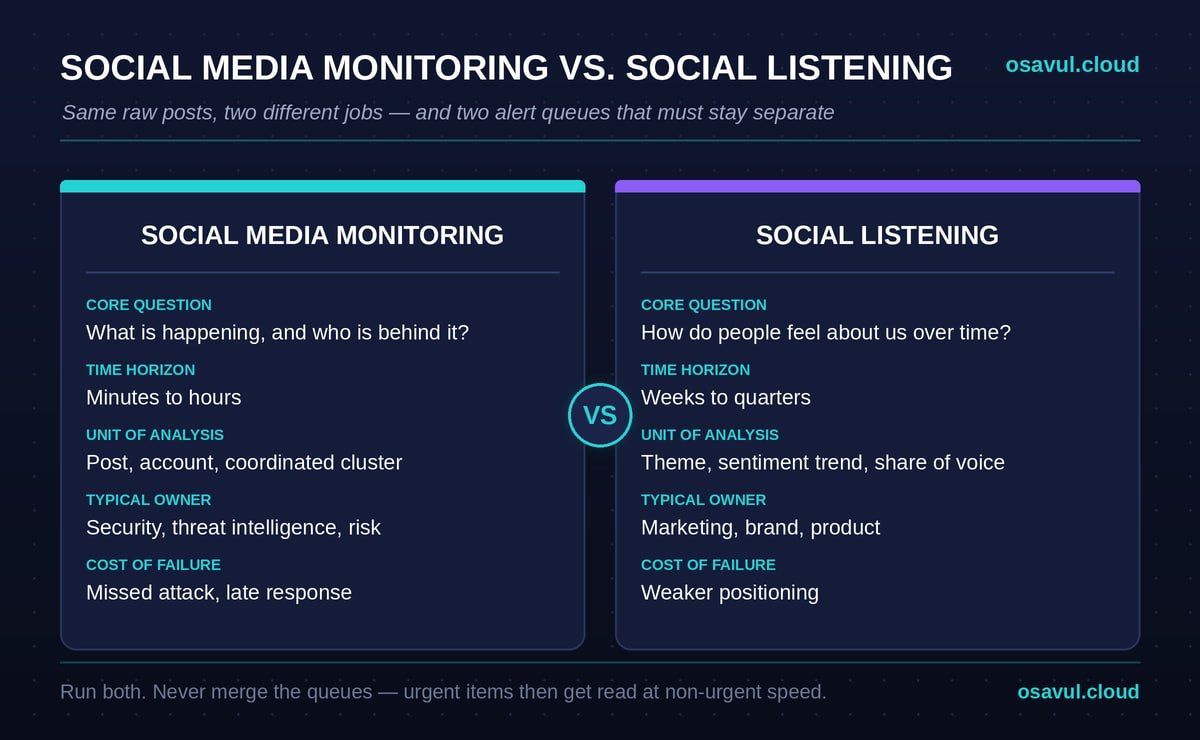
| Dimension | Social media monitoring | |
| Core question | What is happening, and who is behind it? | How do people feel about us over time? |
| Time horizon | Minutes to hours | |
| Unit of analysis | Post, account, coordinated cluster | |
| Typical owner | Security, threat intelligence, risk | Marketing, brand, product |
| Cost of failure | Missed attack, late response | Weaker positioning |
Most organizations run both already and haven’t noticed they merged the alert queues. That’s how complaints about shipping delays and a seeded narrative about product safety land in one inbox, sorted by volume, triaged by whoever is on shift. We pulled the two apart in more detail when mapping what monitoring actually returns to a business day to day.
Where SOCMINT sits in the intelligence stack
Social media intelligence (SOCMINT) is the OSINT subdiscipline focused on data produced by social platforms — posts, profiles, networks, engagement patterns. Social media monitoring is the collection layer feeding it. SOCMINT is the analytical layer that turns raw observations into an assessed finding someone will sign their name to.
Be blunt about this during procurement. A tool streaming keyword hits has sold you monitoring, full stop. Attribution, network mapping, and media forensics are analyst work resting on tradecraft and a documented source model — the distinction we walked through in OSINT vs. traditional monitoring.
Why social media monitoring moved out of the marketing team
Social media monitoring became a security function because the incidents it catches now carry balance-sheet consequences: coordinated narrative campaigns, fabricated executive statements, and manufactured outrage built specifically to move a procurement decision, a share price, or a regulator’s attention.
For most of the 2010s this was reputational housekeeping. Somebody watched the mentions, escalated the loud ones, and drafted a reply. The assumption underneath — that a spike in criticism reflects real people reacting to something real — held up well enough that nobody stress-tested it.
Three things broke that assumption more or less at once. Generating a thousand plausible posts in six languages stopped costing anything. Seeding moved to closed and semi-closed channels first, then surfaced on open platforms already looking organic, which is why Telegram-origin content keeps arriving on X and TikTok with its provenance sanded off. And engagement itself became rentable — by the account, by the hour, by the region. Detection stopped being a language problem and became a behavioral one.
The regulatory side moved in the same direction. Very large platforms now assess and report systemic risk under Articles 34–35 of the EU’s Digital Services Act, and the EEAS threat reports on foreign information manipulation and interference document the tactics in a way risk committees can cite without a translation layer. Boards ask about this now. They did not five years ago.
Here’s the practical tell that an organization has finished the transition: look at who gets paged. If a coordinated cluster hits at 11 p.m. and the alert goes to a social media manager with no authority to open an incident, the program is still a marketing asset wearing security vocabulary. When it goes to a duty analyst who can pull account histories, cross-check a Telegram origin, and brief legal before the morning, the transition is real.
Getting there is mostly organizational, not technical — the same conclusion we reached working through how brands absorb and answer information attacks.
What social media monitoring detects
Social media monitoring detects three things a security team can act on: coordinated inauthentic behavior, narrative attacks aimed at a specific target, and sentiment inflections that arrive before a crisis does. Everything else the platform shows you is context — useful for a weekly report, not for a decision.
Coordinated inauthentic behavior and botnet activity
Coordinated inauthentic behavior (CIB) is activity where multiple accounts, operated or automated by one actor, present themselves as independent voices to manufacture the appearance of consensus. It is detected through behavior, not content — the posts themselves often read perfectly normal.
The cheapest reliable tell is timing. Real outrage builds in an uneven curve, with pauses, sleep cycles, and time-zone gaps. Rented amplification arrives in blocks: forty accounts inside eleven minutes, then nothing for six hours, then another block. Add account registration clustering, near-duplicate text with the emoji shuffled, shared link shorteners, and heavy follower-graph overlap, and you have a case worth escalating.
None of these signals is conclusive alone. Two accounts created the same day means nothing. Two hundred created the same week, posting the identical claim inside one hour, using three shortener domains registered to the same host — that’s a finding. The scoring logic behind that judgment is the part we’ve broken down separately in how bot detection actually works.
Narrative attacks on brands and institutions
A narrative attack is a deliberate campaign that attaches a damaging claim to a target and pushes it until the claim becomes the default explanation for something. It differs from criticism in having three components: a specific claim, a carrier network, and a target asset — a product, a funding round, a person, a contract.
Criticism says your delivery is slow. A narrative attack says your delivery is slow because the company quietly moved operations offshore and is hiding it, then supplies four screenshots that look like evidence. The first needs a customer service answer. The second needs verification, provenance work, and a decision about whether responding publicly feeds the reach.
Short-form video has made this considerably harder, since the claim and the “evidence” arrive fused in one fifteen-second clip that survives being re-uploaded without its source — the mechanics we traced through narrative attacks against brands on TikTok.
Sentiment inflection before a crisis breaks
Sentiment inflection is a sharp directional change in how audiences discuss one specific attribute of an organization, which typically precedes the visible crisis by days. Catching it requires aspect-based sentiment analysis rather than a single polarity score.
Aggregate sentiment is a blunt instrument and it lies by averaging. We’ve reviewed dashboards showing a stable overall score while sentiment on one attribute — product safety, in that case — had gone from neutral to strongly negative over nine days. Volume was too small to move the average. It was also the exact thread a journalist pulled two weeks later.
Signal-to-owner reference
| Observed signal | What it usually indicates | |
| 40+ accounts under 30 days old posting one claim within an hour | Coordinated inauthentic behavior | Threat intel / duty analyst |
| Reach spikes while unique author count stays flat | Amplification without adoption | |
| Aspect sentiment collapses on one attribute only | A real product or safety issue surfacing | |
| Fabricated executive quote or doctored screenshot | Impersonation or forgery | Legal + security |
| Closed-channel content appearing on open platforms | Laundering chain already in motion | Threat intel — escalate |
Use this table to settle the ownership argument before an incident, not during one. Teams that pre-assign the first move consistently cut hours off their response, and the failure pattern when they don’t is depressingly consistent across the social media attack types we see most often.
How social media monitoring works: the five-stage loop
Social media monitoring works as a five-stage loop — collection, enrichment, detection, verification, response — where the output of the final stage rewrites the rules governing the first. Programs that skip the return path decay within a quarter, no matter how good the tooling was on day one.
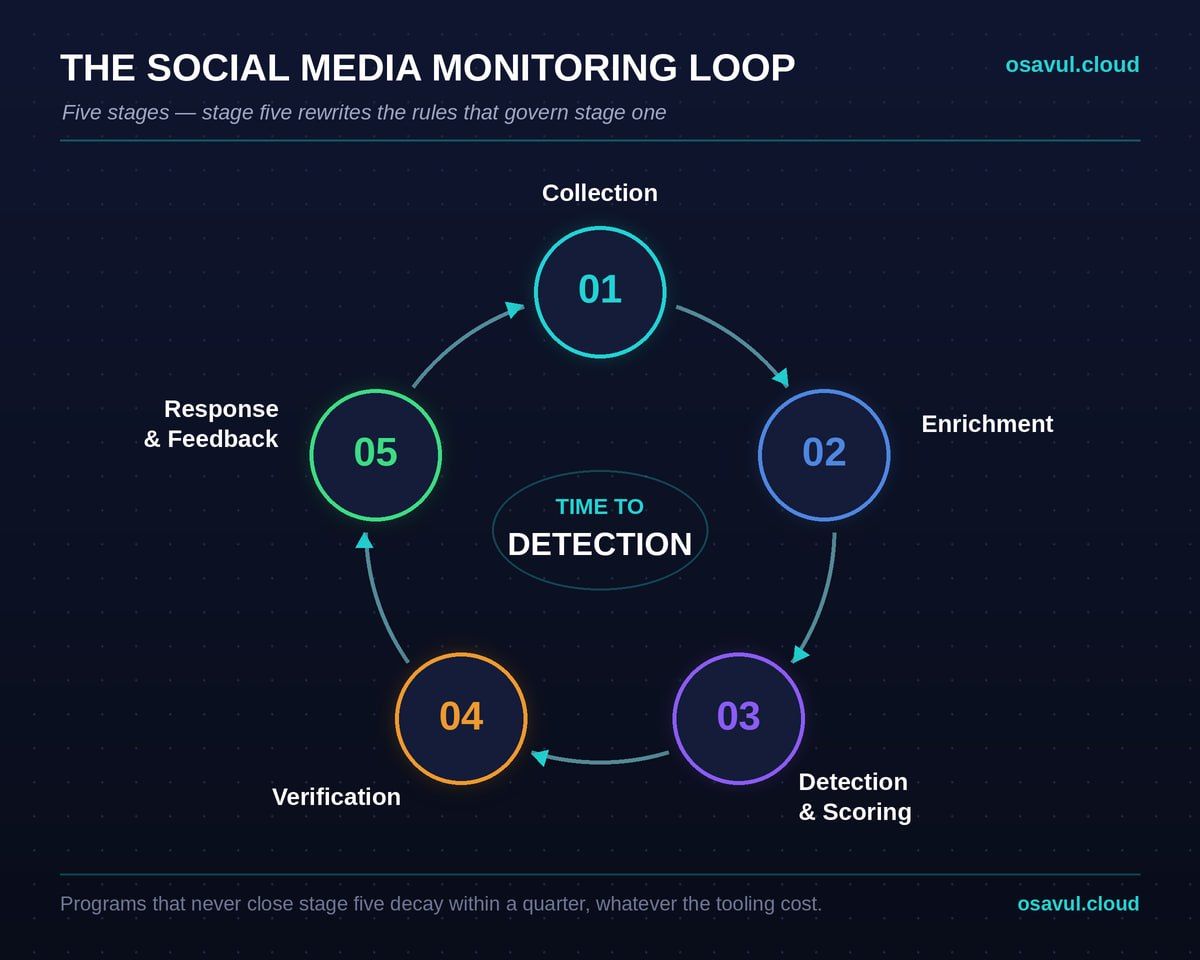
1. Collection. Platform APIs, licensed data feeds, crawlers, and access to closed or semi-closed channels. Every coverage decision made here becomes a blind spot later, and almost nobody revisits the list after procurement. Ask which platforms your current setup does not cover. The answer is usually longer than expected.
2. Enrichment. Raw posts get language identification, translation, entity extraction, deduplication, and account metadata — registration date, posting cadence, device fingerprint where available. Then near-duplicates collapse into clusters, and clusters get grouped into narratives. Vendors differ most here and demo this least. Push on it.
3. Detection and scoring. Rules catch the known patterns; models catch the shape of the unknown ones. A workable score combines three axes: coordination evidence, reach velocity relative to baseline, and proximity to a protected asset. A cluster scoring high on all three is an alert. High on one is a note in the log.
4. Verification. A human establishes provenance — earliest occurrence, original language, reverse image results, the cross-platform chain from closed channel to open feed. This stage cannot be automated away, and every serious social media monitoring and analysis workflow budgets analyst hours for it explicitly. Automated systems produce candidates. Analysts produce findings.
5. Response and feedback. Brief the owner from the table above, decide whether public response helps or feeds reach, then push the labeled outcome back into detection. Confirmed campaigns and confirmed false positives are both training data. Teams that log only the confirmed attacks build detectors that see attacks everywhere.
The loop is what separates a monitoring program from a subscription. We’ve watched well-resourced teams run stages one through four flawlessly for eight months and never close stage five — by month nine their analysts were ignoring roughly 70% of alerts by reflex, which is precisely the decay pattern described in our notes on early-warning information monitoring.
Designing queries that don’t drown your analysts
Query design fails in exactly two directions. Too broad and the queue fills with noise until people stop reading it. Too narrow and the campaign that actually matters arrives using vocabulary nobody thought to list. Both failures look identical in a monthly report — alert volume is fine, detection is not.
Start with priority intelligence requirements, not keywords
Write the questions leadership will ask during an incident first, then build queries that answer those questions. Keyword lists assembled without that anchor grow past three hundred terms within a year and quietly stop being maintained.
Good priority intelligence requirements are uncomfortably specific. Is anyone claiming our product caused physical harm? Is a state-linked outlet naming our contracts or our customers? Are our executives being impersonated on video? Each of those implies a different query tier — asset terms, claim terms, actor terms — and a different escalation path.
One trap worth naming: monitoring only the brand name. Early-stage campaigns often avoid it deliberately, working through product names, deliberate misspellings, hashtags, and phrases like “that logistics company everyone uses.” By the time your brand name appears in volume, the claim has already found its audience. Effective social media threat monitoring watches the claim, not just the label.
The platform blind spot: Telegram, TikTok, and fringe forums
Most programs cover X, Facebook, Instagram, and LinkedIn well, and cover the places campaigns actually originate badly. That list includes Telegram channels, TikTok comment sections, Discord servers, regional platforms, and a rotating set of fringe forums.
TikTok deserves a specific note. Teams monitor captions and ignore comments, where the sharper claims usually live and where coordination is easiest to spot because the same eleven accounts appear under every upload. Regional coverage has the same shape — a campaign targeting a European operation may run three weeks in Russian-language channels before a single English post exists.
Here’s a measurement worth running once: pick three past incidents, find the earliest closed-channel appearance, and compare it to when your platform first flagged anything. The gap is your real warning window, and for most organizations we’ve done this with, it runs from several hours to several days. That window is the entire value proposition of monitoring closed channels properly, which is why we keep returning to Telegram monitoring as an OSINT discipline rather than as a checkbox.
Choosing social media monitoring tools and platforms
Evaluate social media monitoring tools on what they retain and expose, not on how the dashboard looks. Every platform demos well. The differences surface at 2 a.m., when an analyst needs account registration histories for sixty profiles and the export button produces a PDF of screenshots.
Run the demo against a past incident of your own rather than the vendor’s sample dataset. Hand them a date range and a claim, and ask them to reconstruct it. Vendors who can do this say yes immediately.
Eight criteria that separate social media monitoring software
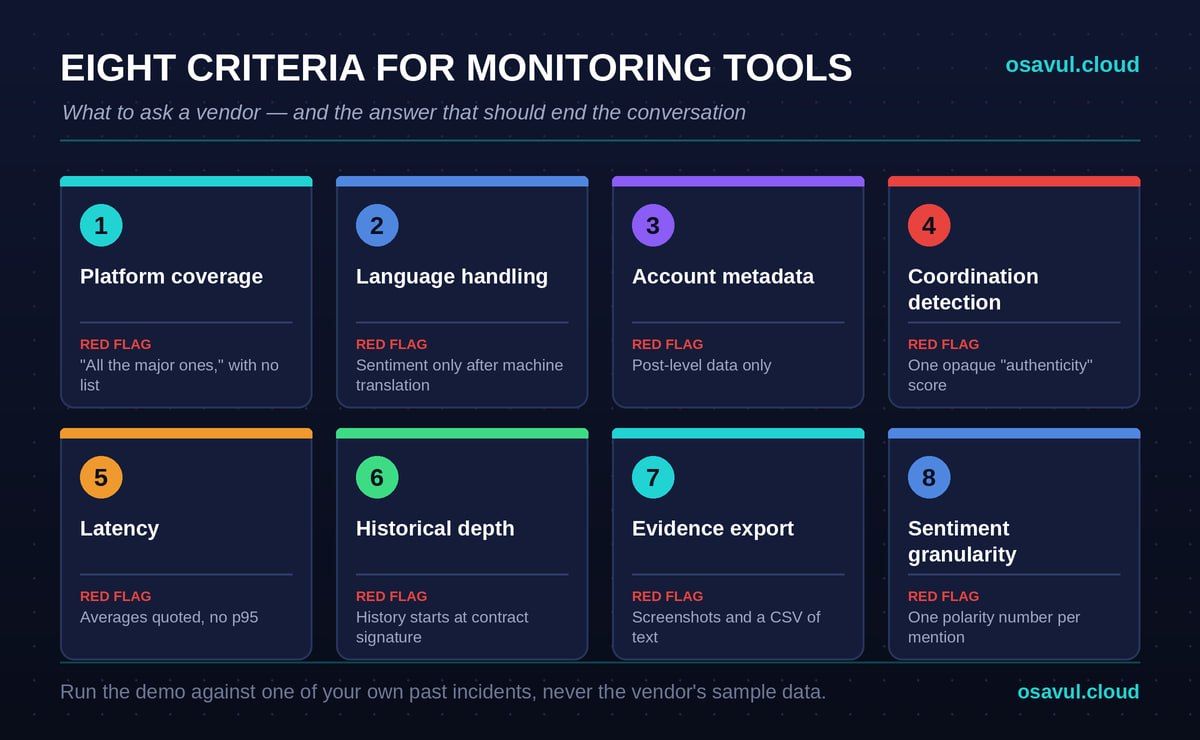
| Criterion | The question to ask | |
| Platform coverage | Which platforms and regions are included, and which are explicitly excluded? | “All the major ones,” with no list |
| Language handling | Is analysis native-language, or translate-then-analyze? | |
| Account metadata | Can I see registration date, posting cadence, follower overlap? | |
| Coordination detection | Which features drive the score, and can I inspect them per cluster? | One opaque “authenticity” percentage |
| Latency | Post-to-alert time at p95, not average? | Averages quoted, percentiles unavailable |
| Historical depth | How far back can I query a keyword I add today? | History starts on contract signature |
| Evidence export | Can I export timestamps, URLs, and archived copies for legal? | Screenshots and CSV of text |
| Sentiment granularity | Aspect-based, or a single polarity score per mention? | One number per mention |
The historical depth line catches more teams than any other. A campaign discovered on Tuesday usually started three weeks earlier, and a social media monitoring platform that only holds data from the moment you added the keyword cannot reconstruct the origin — which means no attribution, no pattern match against previous incidents, and a report that says “we first observed.”
Where free social media monitoring tools stop being enough
Free tools handle awareness and stop at attribution. They will tell you a term is trending and roughly how people feel about it, which is genuinely useful for a small team with no budget and no adversary.
They break on the things that matter during an incident: closed-channel coverage, account-level history, native analysis across languages, retention beyond a few weeks, and evidence export that survives a legal review. Rate limits also tend to bite precisely when volume spikes — the one moment you need the data.
The buy-versus-build question resolves on analyst headcount more often than on money. Organizations with two or fewer dedicated analysts get more from managed social media monitoring services than from a self-operated platform they lack the hours to tune. We split our own work along the same seam, building Nebula around coordination and narrative detection and Echo around aspect-level sentiment across languages, because those two jobs need different data retained and different questions asked of it.
Metrics that prove the program works
Measure social media monitoring on four numbers: time to detection, verified-to-noise ratio, retrospective coverage, and reach at the moment of intervention. Mention volume is not a metric. It is a description of the internet.
Time to detection. Hours between the first observable post and the alert reaching a human who can act. Track p50 and p90 separately, because the tail is where incidents live. This is the single number executives understand without a briefing, and the only one worth putting on a board slide.
Verified-to-noise ratio. The share of escalated alerts confirmed as real findings. Below roughly 20%, analysts start closing the queue by reflex and your detection quality no longer matters. Above 80%, tuning is probably too tight and quieter campaigns are passing through unseen.
Retrospective coverage. Once a quarter, replay your last four incidents through the current configuration. How many would today’s setup have caught, and how many days earlier? This exercise is unpleasant and worth every hour it costs — it’s the same audit logic we apply when reviewing media monitoring programs end to end.
Reach at intervention. Cumulative reach when you acted, as a fraction of the campaign’s eventual total. Teams consistently acting after 60–70% of reach has accumulated are performing response, not conducting it.
Three numbers to stop reporting: raw mention counts, aggregate sentiment averages, and share of voice. All three move for reasons unrelated to threat, and all three have been used to declare social media reputation monitoring healthy the week before it visibly wasn’t.
Four failure modes we see in the field
Most social media monitoring programs fail for organizational reasons rather than technical ones. These four account for the large majority of what we encounter during reviews.
The unowned queue. Detection works, alerts fire, and no one holds the authority to open an incident. Alerts accumulate, someone eventually reads them in a Monday summary, and the program’s real function becomes documenting what already happened. The fix costs nothing and takes one meeting: name a duty owner per signal class and give that person escalation rights.
Answering amplification as though it were adoption. A cluster of forty rented accounts pushes a claim. The brand issues a public statement. The statement carries the claim to an audience that had never seen it, and the campaign’s reach multiplies at zero cost to the operator. Verify who is actually carrying a claim before deciding whether silence beats a response — the calculus differs completely across the social media threats that hide inside normal-looking engagement.
English-only detection inside a multilingual exposure. A company with operations in eleven countries monitoring in two languages has not built coverage, it has built a sample. Campaigns targeting a regional subsidiary run in the regional language for weeks, and headquarters learns about them from a journalist who reads that language.
Removing the bots and declaring the incident closed. Takedowns eliminate carriers. They do not retract a claim that real people have already adopted, and after roughly seventy-two hours the sincere believers usually outnumber the paid accounts. At that point it stops being an inauthenticity problem and becomes a correction problem with a different playbook — which is why the distinction between misinformation and disinformation is operational, not academic.
None of these is exotic. All four are visible in a thirty-minute conversation with the team running the queue, which is usually where we start.
Frequently Asked Questions
What’s the difference between social media monitoring and social listening?
Social media monitoring is real-time and event-driven; social listening is periodic and theme-driven. Monitoring exists to catch a specific thing happening now, with actors attached. Listening exists to describe how sentiment moves over months.
The practical consequence is scheduling. Monitoring output needs an owner on shift. Listening output needs a slot in a quarterly review. Most vendors sell social media listening and monitoring under one contract, which is fine — merging the two alert queues is not, because it guarantees the urgent items get read at the pace of the non-urgent ones.
Is social media monitoring legal under GDPR and the DSA?
Monitoring publicly available posts is generally lawful in the EU when there is a documented legitimate interest, data minimization is applied, and personal data is retained only as long as the purpose requires. The public nature of a post does not by itself remove it from GDPR’s scope.
Two lines to hold: monitor claims and behavior patterns rather than building profiles of private individuals, and document your lawful basis before the program starts rather than after a complaint. Platforms themselves carry heavier obligations under the EU’s Digital Services Act, including systemic risk assessment. Get your counsel’s sign-off on the specifics — jurisdictional detail varies, and this is not legal advice.
How do you separate a coordinated campaign from organic outrage?
Look at behavior, not volume or tone. Organic outrage produces an uneven curve with sleep gaps, varied phrasing, and a wide spread of account ages. Coordinated activity clusters — synchronized posting windows, compressed account registration dates, recycled phrasing, and overlapping follower graphs.
One quick test before escalating: count unique authors against total reach. When reach climbs sharply while unique authors stay flat, you are watching amplification. Government advisories on foreign influence operations, including CISA’s public guidance, describe the same behavioral markers if you need external language for a board memo.
Which platforms should a social media monitoring program cover?
Cover the platforms where your audience is, plus the platforms where campaigns against your sector originate. Those two lists rarely overlap as much as teams assume — the second usually includes Telegram, TikTok comment sections, Discord, regional platforms, and a handful of fringe forums.
Rebuild the list annually. Origin platforms rotate faster than audience platforms do.
How large does the team need to be?
One trained analyst plus a tuned platform covers a mid-sized organization with a single-language exposure. Multilingual, multi-region exposure realistically needs three to five, or a managed service supplying the analyst hours you don’t have internally.
Headcount matters less than authority. One analyst who can escalate directly outperforms four who must route everything through a communications approval chain.
Where to start
Start by measuring what your current setup would have missed, then fix coverage before buying anything. Procurement made before that measurement tends to solve the problem the vendor is good at rather than the one you have.
Days 1–30. Replay your last four incidents through today’s configuration and record how many you’d have caught and how early. Write five priority intelligence requirements in leadership’s own words. Name a duty owner for each signal class in the reference table above.
Days 30–60. Close the largest coverage gap the replay exposed — for most organizations that’s closed channels, one regional language, or TikTok comments. Establish a baseline time to detection at p50 and p90 so later claims of improvement mean something.
Days 60–90. Run one live cluster through all five stages, verification and feedback included. Log the outcome back into detection. Report the change in time to detection, not the change in alert volume.
That sequence matters more than the vendor decision. Teams who map their own blind spots first ask far sharper questions of every social media monitoring platform they evaluate afterward — including ours.
The programs that work are rarely the ones with the best dashboard. They’re the ones where somebody is awake, holds the account histories, and is allowed to make the call.