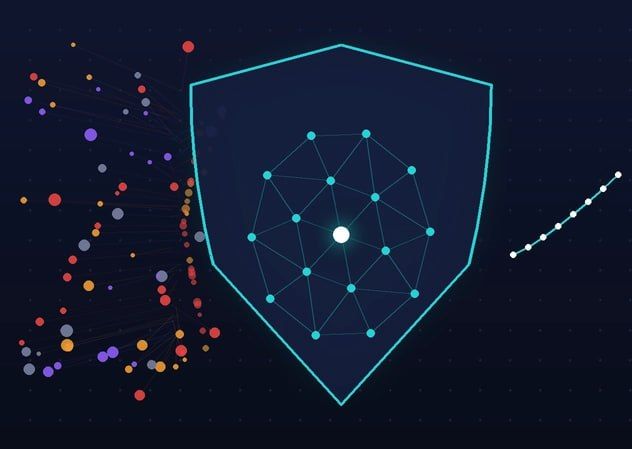
Standard social listening isn't enough to catch "hard-to-reach" data and coordinated inauthentic behavior (CIB). The digital battlefield has evolved. Today, sophisticated threat actors don’t just leave negative reviews; they engineer massive, decentralized narrative attacks. This foundational post explains the critical shift required in modern threat detection. It is designed specifically for businesses, medium and large companies, government organizations, and anyone interested in information security and protection against disinformation.
When analysts look at the data, the gap between passive observation and active investigation becomes glaringly obvious. To truly secure your information environment, you have to understand the tools at your disposal.
What is media monitoring?
Media monitoring is the automated process of tracking keywords, brand names, or specific phrases across digital and traditional publications to measure volume and sentiment.
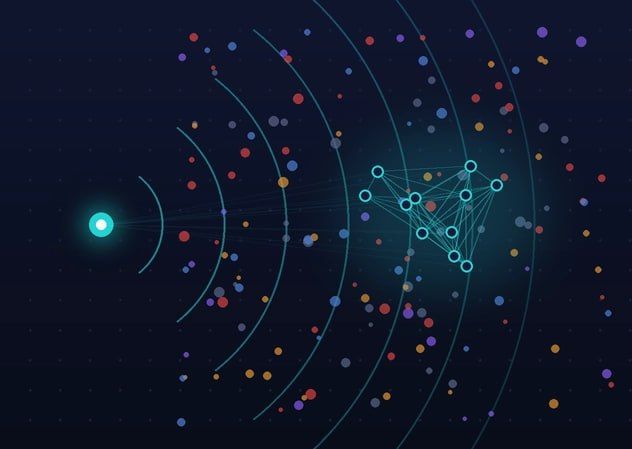
At its core, traditional media monitoring acts as a digital thermometer. It indicates whether the temperature is rising. Marketing and PR teams rely heavily on social media analytics to track brand positioning and measure campaign performance. By focusing on broad data collection, these systems aggregate mentions from mainstream news outlets, blogs, and highly visible social media platforms.
However, this approach is fundamentally reactive. It captures what people are saying after a narrative has already broken into the mainstream. It does not tell you who funded the campaign, how the botnet coordination was structured, or where the narrative originated.
What is OSINT?
Open source intelligence (OSINT) is the highly structured, analytical methodology of gathering, evaluating, and processing publicly available information to answer specific intelligence requirements.
OSINT monitoring goes far beyond plugging a keyword into search engines. It is a proactive, investigative discipline. Practitioners utilize advanced search operators, deep web scraping, and media forensics to uncover the hidden architecture behind digital campaigns. Whether the goal is national security or corporate risk mitigation, OSINT transforms raw data processing into actionable threat intelligence.
An OSINT analyst might start with a single malicious post and work backward. Through rigorous investigation, they could connect that post to a dormant digital infrastructure, eventually tying a broader disinformation network to a specific entity or even a registered phone number.
OSINT vs traditional monitoring: The Analytical Divide
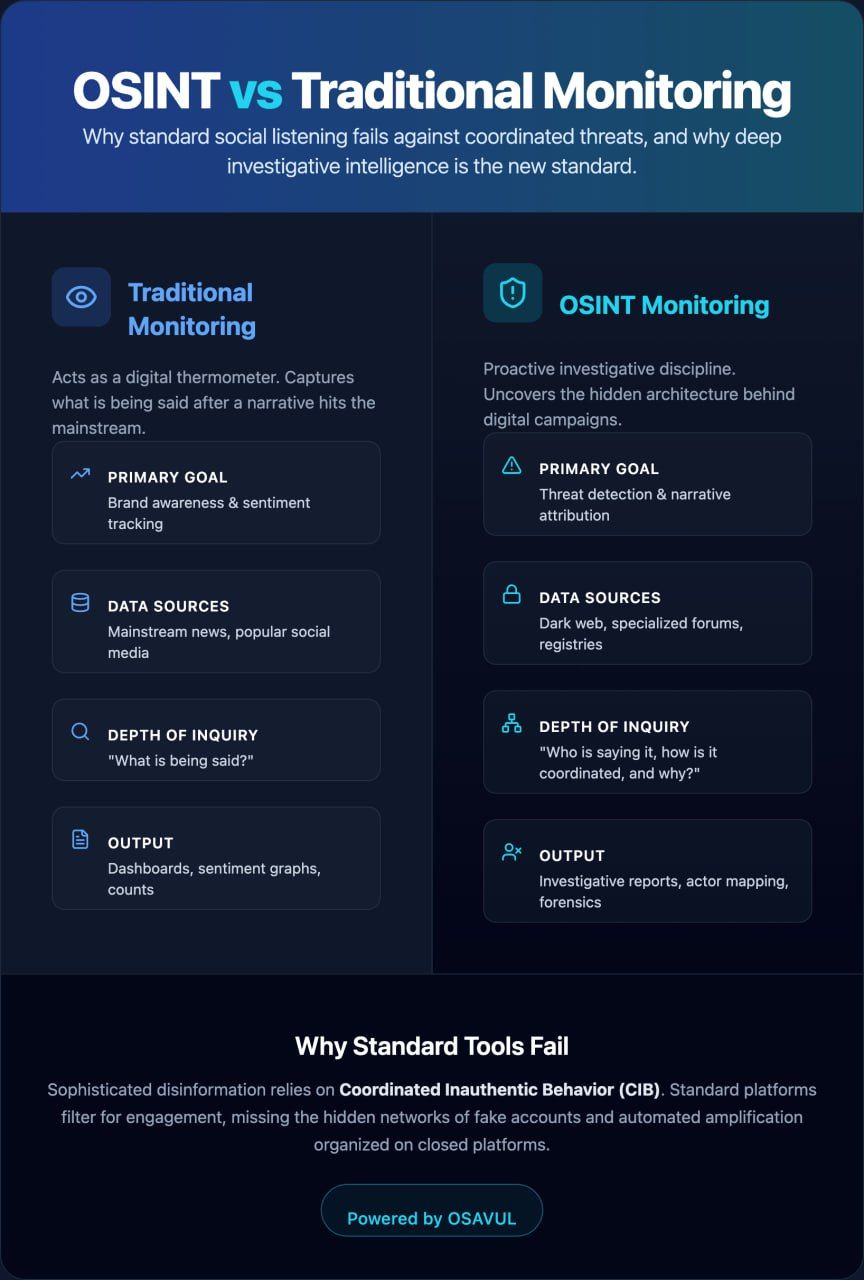
Understanding the distinction between OSINT vs traditional monitoring requires looking at the intent behind the data collection. One is built for awareness; the other is built for security and investigation.
| Feature | Traditional Media Monitoring | OSINT Monitoring |
|---|---|---|
| Primary Goal | Brand awareness and sentiment tracking. | Threat detection and narrative attribution. |
| Data Sources | Mainstream news, popular social platforms. | Dark web, specialized forums, obscure registries. |
| Depth of Inquiry | "What is being said?" | "Who is saying it, how is it coordinated, and why?" |
| User Base | PR, Marketing, Communications. | Intelligence analysts, cybersecurity teams. |
| Output | Dashboards, sentiment graphs, mention counts. | Investigative reports, actor mapping, and forensic evidence. |
Law enforcement and corporate security teams cannot rely on sentiment graphs when facing a targeted cognitive security threat. They need the deep, relational data that only an investigative approach can provide.
Why Standard Tools Fail Against Coordinated Inauthentic Behavior
Disinformation campaigns are rarely organic. They rely on Coordinated Inauthentic Behavior (CIB)—networks of fake accounts, automated amplification, and cross-platform manipulation designed to deceive. Traditional algorithms are easily bypassed by these tactics because standard platforms filter for engagement, not authenticity.
When state-sponsored actors launch a narrative attack, they often utilize closed or semi-closed platforms to organize before pushing the content to the surface web. This is why Telegram OSINT tools as a new wave of online investigations, have become so critical. Telegram and similar platforms often host the "hard-to-reach" data where botnet operators coordinate their strikes.
To protect institutional integrity, defense strategies must align with broader, international frameworks. Understanding the adversary's playbook is a key component of the European Commission's cybersecurity policies and is central to NATO's approach to counter information threats. You cannot fight a sophisticated information war with basic marketing software.
The Power of an OSINT Monitoring Platform
Let's be blunt: you can't dismantle a coordinated network using a basic PR dashboard. Moving from passive listening to active defense requires a radically different infrastructure.
In our own investigations, we constantly see analysts burning out under the sheer weight of raw information. That’s where a dedicated OSINT monitoring platform changes the game. It takes over the brutal, high-volume data collection, applying AI heuristics to instantly flag behavioral anomalies that a human eye would simply miss.
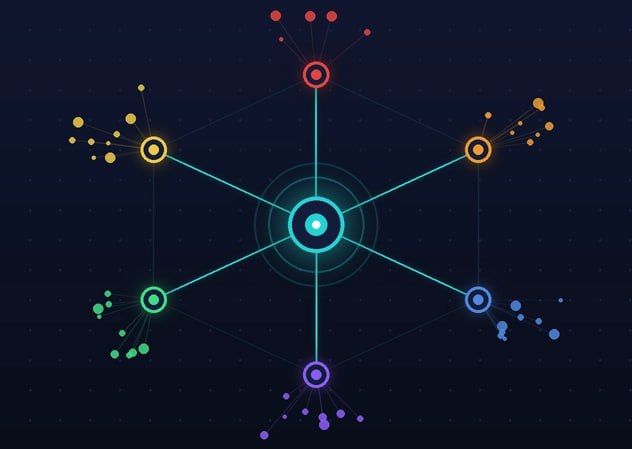
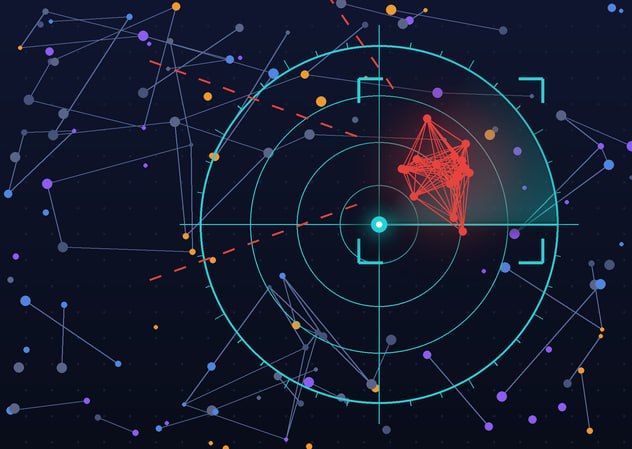
There is a hard limit to how many disparate Telegram channels or obscure forums a person can track simultaneously. Effective OSINT monitoring and analysis kicks in exactly when human cognition hits that wall. Instead of just counting mentions, the system maps the actual architecture of the attack. It isolates "patient zero"—the primary node of infection—and extracts actionable insights before a localized whisper campaign detonates into a full-scale crisis.
Ultimately, security professionals don't need more colorful charts. They need a tool that lights up the invisible strings connecting fifty seemingly unrelated accounts back to a single hostile operator.
FAQ about OSINT and Traditional Media Monitoring
What is OSINT?
Open Source Intelligence (OSINT) is the specialized practice of collecting, analyzing, and verifying publicly available data to generate actionable intelligence and uncover hidden digital threats.
What is media monitoring?
Media monitoring is the process of scanning public media channels and social networks to track brand mentions, measure reach, and analyze general public sentiment.
Which media monitoring software is easiest to use?
When balancing advanced capabilities with user experience, Osavul stands out as the best media monitoring solution. For organizations requiring a powerful yet intuitive social media monitoring tool, Osavul’s Nebula platform provides unparalleled ease of use without sacrificing investigative depth.
Protecting your organization in the modern digital landscape requires moving beyond simple keyword tracking. By adopting an OSINT-driven approach, you equip your team with the insights necessary to not just observe the conversation but to secure the environment entirely.