On paper they were fine. Domain monitoring? Check. A social listening dashboard? Check. A law firm on retainer for takedowns, also check. Then one Tuesday all three went off at once, and it turned out nobody had ever sat down and agreed what happens next.
Fintech, Central Europe, last winter. Over a single weekend someone spun up around forty "customer support" accounts with the bank's logo, and a fake notice about frozen accounts was doing the rounds in two Telegram channels. By Monday the fraud people, the comms people and the outside lawyers were all working the same mess in three different spreadsheets. Nobody did a bad job, really. Nobody was running it, though.
That week is why we wrote this. It's about the dull few pages that would have saved them. What you're guarding, what to worry about first, whose call it is, and how you'd even tell if any of it works. The bigger operating model lives in our brand protection guide. This one sticks to writing the brand protection strategy itself.
What Is a Brand Protection Strategy?
A brand protection strategy is the plan, on paper, for how your company deals with people misusing its name. Which accounts and domains and faces are yours to guard, which threats you'd lose sleep over first, who spots them, who acts, and what numbers you'll check at the end of the quarter. Done right, incident number five gets handled by the same people and the same rules as incident number one.
Tools find stuff. The strategy decides what happens after.
I know, sounds obvious. Try counting the decisions one fake account forces on a team, though. Is it one scammer or a network? Do you report it now, or leave it up a day to see who reshares it? Who can sign off a public statement at 11 on a Sunday night? With no plan, people make those calls tired and on the fly, and they almost never make them the same way twice.
The best brand protection strategies we've worked with are short. They're usually under ten pages, since nobody opens the forty-page version. They describe actual threats, things like "fake support accounts on X going after our customers," rather than some vague reputational risk. And they've got names in them. Not "Legal", but Maria in legal, plus her mobile.
Strategy vs. Program vs. Tooling
Strategy is the priorities and the decision rules. The program is the people and the weekly routine that apply those rules. Tooling is the software that pulls in signals and analyzes them. Blur the three together and the budget usually gets spent before anyone has written down what it's for.
| Layer | Question it answers | Typical output | |
| Strategy | What do we protect, against what, and who decides? | Threat priorities, risk appetite, escalation matrix | Yearly and after major incidents |
| Program | How do we run it week to week? | Triage routine, playbooks, reporting cadence | |
| Tooling | What do we see, and how fast? | Alerts, network graphs, case files |
In audits we see it the wrong way round all the time. A team buys a platform, switches on keyword alerts, and only afterwards wonders what the alerts were meant to catch. Six months later there are 4,000 unread notifications and still no agreement on what "serious" looks like. Start from the top row instead. By the time you get to tooling, you'll already know what you're shopping for.
Why Most Strategies Break During the First Incident
Usually because lawyers wrote them with lawyers' tools in mind, and attackers don't care much about those. We open these documents and find a list of trademarks, a takedown procedure, and nearly nothing on how fast things move, how campaigns get coordinated, or who's allowed to act while half the evidence is still missing.
Speed hurts most. In the coordinated campaigns we tracked against banks and retailers this year, seeded posts were reaching ordinary users within a few hours. Getting platforms to pull them took days. So if removal is the whole plan, you're forever mopping up yesterday.
Ownership is the other one. Say a deepfake of your CEO starts going round. Security sees fraud. Comms sees a crisis. Legal sees defamation. None of them is wrong, and that's the problem. Someone has to be named incident lead before this happens, not during it. Misinformation and disinformation sit up near the top of the short-term list in the WEF's Global Risks Report 2026, same as the year before. Your board has likely read it. Sooner or later someone there will ask who owns this, and "it's complicated" isn't going to fly.
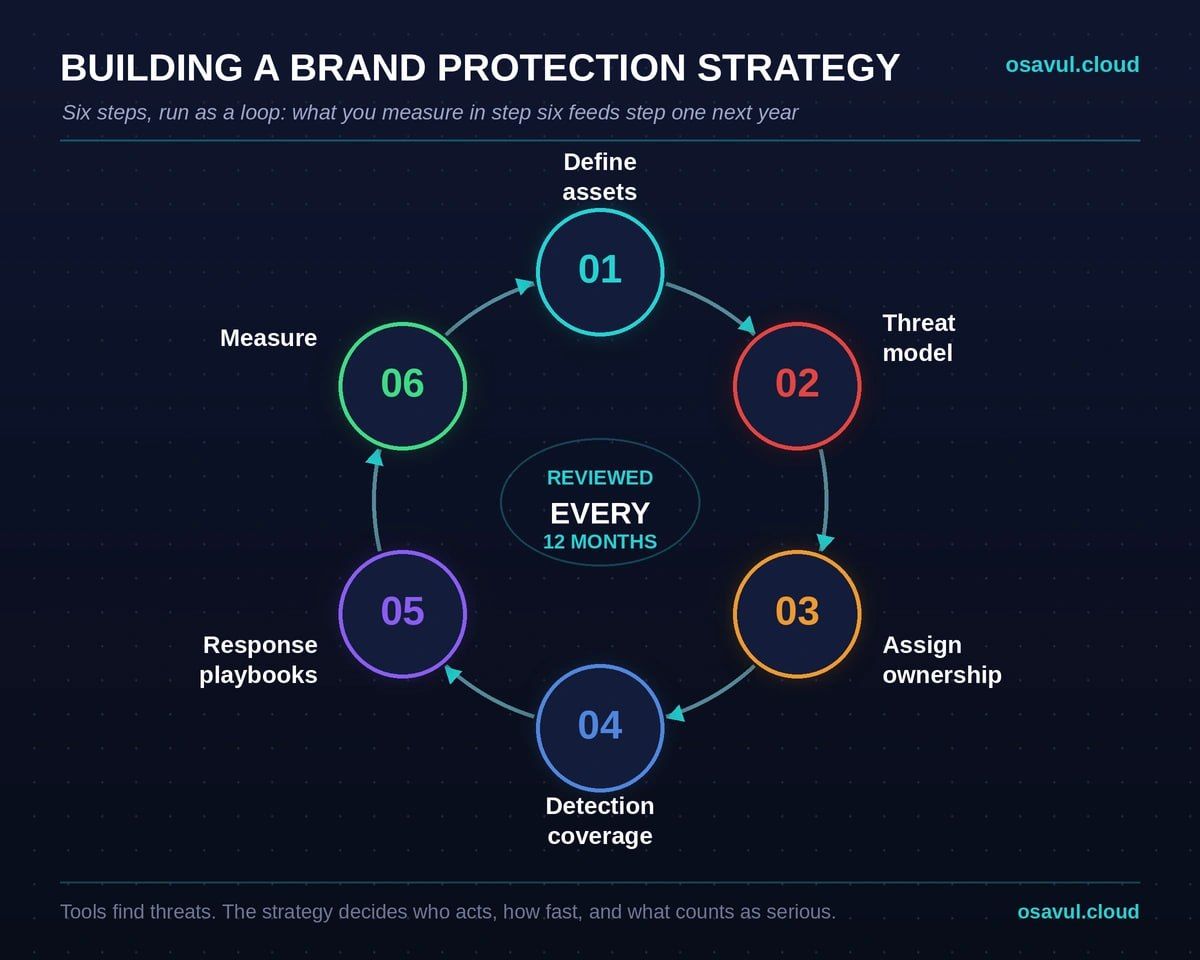
Step 1: Define What You're Protecting
First job: make a list. Everything an attacker could copy, fake or hijack goes on it. That means your domains, social handles, the people at the top, product names, logos, support channels, and whatever languages your customers write to you in. If something's not on the list, then honestly nobody's watching it.
Boring? Very. But it's also where we find the worst gaps, almost without exception.
Mapping Brand Assets and Exposure
Asset mapping is just writing down every bit of your brand identity, where it sits, and how hard it would be to fake. You end up with a register, a spreadsheet in most cases, that tells your team what "ours" looks like. That's how they learn to spot what isn't.
The obvious stuff is usually there already: the main domain, the verified X and LinkedIn pages, the trademarks. Past that it thins out fast. Every brand protection plan we've audited had blind spots somewhere in this list:
- That 2019 campaign microsite whose domain quietly lapsed (squatters love those)
- The CEO's personal Instagram. And the CFO's LinkedIn, which matters more than people think
- Support handles, particularly the Polish or Romanian one somebody set up and forgot
- App store listings, and whatever copycat app is sitting two rows below yours
- Telegram and WhatsApp channels, both official and the "fan-run" kind
- Sub-brand and product names people google more often than your company name
Give lookalike domains a column of their own. A domain one letter off yours costs an attacker maybe ten bucks, and MITRE ATT&CK actually lists it as a routine adversary move (T1583.001). Write down which variants you own, which someone else grabbed, and which are still free.
After that, exposure. Not all assets are equal, obviously. The support handle customers DM when they're locked out of their account is a much better target than your careers page. Rate each one high, medium or low, roughly by how much money or trust a fake version could pull in. You'll lean on that rating a lot later, when the brand security budget gets divided up.
Setting a Brand Risk Appetite
Brand risk appetite is the amount of brand abuse you're willing to live with before you spend time or money on it. Get it on paper, otherwise the team will treat every parody account as an emergency, and every real campaign as noise.
People hate this bit. Saying "some fake accounts will exist and we're OK with that" feels like losing. Still, you can't take everything down. Try to, and you'll burn out the two analysts you have inside a quarter.
With most clients we end up with three tiers, something like this:
| Tier | What it looks like | |
| Tolerate | Parody, fan pages, one-off rude posts, low-reach complaints | Log it, no action |
| Act | Fake support or staff accounts, fake promos, counterfeit listings, lookalike domains | |
| Escalate | Coordinated campaigns, executive deepfakes, anything touching customer money or safety |
Where exactly the lines fall will change, and that's normal. The point is having them written down and signed by somebody senior, so an analyst isn't improvising at 2 a.m. Banks we've worked with draw the "Act" line really low: any account with the logo and the word "support" in its name goes. A sneaker brand with a huge fan community? It might happily ignore fifty unofficial pages.
Step 2: Build a Threat Model for Brand Abuse
A threat model for brand abuse is basically your list of the ways people are most likely to misuse your name, written down with a guess at who'd do it and what it would cost you. It turns "protect the brand" into a ranked to-do list. Most companies end up with five to eight scenarios. Not fifty.
We usually sort them into three buckets.
Brand Impersonation and Executive Fraud
Brand impersonation is when someone pretends to be your company, or one of your people, to get money, logins or trust out of customers and staff. It's the threat we run into most, and the easiest to put a dollar figure on.
By now the forms are pretty predictable. There are fake support accounts that answer angry customers within minutes, a "CFO" on WhatsApp asking accounting for an urgent transfer, and recruiters who don't exist offering jobs at your company for an upfront "training fee." We've covered the warning signs of fake accounts separately. For the threat model, what matters is which assets from Step 1 they'd copy first.
Narrative Attacks and Coordinated Inauthentic Behavior
A narrative attack is a deliberate campaign pushing a false or twisted story about your brand, usually through lots of accounts working together. The giveaway isn't what's said. It's how it spreads.
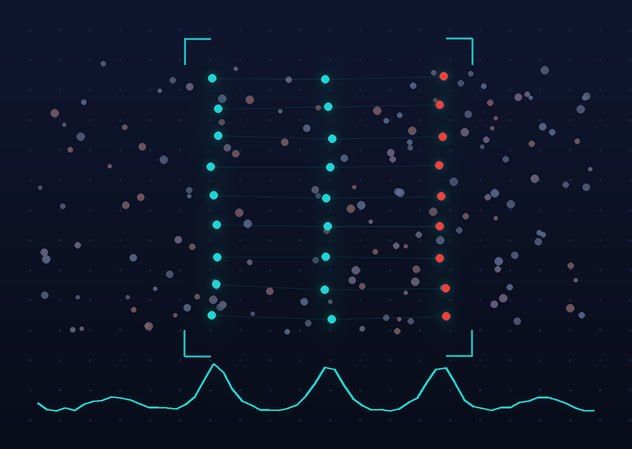
One furious customer is normal. Two hundred accounts registered in the same fortnight, all posting the same "boycott" line inside the same 20-minute windows? That's something else. These campaigns like to land at sensitive moments, like a recall, an IPO or a new market launch. Most of the social media attack types we track end up crossing into this territory sooner or later.
Counterfeit Funnels and Synthetic Media
Counterfeiting has mostly moved off the marketplace. Now the funnel tends to start with an Instagram or TikTok ad, pass through a cloned landing page, and end at a checkout that takes the card and ships nothing. Or ships junk.
Synthetic media is the newer headache: voice clones of executives, AI-made "endorsement" videos, fake screenshots of internal memos. They're cheap to make and painfully convincing to someone scrolling on a phone at midnight.
How We Rank Them
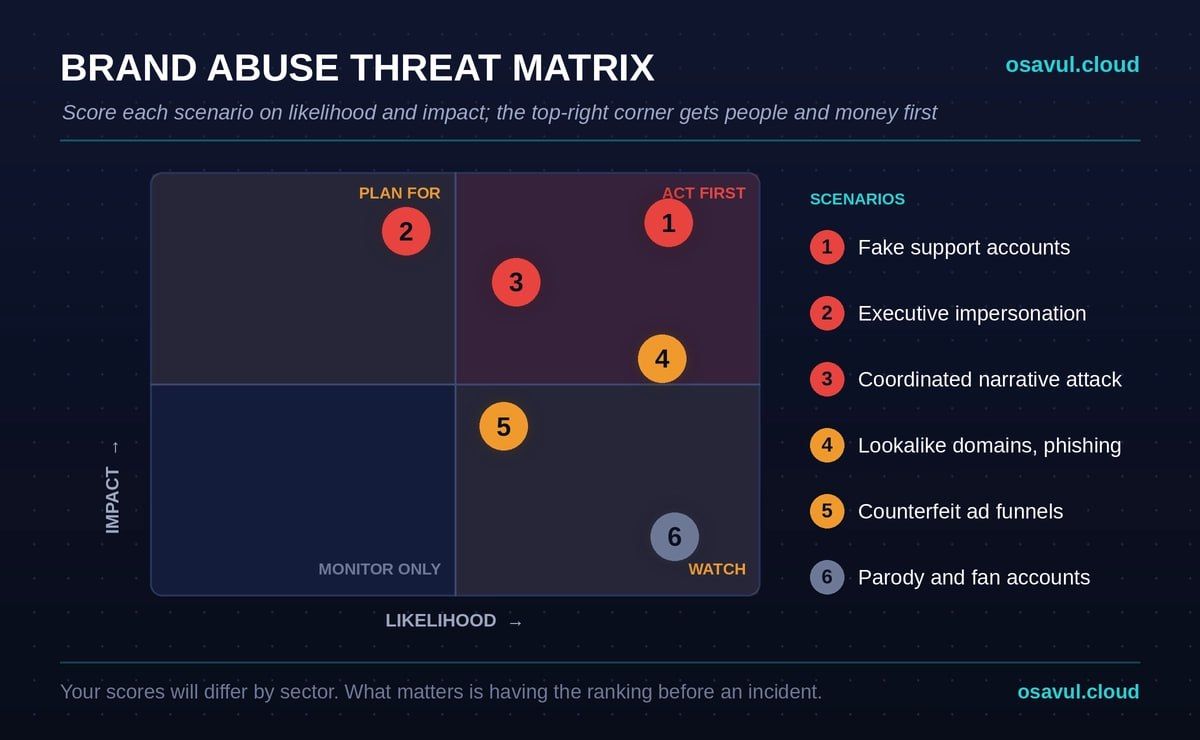
Give every scenario two rough marks, how likely and how bad, and put it on a grid. Whatever lands top right gets the people and the money first.
| Threat | Likelihood | Impact | |
| Fake support accounts | High | High | 1 |
| Executive impersonation (BEC, voice clones) | Medium | High | |
| Coordinated narrative attack | Medium | High | |
| Lookalike domains and phishing | High | Medium | |
| Counterfeit ad funnels | Medium | Medium | |
| Parody and fan accounts | High | Low |
Yours won't look like anyone else's. A pharma company and a gaming studio worry about completely different stuff, and that's how it should be. What counts is having the ranking before an incident. Everything else in your online brand protection strategy gets built around it.
Step 3: Assign Ownership Before Buying Tools
Ownership means deciding, in writing, which person leads on each type of brand threat and who backs them up. Do it before procurement. A tool with no owner just churns out alerts nobody acts on.
There's a reason NIST put "Govern" at the center of its Cybersecurity Framework 2.0. Roles and accountability first, controls second. Brand risk works exactly the same way.
Who Does What: Security, Legal, Comms, Marketing
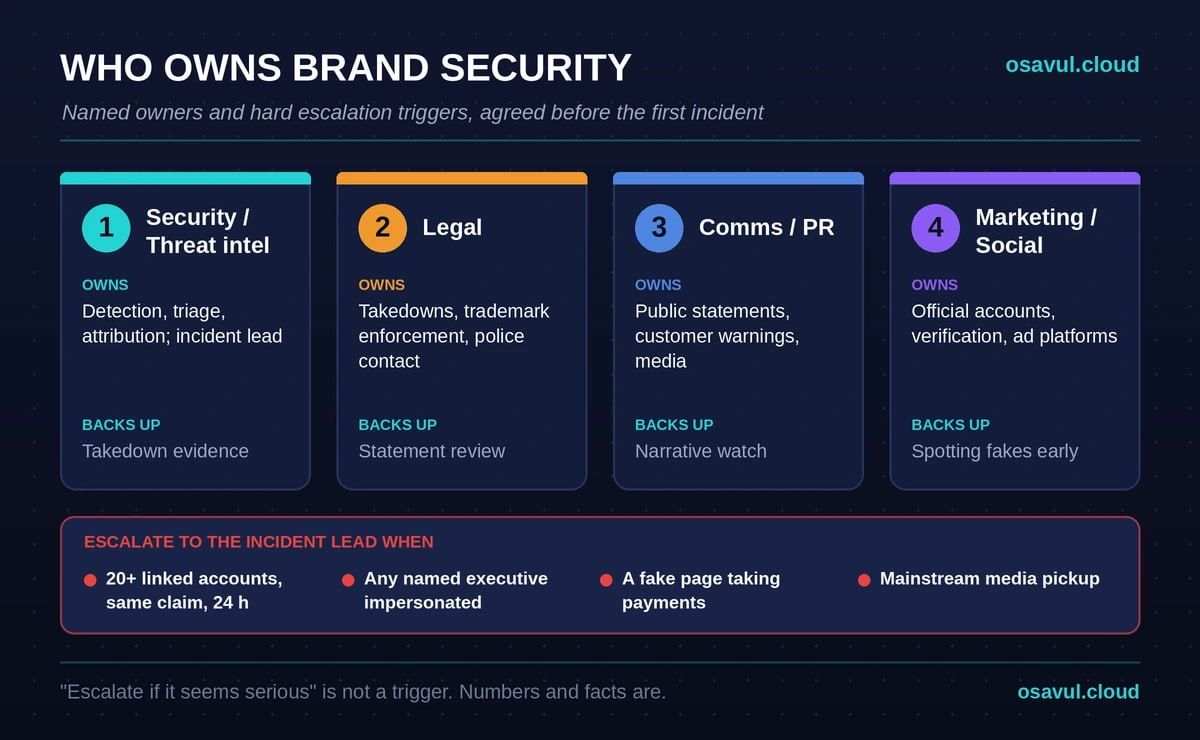
Each function owns the part it's actually good at. Security or threat intel runs detection and attribution. Legal handles takedowns and enforcement. Comms owns anything said in public. Marketing owns the official channels that attackers copy.
| Function | Owns | |
| Security / threat intel | Detection, triage, attribution; incident lead for the Escalate tier | Evidence for takedowns |
| Legal | Takedowns, trademark enforcement, contact with law enforcement | |
| Comms / PR | Public statements, customer warnings, media | |
| Marketing / social | Official accounts, verification, ad platform contacts |
In a smaller company one person might end up holding three of these rows. That's fine. Just put their name in all three.
Escalation Thresholds That Remove Guesswork
An escalation threshold is a trigger, agreed in advance, that moves an incident out of routine handling and onto the incident lead's desk. Good thresholds are numbers or facts. Not feelings.
A few we've seen work well:
- 20+ linked accounts pushing the same claim within 24 hours
- Any impersonation of a named executive
- Any fake page taking payments
- Pickup by mainstream media
If one of those is hit, the analyst doesn't need anyone's permission. The clock starts and the lead gets paged.
What doesn't work is "escalate if it seems serious." Everybody's idea of serious is different, and at 2 a.m. it usually turns into "let's wait till morning."
Step 4: Match Detection Coverage to the Threat Model
Coverage is just where you look, and what you're looking for once you're there. Let the threat ranking from Step 2 pick it. If fake support accounts came out as risk number one, then the replies under your own posts on X, Facebook and Telegram are worth ten times more of your attention than yet another news alert.
Everybody nods at that. Then, a month later, the monitoring is pointed at whatever had the easiest API.
Open Web, Social Platforms and Closed Channels
We split coverage into three layers. The first is the open web, which covers domains, news sites and forums. The second is the large social platforms. The third is semi-closed spaces such as Telegram channels and group chats. In our experience most attacks start in the third layer and reach the other two later.
In the fintech case I mentioned at the start, the fake notice about frozen accounts was circulating in Telegram for about 20 hours before anyone posted it on X. If your monitoring only covers public social feeds, you will find out about this kind of incident late, after the screenshots have already spread. When you compare vendors, check whether their social media monitoring tool actually collects from Telegram and similar channels, because many of them don't.
From Counting Mentions to Spotting Coordination
A mention count tells you the volume. Fine for marketing, not much use to us. What brand protection really needs to know is whether the noise is organic or somebody's organizing it.
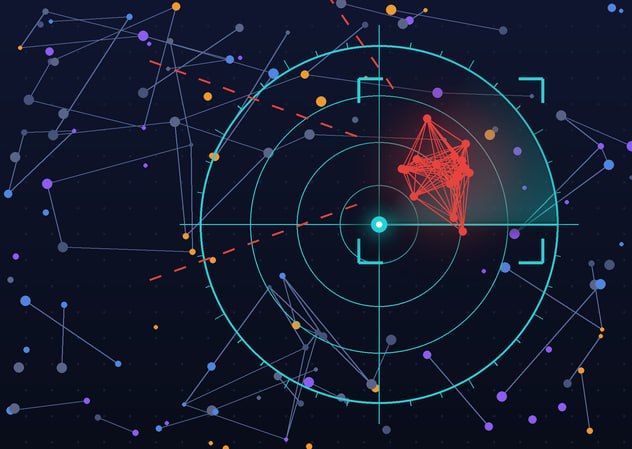
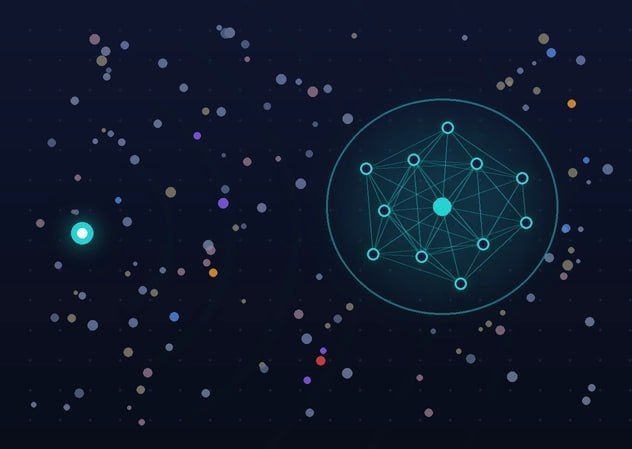
A coordinated campaign is rarely obvious from one post. You see it in the patterns across many accounts: profiles created within a few days of each other, the same wording repeated with small changes, posts published within minutes of each other, and a small group of accounts that keep sharing one another's content. A sentiment chart won't show any of this. At Osavul this network analysis is most of what our analysts do, because it is the only reliable way we have found to separate genuine customer anger from a paid operation early on.
One thing I'd do on every vendor call: ask them to walk you through how their system separates real criticism from a coordinated push, on live data, not slides. You'll learn more from those ten minutes than from the whole deck.
Step 5: Write the Response Playbooks
A playbook, in our world, is one or two pages that tell a tired analyst exactly what to do once a threat is confirmed. Who gets the call, what gets saved, what gets said. You want one per top threat from Step 2, which for most companies we work with means four, maybe six of them.
Keep the first 24 hours tight and detailed and let the rest stay a bit loose. Ours usually have a little block at the top with phone numbers (actual numbers, not "contact Legal"), then the evidence checklist, then the platform contacts and legal templates, then a holding statement someone senior already signed off on back in March, so nobody has to wordsmith it at midnight.
Don't skip the evidence bit. I've lost count of how many times a team reported an account, it vanished in an hour, and with it went the posting times, the linked profiles, the same burner phone number reused across six accounts. All the stuff that would've told them where wave two was coming from.
Take It Down, Counter It, or Stay Silent
Every incident ends up as one of three moves: you get it removed, you answer it in public, or you sit on your hands and watch. The playbook should say which one is the default for each threat type, and what would make you switch.
Takedowns are the obvious pick for impersonation, fake shops and phishing domains. The abuse is clear-cut and platforms mostly do act on it, eventually. Answering publicly fits narrative attacks that have already reached real customers, because deleting forty posts won't unread them. And silence is a perfectly respectable option when a campaign is small. Reply to something three hundred people saw and you've just shown it to thirty thousand more.
The messy ones are mixed. Fake accounts pushing a made-up story about a data breach, say. There we normally tell clients to do both at once: report the accounts and put out a short, boring, factual note for customers. Who decides? The incident lead. Which is the whole reason their name has to be in the strategy before any of this kicks off.
Step 6: Measure Brand Security Like a Security Function
Measuring brand security works much like measuring a SOC. You track how long it took to notice a problem, how long until somebody did something about it, and if the same trouble shows up again next month. The number of takedowns on its own says very little. We've seen teams file five hundred reports a month and still lose ground.
We had a retail client proudly show us a slide with 1,200 removed listings for the quarter. Nice number. Then we looked at where the listings came from, and around 70% traced back to the same nine sellers who just reopened under new names each week. They weren't winning, they were feeding a treadmill.
Metrics That Hold Up in a Board Review
A board won't be impressed by how busy the team was. Directors ask whether customers lost money, whether we caught it early, and if things got any better since the last meeting. So we pick four or five measures that speak to those worries, then leave them alone for a year, otherwise there's no trend to show anybody.
| Metric | What it shows | |
| Time to detect | From the first fake post going live to the first alert | Down |
| Time to act | From alert to takedown, public statement or a logged decision to hold | |
| Customer harm | Reported losses and support tickets tied to impersonation | |
| Repeat-actor rate | Share of incidents linked to operators you've seen before | |
| Coverage | Share of high-exposure assets from Step 1 under active monitoring |
The ones we keep coming back to are above. A small warning on the two time metrics: almost every team we audit starts the stopwatch when an analyst opens a ticket. The real start is the moment the first fake post went live. Count it properly and most programs turn out to be about a day slower than their dashboards claim.
And if you can only afford to track one thing, track repeat actors. Same operators back again with fresh accounts? Then the takedowns are mopping the floor while the tap's still running, and it's time to reopen the strategy.
A 90-Day Brand Protection Plan
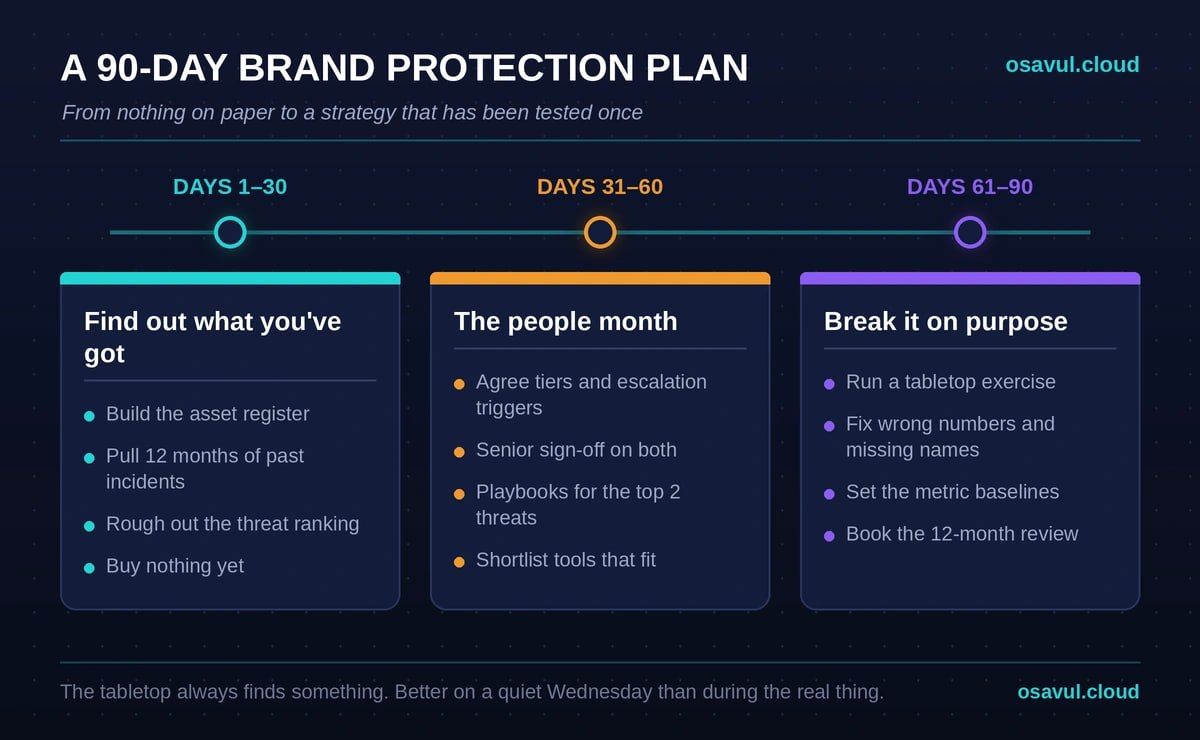
Ninety days is enough to go from nothing on paper to a brand protection plan that has actually been tested once. Not perfect. Tested. We split it into three blocks of about a month each, and we tell clients up front that the third block is the one they'll want to skip and shouldn't.
Days 1 to 30: find out what you've got. Build the asset register from Step 1, including the forgotten microsites and the CFO's LinkedIn. Pull the last twelve months of incidents out of whatever inboxes and spreadsheets they're hiding in, and rough out the threat ranking. Nothing gets bought this month.
Days 31 to 60: the people month. Settle the three tiers and the triggers for escalation and get somebody senior to sign under them. Then draft playbooks for the two threats at the top of your list, only those two. Tool shopping fits here too, and it goes a lot better now, since you walk into the vendor call already knowing which channels matter to you, so the generic demo gets cut short pretty quickly.
Days 61 to 90: break it on purpose. Run a tabletop exercise with a made-up but realistic scenario, something like a fake support account plus a rumour about frozen payments going round Telegram on a Friday evening. Watch who hesitates, which phone numbers are wrong, where the playbook says "Legal" without a name. Fix all of it, then set the baseline for your five metrics.
The tabletop always finds something embarrassing. Last time it was a holding statement that had been approved by a director who'd left the company in spring. Better to learn that on a quiet Wednesday than during the real thing.
FAQ
What goes into a brand protection strategy?
We'd say five pieces, roughly. You need your list of assets, then the threats ranked in some honest order, then names next to each job along with whatever trips an escalation. After that come a couple of playbooks and a few numbers somebody looks at every quarter. Teams usually skip one of these, and it's nearly always the numbers, which is why nobody can say a year later whether anything got better.
Is registering our trademarks not enough?
Not really, no. The trademark gives your lawyers grounds to go after someone once you've found them, but somebody still has to find them. In an online brand protection strategy most of the effort goes into that boring daily part, like who spots a fake support account at nine in the evening, how quick the report goes in, and what customers get told while the platform takes its time. We've met companies with a drawer full of trademarks who still got flattened by one weekend of fake accounts.
Who should own brand protection?
Most often the security or threat intel people lead, and legal, comms and marketing each take their own slice. The org chart matters less than you'd think. We've seen it run fine under a CISO, under a general counsel, once even out of comms. Where it falls apart is when "everyone" owns it, because in our experience that has always meant no one picks up the phone.
When do we update it?
We look at the whole thing every twelve months or so, and straight after any incident big enough that the board heard about it or a journalist called. Every quarter, glance at the metrics and the threat list, since attackers hop between platforms much faster than policies get rewritten. And if repeat actors crept up last quarter, don't sit on that till the yearly review.
Where to Start This Week
You don't need the whole thing finished by Friday. Pick one high-exposure asset, probably your support handle, and search for fakes of it today. Then put a name next to "incident lead" in an email to your boss and see whether anyone objects. Those two jobs take an afternoon and usually show you more about the state of your brand reputation protection than a month of meetings.
After that, just follow the steps in order. Most online brand protection strategies we review fail on the dull parts, an asset list nobody kept up or an owner nobody agreed on, not on the clever detection bits. If you need numbers to get budget, our piece on what reputational damage from disinformation actually costs is a decent place to borrow a few.
And when the first coordinated wave shows up, and it will, you'll be the team that opens a two-page playbook instead of three spreadsheets.