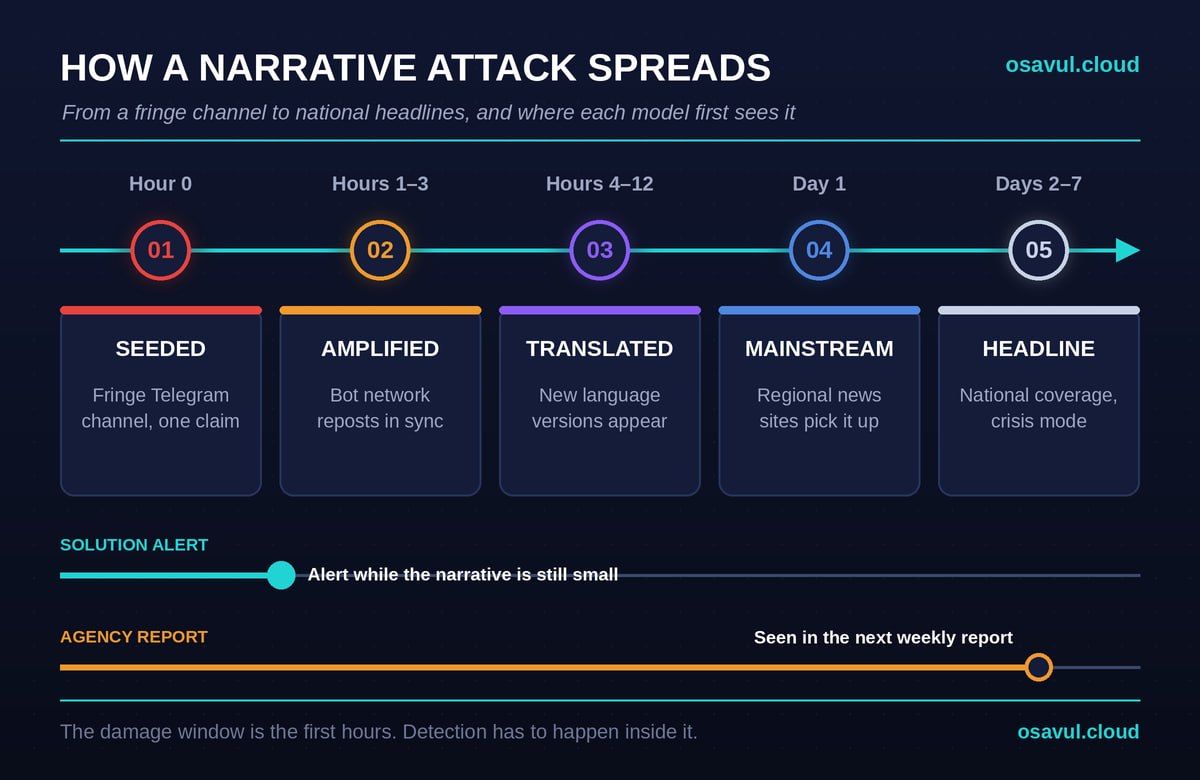
We've seen some version of this happen more than once. Around 2 a.m., a batch of near-identical posts claiming a product is unsafe appears in three Telegram channels. By breakfast the claim has Polish and German versions, and by lunch a regional news site is quoting it.
The brand's agency catches it too, in the Monday report.
Nobody made a mistake there. The agency delivered exactly what the contract said. The problem is built into the model: there's a gap between the moment a narrative starts and the moment someone who can act sees it. That gap, more than the retainer fee or the dashboard design, is what the online reputation management agency vs solution debate is really about.
This guide covers what each model is good at, where each one fails, and why more security and communications teams now want to see the raw data themselves.
What an Online Reputation Management Agency Actually Does
An online reputation management agency tracks what people say about a brand or a person online and then works to change the picture. It answers reviews, pushes negative results down in search, pitches friendlier stories to the press, and steps in when a crisis hits. You usually pay a monthly retainer, and what you're really buying is people: account managers, writers, SEO specialists, and someone who knows which journalist to call.
Don't underrate that. A sharp agency team brings judgment and relationships that no software login can replace. The cost is distance. The agency sits between you and your own data, and you only see it after they've filtered and summarized it.
The Standard Agency Service Menu
Open almost any reputation management agency proposal and you'll find some version of the same five services:
- Review monitoring and replies on review sites and app stores, plus requests to remove reviews that look fake.
- Search suppression, which means publishing and promoting positive content until the unflattering article drops off page one.
- PR outreach: story pitches, expert commentary, and relationships with journalists.
- Social media reputation management, which mostly means watching brand mentions on the big networks and replying to complaints.
- Crisis communications, from holding statements to preparing spokespeople.
Read that list again and look for detection. It's there, but only as an input to the communications work. Nobody on the account is paid to find the threat first.
Where the Agency Model Starts to Strain
The agency model runs into trouble when threats move faster than the reporting cycle, start on platforms the agency doesn't watch, or come from coordinated operators instead of real unhappy customers. A few years ago that was rare. In our monitoring work, we now see it almost every week.
Speed is the first problem. A weekly report made sense when reputation lived in newspapers and on review sites. It's a poor fit for a story that can jump from an anonymous forum to national headlines in one news cycle.
Then there's coverage. Agencies watch what their tools can see, and that's usually the major networks, news, and reviews. Telegram, regional forums, and non-English media often go unwatched, which is a problem because many of the coordinated campaigns we track start there.
The hardest gap is attribution. An online reputation management agency is built to answer "What are people saying about us?" Very few can tell you who is pushing the story or whether the accounts behind it are real. If it turns out to be a botnet, a polite reply and a press release can end up spreading the story you're trying to contain.
What a Reputation Management Solution Brings In-House
A reputation management solution is software your own team uses to collect, analyze and get alerts on everything said about your organization across news, social media, messaging apps and forums. The analysts work for you, and so does the data.
That second part matters more than people expect. When the raw feed is yours, nobody decides for you that a spike was "not worth mentioning." Your security lead, your comms director and your legal counsel can all look at the same evidence at the same moment instead of waiting for a PDF.
It's also a different job. Reputation management software doesn't write your press release. It makes sure the people writing it have the full picture, and have it hours earlier.
From Counting Mentions to Mapping Narratives
Modern online reputation monitoring tracks narratives, not just mentions. It doesn't stop at telling you your brand name appeared 4,200 times this week. It groups those posts by the story they tell, shows where each story started, and measures how fast it's growing.
That sounds academic until you've been through it. A count of 4,200 mentions tells you almost nothing. Now suppose you learn that 3,100 of them push the same claim, that the claim first appeared in a single channel with 800 subscribers, and that it's doubling every six hours. Your team can act on that before lunch.
Our guide to brand monitoring goes through how this works. The short version: brand reputation monitoring stopped being about counting once attackers learned to game volume.
AI Reputation Management in Practice
AI reputation management uses machine learning to sort material at a volume no human team can handle. It groups millions of posts into narratives, reads sentiment in dozens of languages, and flags accounts that behave like a coordinated network instead of independent people.
In practice, these are the capabilities that matter:
- Narrative clustering groups posts by meaning, not keywords, so a claim still gets caught after it's reworded or translated.
- Aspect-based sentiment tells "the price is outrageous" apart from "the CEO is lying." Both score as negative, but they're very different problems.
- Coordination signals are patterns such as accounts created in the same week, posting within seconds of each other, and reusing identical text.
- Source mapping traces a story back from the news article to the forum thread or Telegram channel that started it.
Osavul's Echo applies this to news and social media in more than 100 countries. Nebula adds messaging apps, websites and the smaller online communities where campaigns usually start. None of this replaces an analyst's judgment. It means the analyst spends the morning deciding what to do instead of scrolling to find out what happened.
Online Reputation Management Agency vs Solution: Side-by-Side
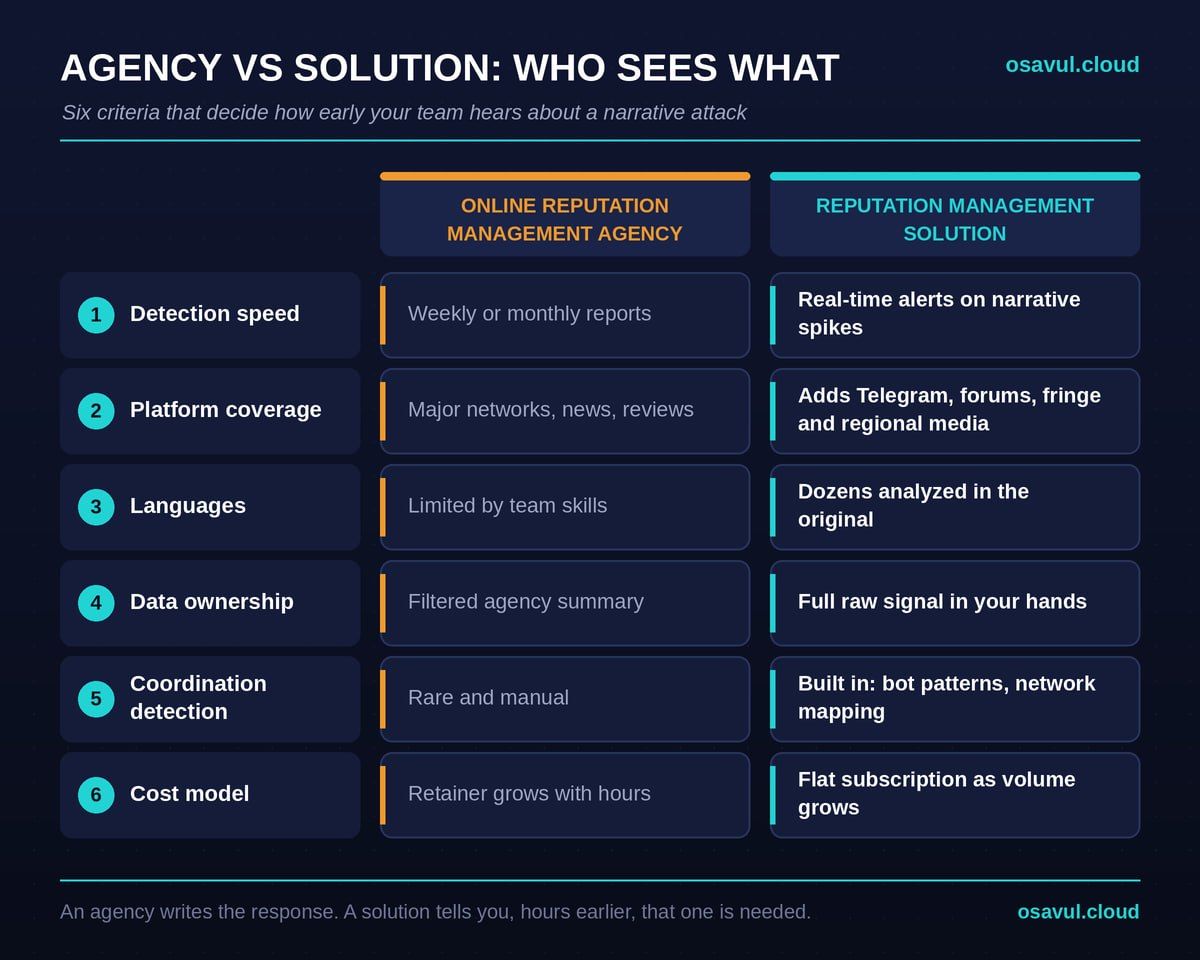
The short answer is that an online reputation management agency is stronger at producing communications, and a solution is stronger at detection, coverage and speed. For most organizations today, the risk comes from reacting too late, so a solution closes the gap that matters most.
The real difference is who holds the signal and how quickly it reaches the people who make decisions. Here's how that looks in practice.
Comparison Table
| Criteria | Online reputation management agency | |
| Detection speed | Periodic reports, usually weekly or monthly, plus escalation calls | Real-time alerts on narrative spikes |
| Platform coverage | Major social networks, news, review sites | |
| Languages | Depends on the team's language skills | |
| Data ownership | The agency filters and summarizes the data | Your team works with the full raw data |
| Coordination detection | Rare, done manually | Built in: bot patterns, cross-posting, network mapping |
| Cost model | Monthly retainer that grows with hours | Platform subscription that doesn't grow with volume |
| Best at | Writing, PR, media relations | Early warning, investigation, evidence |
Speed: Weekly Reports vs Real-Time Alerts
Speed decides most reputational incidents, and a solution wins it by design. It raises an alert when a narrative starts to grow, not when someone has time to compile a report.
We've reviewed plenty of incidents after the fact, and the most expensive ones rarely came from a lack of information. The signal existed. It sat in a channel nobody watched, or in a spreadsheet that went out on Friday. An agency can't escalate what it hasn't seen yet.
Visibility: Sampled Summaries vs Full-Signal Data
An agency report is a summary, and every summary leaves things out. With a solution, your own analysts see everything, including the odd small thread that turns out to matter three days later.
This is where corporate reputation management and security start to overlap. A comms team reading an agency summary sees tone and volume. A security analyst looking at the raw data might notice that forty "angry customers" all joined the platform in the same week. That difference changes how you respond.
Online Reputation Management Cost: Retainers vs Platform Economics
Online reputation management cost works very differently in the two models. An agency bills for people and hours, so the cost grows with every new market, language and crisis. A platform charges for access, so monitoring ten countries doesn't cost ten times as much as monitoring one.
Retainers are easy to underestimate. The base fee covers routine work, but crisis support, extra languages and "urgent" requests usually come as add-ons, right when the pressure is highest. Reputation management tools move most of that cost into a predictable subscription. The team's time then goes to analysis instead of briefing an outside vendor.
That doesn't make an online reputation management agency useless. It changes its role: the agency becomes a specialist you call in when needed, not the eyes and ears of your whole reputation program.
The Threats Agencies Weren't Built to See
Agencies were built for organic reputation problems: an unhappy customer, a critical article, a bad quarter. Hostile information operations are a different kind of threat. They're planned, well resourced and spread across several platforms from the first hour, and they don't show up in review scores until the damage is already done.
The World Economic Forum's Global Risks Report has ranked misinformation and disinformation as the top short-term global risk two years running. That ranking isn't about politics alone. The same methods now target brands, supply chains and executives.
Coordinated Narrative Attacks and Botnet Amplification
A coordinated narrative attack is a planned campaign in which a group of accounts, often automated or bought, pushes the same claim to make it look like public opinion. What gives it away is the pattern of behavior, not what the posts say.
A single hostile post is noise. Two hundred accounts posting near-identical wording within the same hour is an operation. Those accounts were created recently, follow each other and never posted before this week. Human reviewers reading mentions one by one almost never see that pattern. Network analysis catches it within minutes.
What you do next depends on it. Answering a botnet as if it were a real customer gives the operation the engagement it's trying to get. Recognizing it lets you document it, report it to the platforms and brief journalists before the story hardens. We described exactly this kind of operation targeting companies in our Central Asia FIMI case.
Telegram, Fringe Forums and Non-English Channels
Many attacks on reputation now start outside the mainstream networks: in Telegram channels, anonymous imageboards, regional forums and local-language media. By the time a claim reaches the big networks, it has usually been tested and refined somewhere else.
In our tracking, the first version of a hostile narrative is rarely in English. It shows up in a Russian-language channel, a Georgian forum or a Serbian news aggregator, and it's often tested there for days before being translated for a wider audience. If your monitoring starts at the big social networks, you only see the campaign's later stages, not its first draft.
That's why coverage should be judged by source type, not by the number of sources. Our breakdown of social media monitoring for security teams covers which layers matter most and why.
How to Choose: A Decision Checklist for Security and Comms Leads
The quickest way to decide is to look at where your last three reputational incidents came from. If they were real customer complaints and critical press coverage, an agency may be enough. If any of them spread through coordinated accounts, fringe platforms or other languages, you need a solution your own team runs.
Before the next retainer renewal, ask your team five questions:
- How many hours passed between the first hostile post and the moment a decision-maker saw it?
- Which platforms and languages did our monitoring actually cover during that time?
- Could we tell whether the accounts spreading the story were real people?
- Who owns the raw data, and can our security team get to it without asking?
- What did the last crisis cost us beyond the base retainer?
If the answers are "too many," "not enough," "no," "not us" and "more than planned," you have your answer.
When an Agency Still Earns Its Fee
A reputation management agency still earns its fee when the job is producing communications. That includes crisis messaging, media placements, content campaigns and search suppression after an old story has resurfaced. Writing well under pressure is a skill, and good agencies have it.
We've worked alongside agencies on several incidents, and that split works well. The agency drafts the statement. It just shouldn't be the one finding out that a statement is needed.
When a Solution Should Take the Lead
A solution should lead whenever the threat model includes deliberate actors: competitors, activist networks, state-linked influence operations or organized fraud. It should also lead when you operate in several countries, when the security team has to be involved, or when you need evidence that holds up with platforms, regulators or courts.ґ
In those situations, detection can't be something you outsource and check once a week. It belongs inside the organization, next to the rest of your brand protection operating model, with reputation management software feeding alerts straight to the people who own the response. An online reputation management agency can still support that setup, just from a supporting role.
What an In-House Reputation Workflow Looks Like with Osavul
An in-house reputation workflow comes down to four steps your team repeats every day: collect, detect, assess, respond. Tools do the first two. People own the last two, and the handoff between them should take minutes.
Here's how that typically plays out for the teams we work with:
- Collect. Sources are set up once, by threat model rather than by habit. That covers news and the major social networks, and also Telegram channels, forums and regional media in the languages where your risk actually sits.
- Detect. Posts are grouped into narratives automatically, and alerts go off when a narrative speeds up, jumps to a new platform or shows signs of coordination. A higher mention count alone doesn't trigger one.
- Assess. An analyst opens the alert, checks where the story came from and which accounts are spreading it, and decides whether it's organic criticism or an operation. That decision drives everything that follows.
- Respond. The comms, legal and security teams work from the same evidence. The response might be a statement, a report to the platform, a briefing for journalists, or a deliberate choice to stay quiet and keep watching.
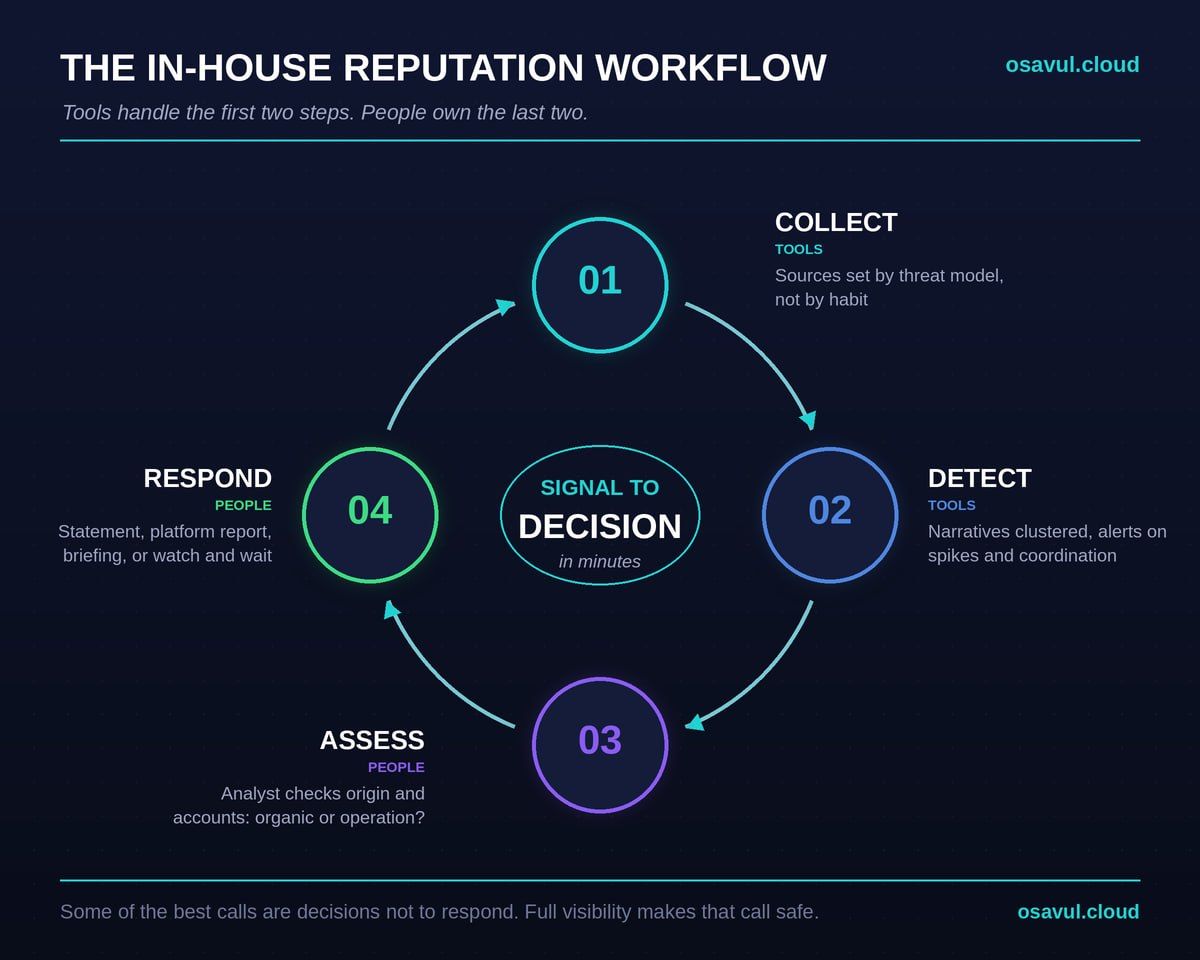
The last option matters. Some of the best calls we've seen were decisions not to respond, because the data showed a narrative running out of steam on its own. Without full visibility, teams tend to overreact, and an overreaction can become the story itself.
That's the thinking behind Osavul's approach to narrative intelligence: give the team the full signal early enough that deciding what to do is a matter of judgment, not a guess. If there's an agency in the picture, it gets a much sharper brief, because your team already knows what's happening and why.
FAQ
What does an online reputation management agency do?
An online reputation management agency watches what people say about a brand or a person online and tries to improve that picture. In practice that means replying to reviews, pushing bad search results down, pitching stories to journalists and handling crisis communications. Most work on a monthly retainer and send a report every week or month.
If you've worked with one, you know where they're strongest: writing, relationships with the press, and staying calm when things go wrong. Early detection usually isn't in the contract at all.
How much does online reputation management cost?
Agency retainers for a single market usually start at a few thousand dollars a month, and the price grows with each extra language, country or crisis. Software is priced differently. You pay for access to the platform, so adding markets doesn't multiply the bill.
One practical tip: when you compare options, pull the invoice from your worst month last year, not the base fee from the proposal. Crisis support and "urgent" requests are usually billed on top of the retainer.
Is reputation management software better than an agency?
For finding problems early and understanding them, software is the better choice. It covers more sources and languages, runs around the clock, and can connect patterns across thousands of accounts that nobody would spot by reading posts one at a time.
An agency is still useful once you know what's going on and need a strong statement or a good media strategy. Many teams end up using both, with each doing a different job.
Can AI detect coordinated attacks on a brand's reputation?
Yes. AI models spot coordinated attacks mainly by how accounts behave, not by what they post. Typical red flags are clusters of accounts created in the same week, posts that go out within seconds of each other, copy-pasted wording, and accounts that mostly share each other's content.
This matters for a very practical reason. We've seen a comms team spend most of a day carefully answering what later turned out to be a few hundred automated accounts. Had they known that in the morning, they would have reported the network to the platforms and moved on.
Can a company combine an agency with a monitoring platform?
Yes, and for larger organizations it's often the most sensible setup. Your own team runs monitoring and analysis on the platform, and the online reputation management agency gets a clear brief with evidence attached, so it can focus on communications.
The main benefit is that everyone works from the same data. The agency isn't guessing what happened, and your team isn't waiting on the agency's report to find out.
Where Reputation Work Is Heading
Companies have long known that reputation carries real financial weight. A Harvard Business Review analysis estimated that 70 to 80 percent of a company's market value comes from intangible assets such as reputation. What has changed since then is how quickly that value can come under attack, and by whom.
Some of today's attacks are organized and well funded, and they play on low public trust in institutions and media, a trend the Edelman Trust Barometer has tracked for years. They also start in places most monitoring setups don't cover.
An online reputation management agency can still play a part in handling all of this, mostly on the communications side. Detection is a different job. From what we see in our work, the teams that cope best keep monitoring in-house, cover the platforms and languages where problems actually start, and hear about a story within the first hour, not in the next report.