Ask five analysts what OSINT is and you'll get five answers that all orbit the same core: intelligence built from information anyone can lawfully access. No hacked databases. No paid informants. Just public data — news archives, corporate registries, satellite imagery, social media chatter — collected with a purpose and analyzed until it answers a question someone actually needs answered.
That last part matters more than most beginners realize. In our work tracking coordinated narrative attacks in Eastern Europe, the raw material is rarely the hard part. Telegram alone produces millions of public messages a day, and teams that monitor Telegram at scale quickly learn that access to data was never the bottleneck — turning it into something decision-ready is. That gap between “publicly available” and “actually useful” is where OSINT lives.
What Is OSINT? A Working Definition
OSINT (open source intelligence) is the practice of collecting, verifying, and analyzing publicly available information to produce actionable intelligence. The term “open source” here has nothing to do with software licensing — it means the source is open to the public: websites, broadcast media, government filings, academic papers, transport tracking, leaked-but-published datasets, and social platforms.
What does OSINT stand for? Simply: Open Source INTelligence. The acronym comes from the US intelligence community, which formalized the discipline decades before the internet made it explode. The CIA was clipping foreign newspapers in the 1940s; the method is old, the scale is new.
Here's the distinction we push hardest when training new analysts: information is not intelligence. A screenshot of a suspicious Telegram post is information. Fifty of those posts, mapped to a coordinated network, timestamped against a military operation, and summarized for a decision-maker — that's intelligence. The OSINT definition worth remembering has three parts: public sources, deliberate collection, and analysis that serves a specific question.
One more boundary worth drawing. OSINT is passive by default — you observe what's already public. The moment you start creating fake accounts to join closed groups or messaging targets directly, you've crossed into different disciplines with different legal and ethical rules. We'll come back to that line, because it's where most self-taught practitioners get into trouble.
How OSINT Fits Among Intelligence Disciplines
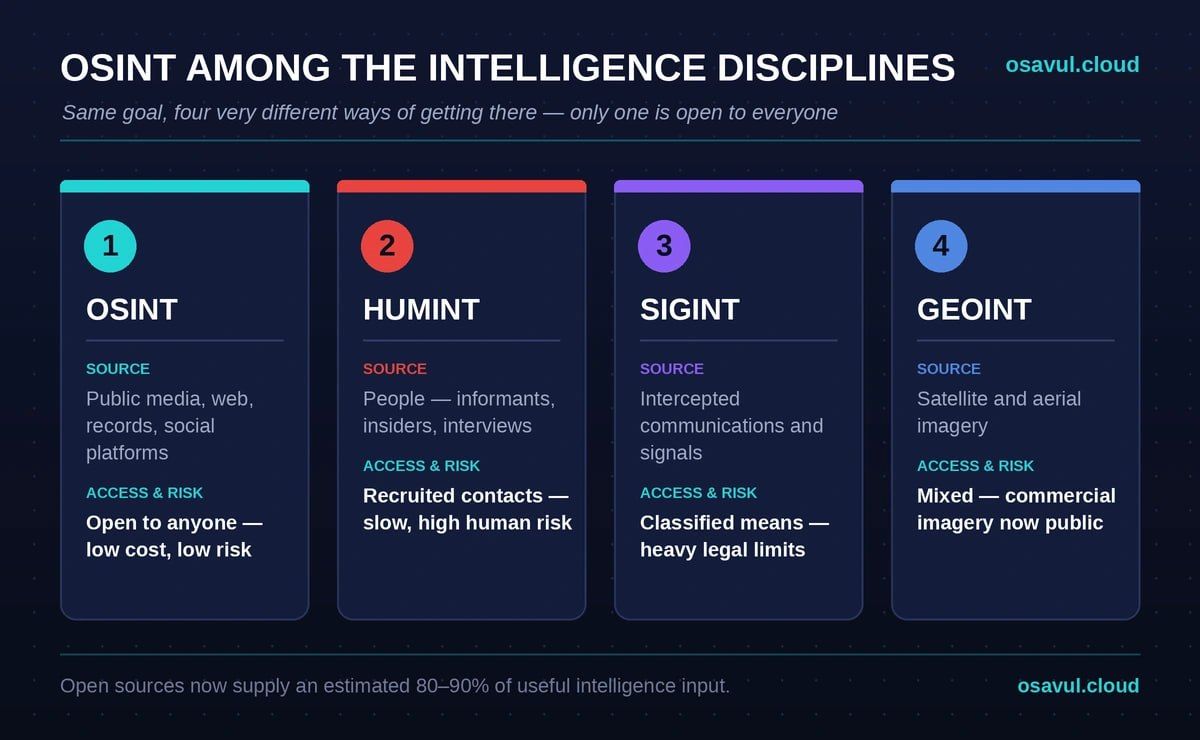
OSINT is one of several intelligence collection disciplines, and it's the only one that works entirely from publicly accessible material. Intelligence agencies traditionally sort collection by source type: signals, human, imagery, and open source. Each has a formal name, a cost profile, and a legal regime — and understanding how they differ explains why OSINT went from an afterthought to the first stop in almost every modern investigation.
The economics shifted, not the theory. Twenty years ago, open sources might have contributed context around “real” intelligence. Today, estimates from within the US intelligence community put open sources at 80–90% of useful intelligence input. When a soldier posts a geotagged photo or a shipping database logs a sanctioned vessel, the public record often beats classified channels on speed.
OSINT vs. HUMINT, SIGINT, and GEOINT
The difference between OSINT and other disciplines comes down to where the information originates and what you risk collecting it.
| Source | |||
| OSINT | Public media, web, records, social platforms | Open to anyone | Low cost, low risk, high volume |
| People — informants, interviews, insiders | |||
| Intercepted communications and signals | |||
| GEOINT | Satellite and aerial imagery | Mixed — commercial imagery is public | Falling cost, growing OSINT overlap |
The boundaries leak, and that's worth noticing. Commercial satellite imagery used to be GEOINT's walled garden; now anyone with a browser can pull yesterday's pass over a conflict zone, which effectively moved a chunk of GEOINT into open source territory. The HUMINT comparison runs deeper than a table row can hold — we've written a full breakdown of HUMINT vs OSINT covering when each discipline earns its cost.
The practical takeaway for civilian teams: OSINT is the only discipline you can run legally without a government mandate. That's why it became the backbone of corporate threat intelligence, journalism, and disinformation research — fields that need intelligence-grade analysis but will never touch an intercept.
Where OSINT Data Comes From: Main Source Categories
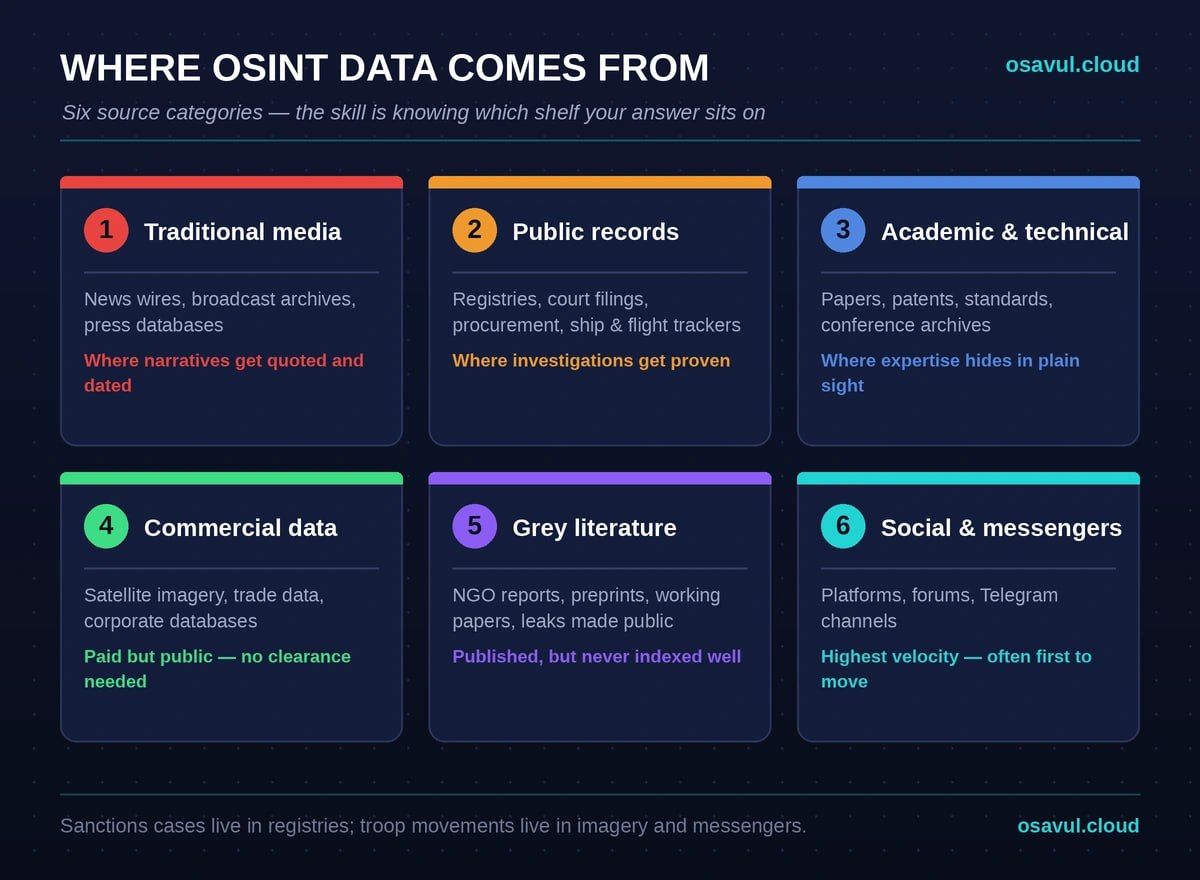
OSINT sources fall into six broad categories: traditional media, public records, academic and technical publications, commercial data, grey literature, and social platforms. Analysts argue about taxonomy at the margins, but the categories matter less than the habit they build — knowing, before you start, which shelf an answer is likely to sit on. A sanctions investigation lives in corporate registries; a troop movement lives in social media and imagery.
Media, Public Records, and the Deep Web
Traditional media and public records remain the most underrated OSINT sources, mostly because they're unglamorous. Court filings, procurement databases, ship and flight trackers, business registries, domain registration records — this is where investigations get proven, not just theorized. A viral claim might start on social media, but the confirmation usually comes from a registry nobody thinks to check.
A note on the deep web, since it confuses people: “deep” just means not indexed by search engines. Most of it is mundane — paywalled archives, databases behind search forms. It's still open source if access is lawful. The dark web is a separate question with separate operational security demands, and beginners should treat it as out of scope.
Social Platforms and Messengers
Social platforms are now the highest-velocity OSINT source, and messengers are the hardest part of that category. Twitter-era OSINT assumed public APIs and searchable archives. The field has since shifted toward semi-closed spaces — and nowhere is that more visible than Telegram, which functions as social network, news wire, and coordination hub across Eastern Europe, the Middle East, and beyond. In our monitoring of pro-Kremlin channels, narratives routinely appear on Telegram 24–48 hours before they surface on Western platforms. That lead time is the whole reason Telegram monitoring became central to modern OSINT.
The catch: messenger data is unstructured, multilingual, and enormous. Channel networks repost each other in patterns no human can track manually, which is why purpose-built open source intelligence tools for Telegram have become their own tooling category rather than a checkbox in general platforms.
The OSINT Cycle: From Collection to Decision
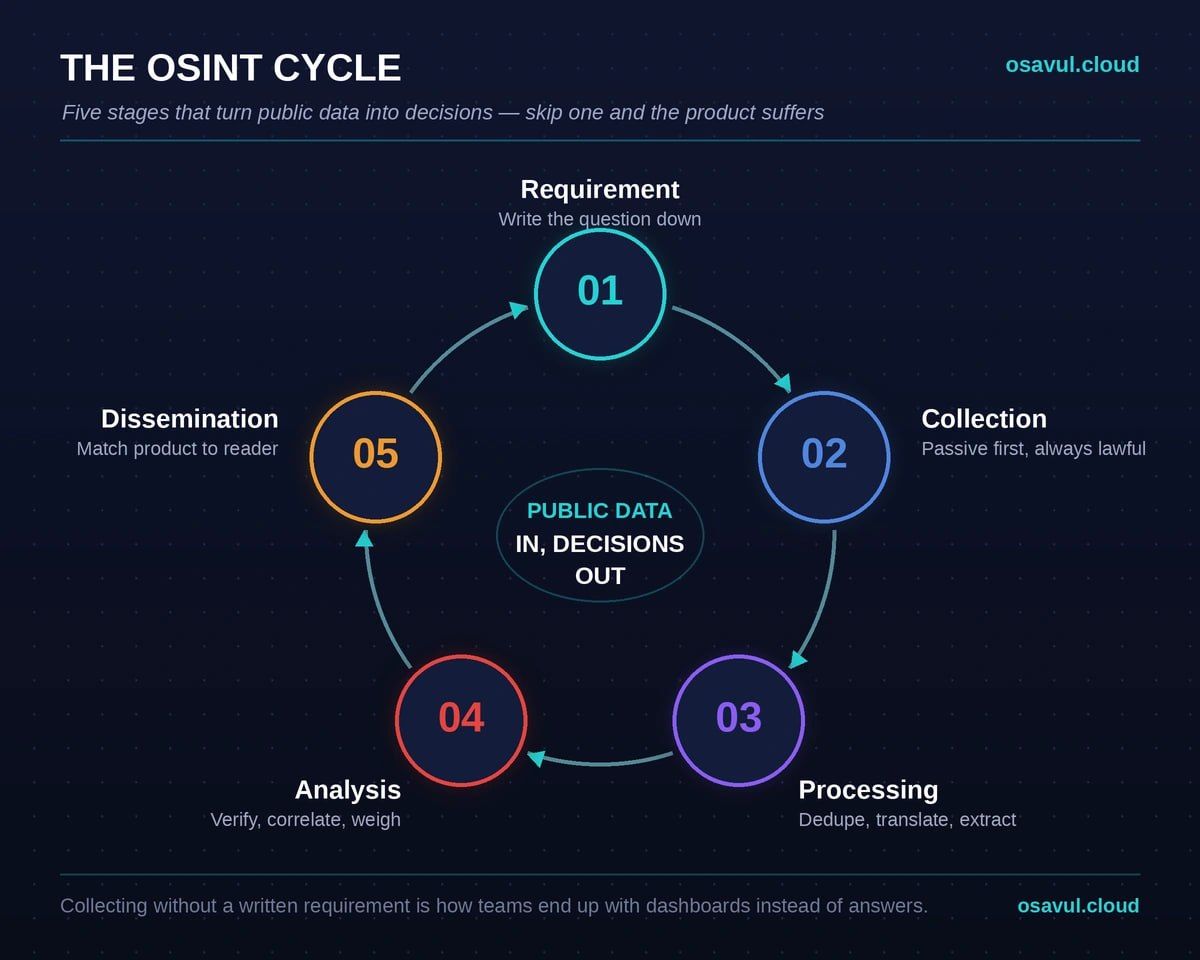
The OSINT cycle is a five-stage loop: define the requirement, collect, process, analyze, and disseminate. It's borrowed directly from the classic intelligence cycle, and it exists to prevent the most common failure in open source work — collecting endlessly without ever answering a question. Every hour spent scraping is wasted if nobody defined what the finished product needs to prove.
Requirement definition is the stage teams skip, and it shows. “Monitor the situation” is not a requirement; “identify which channels amplified the mobilization rumor first, and whether they've coordinated before” is. We've watched well-resourced teams drown in dashboards because nobody wrote the question down. The discipline of the cycle is what separates an intelligence function from a news feed.
Processing deserves more respect than it gets. Between raw collection and analysis sits the unglamorous work: deduplication, translation, entity extraction, timestamp normalization. On messenger data this stage eats more analyst hours than analysis itself — one reason the full OSINT process rewards study before you build a workflow around ad-hoc habits.
Dissemination is where intelligence either lands or dies. A finding that reaches the decision-maker three days late, or formatted as a 40-page dump, changes nothing. Match the product to the reader: two paragraphs for the executive, the full evidence chain for the follow-on investigator.
Passive vs. Active Collection
Passive collection observes what's already public; active collection interacts with the target or its infrastructure. Reading a channel is passive. Joining a private group under a persona, or probing a website's infrastructure, is active — higher yield, higher legal exposure, and in adversarial contexts it can tip off the target. MITRE ATT&CK catalogs this from the attacker's side: its Reconnaissance tactic describes adversaries running the same open source collection against organizations that defenders run in reverse. The mirror is instructive — your public footprint is someone else's OSINT.
OSINT Examples in Practice
The clearest OSINT examples come from three fields: disinformation research, sanctions enforcement, and conflict verification. Each takes the same raw material — public data — and turns it into a different kind of proof. Walking through them shows the method better than any definition can.
Disinformation tracking is our home turf, so start there. When a fabricated story about refugee crime spiked across European media in 2024, the interesting question wasn't whether it was false — fact-checkers handled that in hours. The question was who pushed it. Mapping first-publication timestamps, repost chains, and account creation dates across a few hundred Telegram channels and fringe sites revealed a seeding pattern: the same network, the same 40-minute amplification window, the same laundering route from anonymous channel to quotable “source.” That's the difference between debunking a claim and exposing an operation — a distinction we unpack in our work on using OSINT against disinformation.
Sanctions evasion shows the public-records side. Investigators routinely reconstruct shadow-fleet oil transfers from nothing but AIS ship-tracking data, corporate registry filings, and port records — catching tankers that go “dark” by noting where their transponder signal stops and which vessel appears nearby on satellite imagery. No classified feed required.
Conflict verification made OSINT famous. Bellingcat's identification of the Buk missile launcher in the MH17 downing — built from dashcam footage, social media photos, and street-level geolocation — remains the canonical case study, later corroborated by the official Joint Investigation Team. A volunteer collective, using open sources, produced findings that stood up in a Dutch court.
Notice the common thread across all three open source intelligence examples: none hinged on secret access. They hinged on patience, cross-referencing, and knowing which public shelf to check.
Core OSINT Techniques and Tooling
Core OSINT techniques cluster into four groups: advanced search, identity resolution, geolocation, and network analysis. Tools change monthly; these four skills have been stable for a decade. A practitioner who masters them can improvise when a favorite platform dies — and platforms die constantly in this field.
Advanced search means making indexes work for you: search operators, archive services, reverse image search, cached page recovery. Identity resolution connects a username to an email to a phone number to a real person — the technique behind most successful attribution work, and the one with the sharpest ethical edges. Geolocation extracts “where” from imagery: shadows, terrain, signage, utility poles. Network analysis maps who amplifies whom — the technique that turns 500 isolated accounts into one visible operation.
Then there's the tooling question every new analyst asks: which tools do I need? The honest answer is fewer than you think, organized better than you expect. The community-maintained OSINT framework — a categorized tree of hundreds of free resources — is the standard map of the territory, and we've published a practical guide to working with the OSINT framework without drowning in its options. Browser, spreadsheet, and disciplined note-taking still solve most cases.
Scale is where manual technique breaks. One analyst can geolocate a photo; no analyst can read 3,000 Telegram channels a day in four languages. That's the honest boundary line for AI-assisted platforms: not replacing analyst judgment, but doing the reading, translating, and clustering that no human team can sustain. AI-driven analysis of narrative spread — the kind Osavul builds for governments and security teams — exists precisely because coordinated influence operations already operate at machine speed, and manual OSINT techniques alone can't keep pace with them.
Limits and Risks of Open Source Intelligence
OSINT's biggest limitation is that public data is public for adversaries too — including the ability to poison it. Everything you can collect, a motivated actor can seed, spoof, or flood. Treating open sources as neutral ground is the rookie error that produces confident, wrong intelligence, which is worse than no intelligence at all.
Verification is the discipline that keeps OSINT honest. The working rule we drill into analysts: two independent sources minimum, and “independent” means genuinely separate origins — fifty channels reposting one anonymous claim is still one source. Provenance checks, metadata inspection, and reverse image search catch most fabrications. The rest get caught by asking the older question: who benefits from me believing this?
Attribution is where good investigations go to die. Matching a username across platforms feels conclusive and often isn't; impersonation, recycled handles, and false-flag accounts are standard tradecraft in influence operations. The professional standard is graduated confidence — “likely,” “highly likely,” with stated reasoning — never certainty from a single correlation.
Legality is less settled than most tutorials admit. Collecting public data is broadly lawful, but scraping terms of service, GDPR's rules on processing personal data, and jurisdiction-specific surveillance law all bite in different places.
And a limit nobody likes saying out loud: OSINT can't see inside closed rooms. Intentions, private communications, unpublished decisions — that's HUMINT and SIGINT territory. The craft is knowing exactly where the public record ends, and saying so in the report.
How to Start Doing OSINT
The fastest way to learn OSINT is to run one small, real investigation end to end — not to collect tools. Pick a bounded question with a verifiable answer: geolocate a published photo, trace a viral claim to its first appearance, map a company's public footprint. One finished case teaches more than fifty bookmarked resources.
Set up minimal infrastructure before you touch a target. A separate browser profile, a research email, and a note-taking habit that logs every URL with a timestamp — that's the whole starter kit. Screenshot everything as you go; open sources vanish without notice, and the deleted post you didn't archive is the finding you can't prove. Ask any analyst their most painful lesson and archiving discipline is usually the answer.
Learn in public, selectively. The OSINT community is unusually generous — practitioner blogs, weekly geolocation quizzes, and post-mortems of major investigations are all free. Reading how a case was actually built, wrong turns included, beats any tool list. When you're ready for structure, our guide to open source investigations walks through scoping, sourcing, and documentation on a real workflow rather than in the abstract.
Then decide what kind of practitioner you're becoming. Hobbyist puzzle-solving, corporate threat intelligence, journalism, and disinformation research share techniques but diverge fast in ethics, legal exposure, and tooling. The person tracing a botnet for a government client and the person doing weekend geolocation challenges are both “doing OSINT” — with very different obligations. Choosing your lane early tells you which skills, and which rules, to take seriously.
Frequently Asked Questions
Is OSINT legal?
Reading public information is legal almost everywhere — that part is settled. What actually gets teams in trouble is everything around the reading. A few years back we watched a European research group nearly lose a grant because their scraper had been hammering a platform's servers against its terms of service. The findings were solid. The collection method almost sank them anyway. So: passive browsing, fine. Automated collection or dossiers on individuals — check the platform terms, check GDPR, and write down your rules before you start, because explaining them after the fact goes badly.
What is the difference between OSINT and HUMINT?
OSINT comes from public sources; HUMINT comes from people. But here's the thing the textbook comparison misses. Open sources are brilliant at “what happened” — timestamps, movements, connections. They're nearly blind on “what's next,” because plans live in heads and closed rooms, not on Telegram. The two disciplines aren't competitors. A solid OSINT workup is often what tells the human-source side which door is worth knocking on, and that division of labor is older than the internet.
What are the best sources for OSINT?
Depends entirely on the question — which sounds like a dodge, so let me be concrete. Corporate questions: OpenCorporates, national registries, court records. Breaking events: messengers, and Telegram specifically tends to run a day or two ahead of mainstream platforms on anything in our region. Historical claims: the Wayback Machine, which has quietly rescued more investigations than any paid platform we know of. The real skill isn't knowing sources. It's diagnosing which kind of question you're holding.
Can OSINT be automated with AI?
Parts of it. Translation, clustering, flagging spikes across thousands of channels — machines do that better than any team, and at messenger scale there's no manual alternative. What we haven't seen, anywhere, is a model that can be left alone with attribution. Too many false-flag accounts, too much recycled-handle noise. The setup that works in practice: automation reads everything and narrows the field, then a human sits with the three channels that matter and decides what they mean.
Do you need special tools to start with OSINT?
No. And honestly, tool-collecting is the most common way beginners stall. Browser, spreadsheet, a log of every URL with a timestamp — that carries your first dozen cases. We've all seen the newcomer with forty bookmarked utilities and zero finished investigations. Work one case to the end with almost nothing. You'll know exactly what tooling you're missing, and it's never forty things.
Key Takeaways
OSINT is the discipline of turning publicly available information into intelligence someone can act on — and the emphasis belongs on discipline, not on access. The data was never the hard part. Anyone can read a public channel; the craft is defining the question, verifying against independent origins, and delivering the answer while it still matters.
A few things worth carrying out of this guide. Open sources now supply the bulk of usable intelligence even inside agencies that own classified collection, so the skills transfer everywhere from journalism to government work. The cycle — requirement, collection, processing, analysis, dissemination — is what separates an intelligence function from an expensive news feed. Verification and graduated confidence are non-negotiable, because every public source you can read, an adversary can poison. And scale is the modern fault line: manual technique still wins on a single photo or claim, but coordinated operations across thousands of channels are machine-speed problems that need machine-speed reading, with human judgment kept firmly in the loop.
Start small, finish one case, archive everything. The rest of the field opens from there.