I’m writing this from my desk, thinking about how much the landscape has changed. Over the last ten years, especially here, I’ve watched the "front line" move from the ground to the servers. We aren't just dealing with physical threats anymore; it’s a constant barrage of twisted narratives and synthetic media. In this reality, knowing how to dig for the truth—how to really do an open source investigation—isn't just for spies or reporters. It’s a survival skill. As we look toward 2026, the tech is getting faster and sharper, sure.
But I’ll tell you this: no algorithm can replace the gut feeling of a human analyst connecting the dots that a machine just ignores. I’ve spent years in cryptography and network security, but the most significant breakthroughs I’ve seen didn’t come from breaking ciphers; they came from patient, structured observation of publicly available data.
This guide isn't about the latest trendy Python script. It’s about the enduring methodology of OSINT investigations adapted for the near future.
What are open source investigations?
At its core, open source intelligence (OSINT) is intelligence produced from publicly available information that is collected, exploited, and disseminated in a timely manner to an appropriate audience for the purpose of addressing a specific intelligence requirement.
It’s important
It’s important not to confuse OSINT research—which might just be casually looking up a topic—with a true investigation. An investigation has a hypothesis, a defined scope, and a rigorous chain of custody for evidence.
While the term often conjures images of social media stalking, the scope is vastly broader. As defined by sources like Wikipedia, it encompasses media (newspapers, radio, TV), public data (government reports, official data), professional and academic publications, and commercial data.
In my work fighting disinformation here in Ukraine, open source investigations have been pivotal in debunking staged propaganda videos by geolocating background landmarks, analyzing shadows to determine the time of day, and cross-referencing vehicle markings with official databases. It’s about turning scattered data points into actionable intelligence.
How to conduct an open source investigation?
The biggest mistake rookies make is jumping straight into tools without a plan. In 2026, the volume of data will be so vast that without a structured methodology, you will drown in irrelevant information.
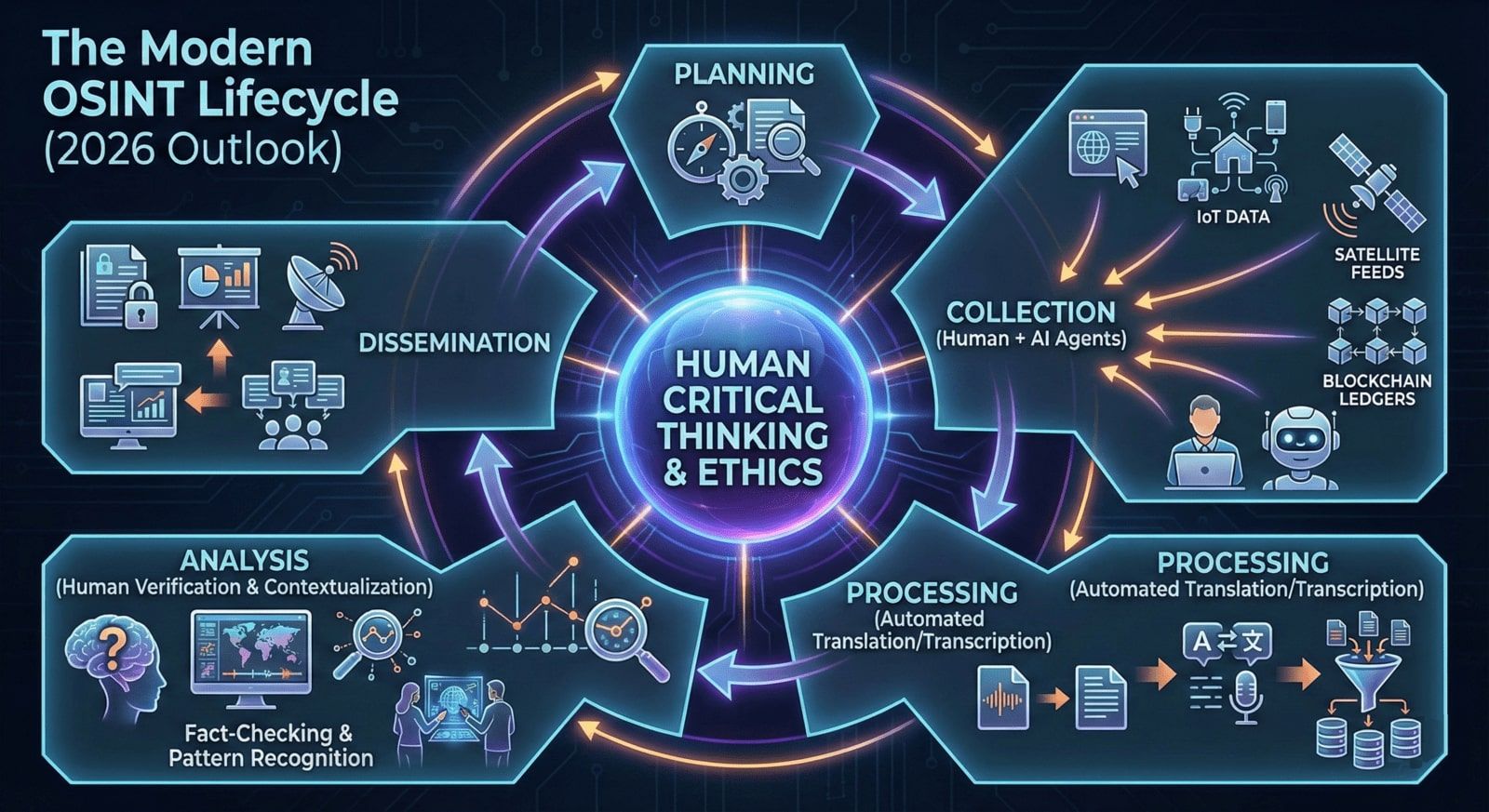
A professional OSINT investigation follows an intelligence cycle, adapted for the speed of the internet.
Planning and Direction
Before you type a single query, define your goal. What is the exact question you need to answer? "Find out about this bad actor" is too vague. "Identify the physical location where this specific piece of malware was compiled based on developer metadata and time zone artifacts" is a workable goal.
Collection and OPSEC
This is where open source investigation techniques come into play. We move from passive reconnaissance (observing without interacting) to active measures.
- The 2026 Toolkit. We aren't just using Google Dorks anymore. We are leveraging specialized search engines for IoT devices, analyzing blockchain transactions, and using automated scrapers to archive transient social media stories.
- Operational Security (OPSEC). You cannot conduct serious investigations from your home IP address logged into your personal Gmail. By 2026, adversary attribution capabilities will be even faster. You need layered defenses—dedicated hardware, complex VPN chains, and personas that cannot be linked back to your real identity. If you are investigating a state actor, assume they are hunting you back.
Processing and Analysis
Collection is easy; making sense of it is hard. You might have terabytes of scraped video, thousands of archived tweets, and dozens of corporate records.
Analysis involves evaluating the reliability of your sources. Is that Telegram channel a primary source, or is it reposting propaganda? You must triangulate data. If a satellite image suggests a building was destroyed on Tuesday, do social media posts from locals corroborate that timeline?
Dissemination
An investigation is useless if the final report is incomprehensible. You must present your findings clearly, separating hard facts from analyst assessments, and showing your work so others can verify it.
Will OSINT be replaced by AI?
It’s the question I hear constantly. By 2026, AI and LLMs will be baked into every investigation we run—that much is inevitable. But the people claiming the software will just run on autopilot? They’re wrong. AI isn't going to replace human investigators; it’s going to free us up. It is incredible at the heavy lifting—summarizing massive files, translating real-time chatter, or spotting anomalies in hours of drone footage. We are talking about tasks that used to take a team of analysts weeks, now finishing in minutes.
But here is the catch
AI doesn't understand context. I’ve personally watched models confidently misidentify military hardware or treat a sarcastic tweet like a credible threat. If you rely solely on what the machine tells you without verifying it, you aren't just being lazy—you’re being dangerous.
The future of OSINT investigations belongs to the "centaur" model—human intelligence aided by machine speed. The human provides the creative hypothesis and the ethical guardrails; the AI provides the scale.
Is using OSINT legal?
Just because information is "publicly available" does not mean it is legally free to use in every context. The line between a legitimate open source investigation and cyberstalking, harassment, or corporate espionage can sometimes be blurry, depending on your jurisdiction.
In the United States, for example, the Department of State’s open-source intelligence strategy emphasizes adherence to legal standards and privacy protections.
Key legal and ethical considerations include:
- Privacy Laws. GDPR in Europe and various state laws in the US act as constraints on how you can collect and store personal data found online.
- Terms of Service Violation. Scraping data from platforms like LinkedIn or Facebook usually violates their ToS. While not always a criminal offense, it can get you banned and your investigative personas burned.
- Hacking vs. OSINT. OSINT stops at the password prompt. Trying to guess credentials, exploiting a vulnerability to access a private server, or deceiving someone into giving you private info is not OSINT; it's illegal hacking or social engineering.
A professional maintains a rigid ethical framework. We document where every piece of data came from to prove it was obtained legally.
How to become an open source investigator?
I get asked this by brilliant computer science students and seasoned journalists alike. Having a PhD in cryptography helps with the technical side, but it’s not the entry requirement.
The primary requirement for successful open source investigations is an almost pathological curiosity combined with deep skepticism. You need a mindset that refuses to accept surface-level information.
To start:
- Master the Fundamentals. Before buying expensive tools, learn how the internet actually works. Understand DNS, IP routing, how browsers render data, and the basics of Linux. Institutions like the University of Tennessee, Knoxville, provide excellent introductory resources on what OSINT really is beyond the hype.
- Learn a Scripting Language. By 2026, knowing some Python won't just be for developers. It will be necessary for investigators to tweak scrapers, automate repetitive searches, and parse large datasets that Excel can't handle.
- Join the Community. The OSINT community is incredibly collaborative. Participate in CTFs (Capture The Flag events), follow reputable researchers on social media, and try to replicate their findings.
The field of open source investigations is evolving faster than any university curriculum can keep up with. The only way to stay relevant is through constant, hands-on practice. As we move toward 2026, the tools will change, the platforms will shift, but the need for truthful, verifiable information will only grow. Stay curious, stay paranoid, and keep digging.