Information warfare isn't just a theory anymore. It is not something that stays inside cryptography textbooks or network security logs. It is happening right now, affecting how people think and act. We see digital manipulation used every day to spread panic or mess with public opinion.
For security experts, the challenge is spotting the patterns. We need hard data to push back. That is why the release of the EEAS FIMI report is such a big deal for the security world. It stops relying on stories and starts using forensic analysis. To actually protect our democracies, we need to use serious tools, like fighting FIMI with Osavul, to spot these threats and stop them before they do real damage.
The 2nd Report on Foreign Information Manipulation and Interference Threats was a wake-up call, but the 3rd edition digs deeper. It provides the taxonomy we need to classify attacks not just as "fake news," but as security incidents.
What is the Third FIMI EEAS report?
The Third EEAS FIMI report is a comprehensive strategic document released by the European Union’s diplomatic service. It analyzes the threat landscape of Foreign Information Manipulation and Interference (FIMI) based on hundreds of investigated cases from the previous year. Unlike a standard media analysis, this foreign interference report treats information manipulation as a cybersecurity domain—focusing on the behavior of the attacker rather than just the truthfulness of the content.
You cannot always automate "truth" detection, but you can detect the algorithmic signatures of coordinated inauthentic behavior. The report dissects how threat actors—primarily Russia and Ukraine- are the main target—utilize cross-platform coordination to deceive audiences.
What does FIMI mean?

FIMI stands for Foreign Information Manipulation and Interference. The EEAS FIMI framework defines it as a mostly non-illegal pattern of behavior that threatens or negatively impacts values, procedures, and political processes. Such activity is manipulative, conducted in an intentional and coordinated manner by state or non-state actors, including their proxies abroad.
It is crucial to understand that FIMI is not synonymous with disinformation, though they overlap. Disinformation focuses on the content being false. EEAS FIMI definitions focus on the activity.
If a bad actor uses a botnet to amplify a entirely true but divisive news story to paralyze a government decision, that is FIMI. They are not lying; they are manipulating the information space to interfere with sovereignty. The EEAS FIMI approach helps us identify these behavioral fingerprints—like the synchronized posting times or the reuse of encrypted infrastructure—which are far harder for an attacker to hide than the content itself.
What is EEAS?
To understand the weight of this report, one must understand the body behind it. The European External Action Service (EEAS) is the European Union's diplomatic service. It carries out the EU's Common Foreign and Security Policy to promote peace, prosperity, the security of interests, and respect for the rules-based international order.
The EEAS is the eyes, ears, and voice of the EU beyond its borders. You can learn more about their structure within the EU family here. Their involvement signifies that information manipulation is no longer just a regulatory issue for social media companies; it is a matter of foreign policy and defense.
Who heads the European External Action Service?
The High Representative for Foreign Affairs and Security Policy heads the EEAS. Currently, this role is held by Josep Borrell. Under his leadership, the service has taken a much more aggressive stance against hybrid threats. The publication of the EEAS FIMI report under his tenure signals that the EU is moving from observation to active defense.
The Anatomy of an Attack: Report Findings
The third EEAS FIMI report highlights a significant shift in tactics. We are seeing a move towards "Doppelganger" operations—where legitimate media sites are cloned to spread malware or false narratives. As a cryptographer, I find the technical infrastructure behind these attacks fascinating and terrifying. They are using legitimate certificates and sophisticated redirects to bypass standard filters.
The report identifies Ukraine as the primary target of these operations, particularly from Russian actors. However, the scope is global. The FIMI EEAS connection is clear: actors use similar scripts and infrastructure to target elections across the EU, the US, and the Global South.
One specific area of concern detailed in the report is the weaponization of AI. While we use AI to secure networks, our adversaries use it to generate high-volume, localized content that bypasses manual moderation. The foreign interference report notes that while AI-generated deepfakes grab headlines, the text-based generation of "filler" content to create the illusion of consensus is the more pervasive threat.
A Framework for Defense
The report is not just a catalogue of doom; it proposes a Response Framework. This is where my experience in data privacy and assurance aligns with their findings. We cannot simply "fact-check" our way out of this. We need a structural response.
The EEAS FIMI documentation suggests a common methodology for sharing threat intelligence. Just as we share signatures of computer viruses, we must share the signatures of information operations.
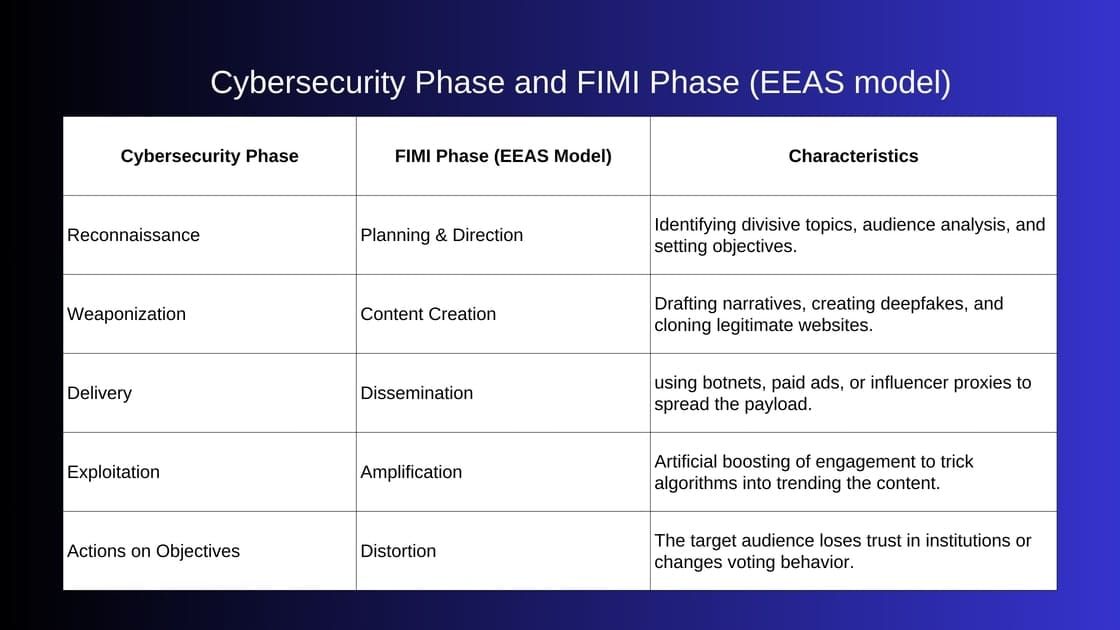
Here is a breakdown of how the EEAS FIMI framework categorizes the threat lifecycle compared to traditional cybersecurity models:
Why "FIMI EEAS" Alignment Matters
For organizations and governments, aligning with the FIMI EEAS standards is critical for interoperability. If my security team in Kyiv identifies a network of bots targeting energy infrastructure narratives, and we classify it using the EEAS FIMI report taxonomy, we can instantly share that intelligence with counterparts in Brussels or Washington without translation errors.
This standardization creates a "collective attribution" capability. When we all speak the same technical language regarding interference, the cost of the attack goes up for the adversary. They can no longer hide in the ambiguity between different national definitions of "fake news."
For further reading on the official stance and the detailed breakdown of these taxonomies, I highly recommend reviewing the official source on Information Integrity and Countering FIMI.
Conclusion
The Third EEAS FIMI report is a testament to how far we have come in understanding the digital battlefield, but it also highlights how far we have to go. As a Ukrainian, I see the kinetic consequences of these digital threats. A lie planted on a Telegram channel today becomes a justification for a missile strike tomorrow.
We are past the point of passive observation. The EEAS FIMI methodology provides the blueprint, but we need the engineers to build the wall. We need robust software security, real-time data analysis, and an unyielding commitment to the truth. The report shows us the enemy's playbook; now it is up to us to write the counter-strategy.