The term hybrid threats has moved from military textbooks into the heart of corporate and civic discourse. To understand the gravity of these modern challenges, one should first look at how coordinated campaigns manipulate public perception, as we explored in our previous look at hybrid information operations.
At Osavul, we monitor the pulse of the information environment every day. We see how the convergence of technology and traditional power projection creates a landscape where victory isn’t measured in miles of territory, but in the erosion of trust.
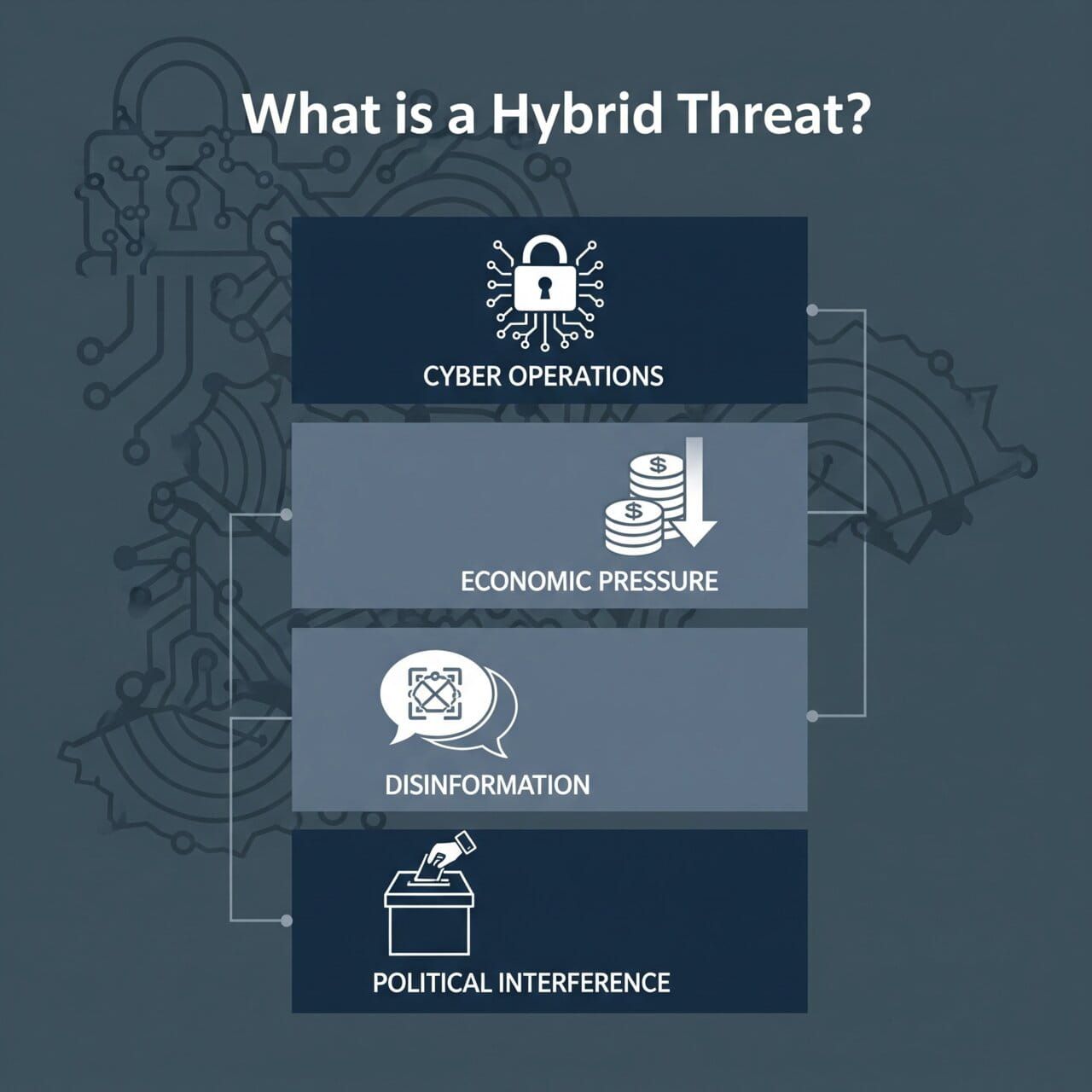
What is a Hybrid Threat?
That is a spot-on way to frame it. The "cocktail" analogy is perfect because, just like a drink, the individual ingredients might seem manageable on their own, but when they’re mixed together, they create an entirely different—and much more potent—effect.
The "gray zone" you mentioned is exactly where the most sophisticated actors prefer to live. It’s that uncomfortable space where things are clearly "not right," yet they don't quite trigger a formal military response or a specific legal violation. It forces a defender to ask, "Is this a random power outage, or is someone testing our grid?" or "Is this a grassroots protest, or was it manufactured in a bot farm?"
Hybryd Threat’s Directons
- Lawfare. Using a target’s own legal system against them to tie up resources or delegitimize institutions.
- Economic Blackmail. Using supply chain dependencies (like energy or rare minerals) as a silent gun to the head during negotiations.
- Cultural Subversion. Slowly eroding the social fabric by amplifying existing internal divisions until a society can't agree on basic facts.
It’s a chess game where the board is constantly shifting.
The Foundation - Hybrid Warfare Definition
When we try to get a handle on the full scope of what we’re facing, we have to look closely at the hybrid warfare definition. In its simplest form, it’s about the strategic use of every tool a state has—political, economic, social, and digital—to hit a target where it hurts. While old-school war is about tanks and soldiers, hybrid warfare relies on the synergy between those physical forces and "softer," sneakier measures like messing with elections or even weaponizing migration.
People often ask us: What is hybrid warfare in the 21st century? Honestly, it’s the art of staying "under the radar." By using hackers, bots, and third-party proxies, an adversary can shake a nation’s foundation without ever firing a single bullet that leads back to them.
Breaking Down the Mechanics - What is a Hybrid Attack?
If we think of the warfare as the long-term plan, then a hybrid attack is the boots-on-the-ground execution. Imagine a synchronized release of leaked (and often doctored) documents hitting the news at the exact same moment a government’s website goes dark from a DDoS attack, all while fuel prices suddenly spike because of market manipulation.
So, what is a hybrid attack in a practical sense? It’s a multi-pronged strike designed to completely overwhelm how a leader thinks and decides. When everything seems to be falling apart at once, it’s hard to know what to fix first, and that’s when people start losing faith that their government can actually protect them.
Why OSINT is Central to Countering Hybrid Threats
In this world, information is the primary battlefield. This is why Open Source Intelligence (OSINT) has become our most essential tool for defense. We get a lot of questions about how OSINT fits into this puzzle, and the most common one is: Can OSINT actually catch a hybrid threat before it gets out of hand?
The answer is yes. By keeping a close eye on public data, social media trends, and technical logs, analysts can spot the "noise" that always comes before a big campaign. A hybrid threat rarely starts with a loud bang; it starts with a whisper—a few small, seemingly random stories that slowly start to sync up and gain steam across different corners of the internet.
Is OSINT just about social media? Not at all. While social media is a major component, OSINT involves analyzing satellite imagery, shipping manifests, financial records, and public registries. In the context of hybrid warfare, OSINT allows us to connect the dots between a physical troop movement on a border and a simultaneous digital campaign targeting the residents of that border region.
The NATO Perspective
The international community has recognized that no single nation can face these challenges alone. NATO has been at the forefront of defining and responding to these multifaceted dangers. Their documentation on countering hybrid threats serves as a vital framework for understanding how democratic institutions can build resilience. They emphasize that hybrid threats target the "seams" of our societies - the places where our legal, political, and technical systems overlap and leave gaps.
The Evolution of Disinformation
At Osavul, we’ve seen that disinformation has become the heavy hitter in the hybrid warfare toolkit. It’s moved far beyond the "fake news" labels we’re all tired of hearing. Today, these campaigns use AI to craft narratives that feel deeply personal, specifically designed to pull at the seams of a community. By picking at existing scars and amplifying local grievances, a hybrid threat can essentially trick a country into fighting with itself, leaving it wide open to outside pressure.
This isn't some "what if" scenario for the future. We’re seeing hybrid threats show up right now—whether it’s the sudden disruption of energy grids, hackers quietly slipping into private companies to steal years of hard work, or the coordinated bullying of journalists and activists to keep them quiet. When you add all these pieces up, the real casualty isn't just data or money; it’s our collective sense of what’s actually true.
How to Build Resilience
Stopping a hybrid attack isn't something one person or one department can do alone. It takes a "whole-of-society" mindset. It’s not just a job for the military or the police—it needs the private sector, the media, and everyday people to stay sharp.
- Technological Defense. We have to start by making our digital infrastructure a much harder target for cyber-attacks.
- Narrative Awareness. We need to get better at spotting how stories are being twisted. When we understand the "why" behind a post, we stop the spread of harmful disinformation in its tracks.
- Cross-Sector Collaboration. Information shouldn't live in a vacuum. When government agencies and tech companies actually talk to each other, we can catch these threats while they're still in the "whisper" stage.
At Osavul, we believe that the only way to effectively counter these maneuvers is through advanced analysis and proactive monitoring. This is exactly why we developed our Nebula solution, which is designed specifically for fighting Foreign Information Manipulation and Interference (FIMI). By utilizing high-level OSINT and machine learning, we help organizations identify the fingerprints of a hybrid threat long before it reaches the level of a national crisis.
The Future of Security
The way we see it at Osavul, the goalposts for these challenges are always moving. As things like deepfakes and generative AI become tools that almost anyone can use, the cost of launching a hybrid attack is dropping fast. At the same time, the potential for real-world damage is only climbing. That "gray zone" we talk about - the space where it’s hard to tell fact from fiction - is getting more crowded by the day.
But here’s the thing: the best defense hasn't changed. It’s still clarity. By honestly asking what is a hybrid threat and pulling its different pieces apart, we take away its greatest weapon: the power to confuse us. When we back up that curiosity with the right tools to double-check what we’re seeing, we can hold our ground against even the most calculated attempts to mislead us.
Ultimately, while the tactics of conflict are shifting, our ability to keep up is growing just as fast. By leaning into smart OSINT practices and staying stubborn about the integrity of our information, we can navigate these complexities and keep our digital and physical communities safe. Whether it’s through countries working together or new tech built right here, dealing with hybrid threats is a journey we’re all on together. It’s a challenge that will define our future, but it’s one we’re more than capable of meeting.