Let’s talk about protection from information manipulation. Humans are full of grey areas, biases, and emotional triggers. That is exactly where the modern battlefield lies. It’s no longer just about hacking servers to steal credit card numbers; it’s about hacking perception to steal consensus.
For those of us who have spent years in information assurance, the shift is undeniable. The threat has moved from the infrastructure to the content itself. We are now up against a relentless, automated, and scientifically precise campaign of information manipulation - one designed to destabilize societies, wreck reputations, and rewrite history.
What is the meaning of manipulation of information?
In a technical sense, it is a coordinated authenticity attack. It is the deliberate injection of noise into a communication channel to degrade the signal. Unlike simple rumors or accidental errors, this is strategic. It involves state actors, private "black PR" firms, and hacktivists utilizing the very algorithms that govern our social media feeds to amplify specific narratives.
This goes way beyond someone just telling lies on the internet. We are looking at a "Sybil attack" on democracy. It involves spinning up thousands of fake identities—bots, trolls, compromised accounts—to manufacture the illusion of support for a fringe idea. When you see a hashtag suddenly trend or a controversial post get thousands of shares in minutes, you aren't seeing public opinion. You are seeing a script execution.
The Theory Behind the Attack
Security experts often refer to the "Kill Chain" - the stages of a cyberattack. There is a similar framework here. What is information manipulation theory? It is the study of how information can be weaponized to exploit cognitive vulnerabilities. The theory suggests that if you can overload a target's capacity to process information (a cognitive DDoS attack), they will revert to heuristics - mental shortcuts.
These shortcuts are where media manipulation thrives. By targeting fear, anger, or tribal loyalty, manipulators bypass the brain's critical analysis centers. They don't need you to believe the lie forever; they just need you to react to it now. They need the click, the share, the outraged comment. That reaction is the fuel that pushes the false information further into the network.
The Payload - Information-Based Manipulation
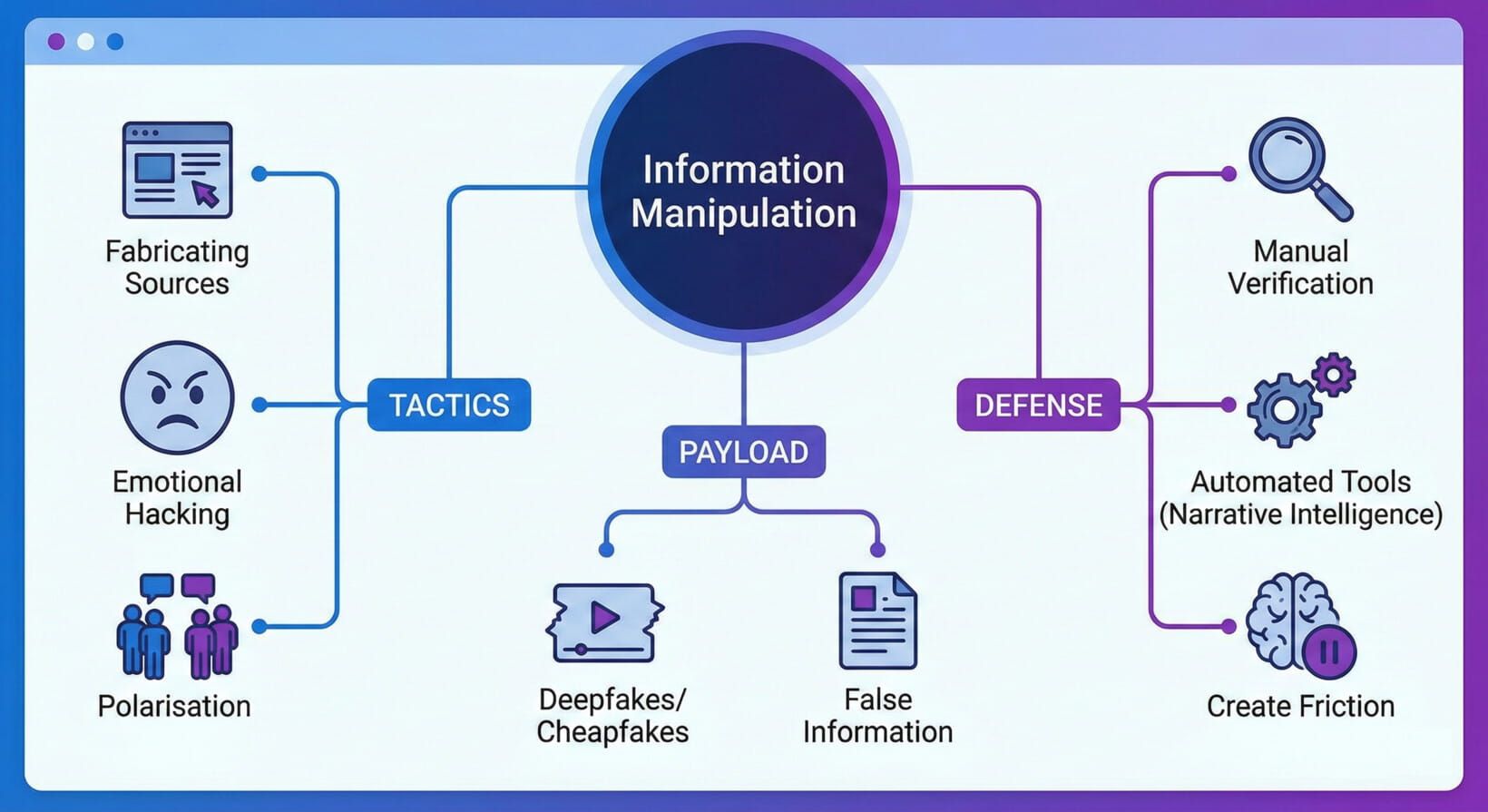
When we analyze the specific vectors, we ask: What is information-based manipulation? This refers to the content itself - the payload. This can take many forms, from subtle decontextualization to blatant fabrication.
In the past, spotting a fake required looking for bad Photoshop skills. Today, we face manipulated content generated by neural networks. Deepfakes can make a CEO declare bankruptcy on video; voice cloning can make a politician threaten war. But even low-tech methods are effective. "Cheapfakes" - where a real video is slowed down, sped up, or captioned incorrectly - are rampant.
The danger of information-based manipulation is that it erodes the "chain of custody" for truth. In a secure data environment, every file has a checksum to prove it hasn't been altered. On the open web, there are no checksums for news. A screenshot of a tweet can be fabricated in seconds, and once it spreads, the retraction never catches up to the lie.
Tactics Used to Fool Us

Understanding the enemy's playbook is half the battle. The European Parliament recently published a helpful breakdown on spotting disinformation and the six tactics used to fool us. From an OSINT (Open Source Intelligence) perspective, these tactics act as "signatures" - patterns we can look for to identify malicious activity.
- Fabricating Sources. Manipulators often build entire ecosystems of fake news sites. They snap up expired domains that sound legitimate - like "BBCNews.ltd" instead of the real BBC - to host false information. It looks real at a glance, and that’s the point.
- The Firehose of Falsehood. This tactic relies on sheer volume. By flooding the zone with dozens of conflicting theories about an event, the attacker buries the reality. They don't need to prove their version is true; they just need to make you doubt that any version is true.
- Emotional Hacking. If a post makes you physically angry or terrified within seconds, it’s likely a weaponized narrative. Information manipulation relies on high-arousal emotions to trigger that "share" button before your logical brain has a chance to kick in.
- Polarisation. This is the "divide and conquer" of the information age. Attackers identify existing cracks in society - politics, race, religion - and pump out content to widen them. They play both sides, often using bot farms to argue with each other just to create the illusion of a fierce debate where there wasn't one.
How do we defend ourselves?
Manual verification is essential, but in the face of automated threats, we need automated defenses. You cannot fight a bot farm with a magnifying glass alone. This is where narrative intelligence comes into play.
Advanced platforms are now capable of analyzing the propagation of narratives across the web in real-time. For instance, Osavul’s narrative intelligence solution Nebula allows analysts to visualize where a story originated, how it mutated, and who is amplifying it. By treating information flows like network traffic, we can identify "inauthentic behavior" - such as thousands of accounts posting the exact same phrase at the exact same second - which is a hallmark of coordinated information manipulation.
Practical Steps for the User
While enterprise tools protect organizations, individuals need to adopt a "Zero Trust" mindset. In information security, Zero Trust means "never trust, always verify." Apply this to your news feed.
- Audit the Source. Do not look at the headline; look at the URL. Is it a verified domain? Does the site have a clear editorial team, or is it an opaque blog registered last week?
- Reverse Search Everything. If you see a shocking image, drop it into Google Lens or TinEye. You will often find that the "war zone photo" you are looking at is actually a movie set from five years ago. This is the quickest way to spot manipulated content.
- Check the Metadata of the Narrative. Ask yourself, "Cui bono?" - who benefits? If a story aligns perfectly with the strategic interests of a hostile state or a competitor, treat it with extreme caution.
- Watch for Logical Fallacies: Disinformation often uses "whataboutism" (deflecting blame) or strawman arguments. Being able to spot a logical error is as important as spotting a technical one.
What's the best advice for avoiding misleading information?
It comes down to friction. The entire social media ecosystem is designed to remove friction - to make sharing effortless. You must reintroduce it. Create a mental "air gap" between seeing information and accepting it.
When you encounter a piece of false information, do not engage with it. Do not comment to correct it. Do not "quote tweet" it to mock it. Algorithms do not care about your sentiment; they only count the engagement. By reacting, you are boosting the signal. The most effective response to media manipulation is often silence and reporting.
Conclusion
We are living through a crisis of epistemic security. The barrier to entry for creating convincing information manipulation campaigns has never been lower. However, the tools and techniques to fight back are evolving just as fast.
Whether you are a casual reader or a security analyst, the responsibility is the same. We must treat information consumption with the same hygiene we apply to our food or our cybersecurity. We verify the ingredients. We check the source. We do not swallow the bait. By combining human skepticism with powerful analytical tools, we can clear the fog and find the signal in the noise.