If you work in the security sector, you’ve likely heard these terms thrown around interchangeably. You might be sitting in a briefing or scrolling through a threat intelligence report, and someone mentions "IO" when they clearly mean "IW," or vice versa. We hear it in boardrooms in Kyiv and at conferences in Washington. But words matter. Definitions matter. Especially when the consequences of getting it wrong aren't just semantic—they are operational.
We, at Osavul, see it firsthand in our analysis. Security is no longer just about protecting data packets; it’s about protecting narratives, cognition, and the very integrity of decision-making. To do that effectively, we need to understand the battlefield. And that starts with clarifying the battle itself.
This isn’t just academic theory. Our information security experts see the practical application of these concepts every single day. But whether you are a CISO (Chief Information Security Officer) protecting a brand or an analyst tracking state actors, understanding the distinction between information operations vs information warfare is the first step in building a resilient defense.
What are information operations?
Let’s start with the "how."
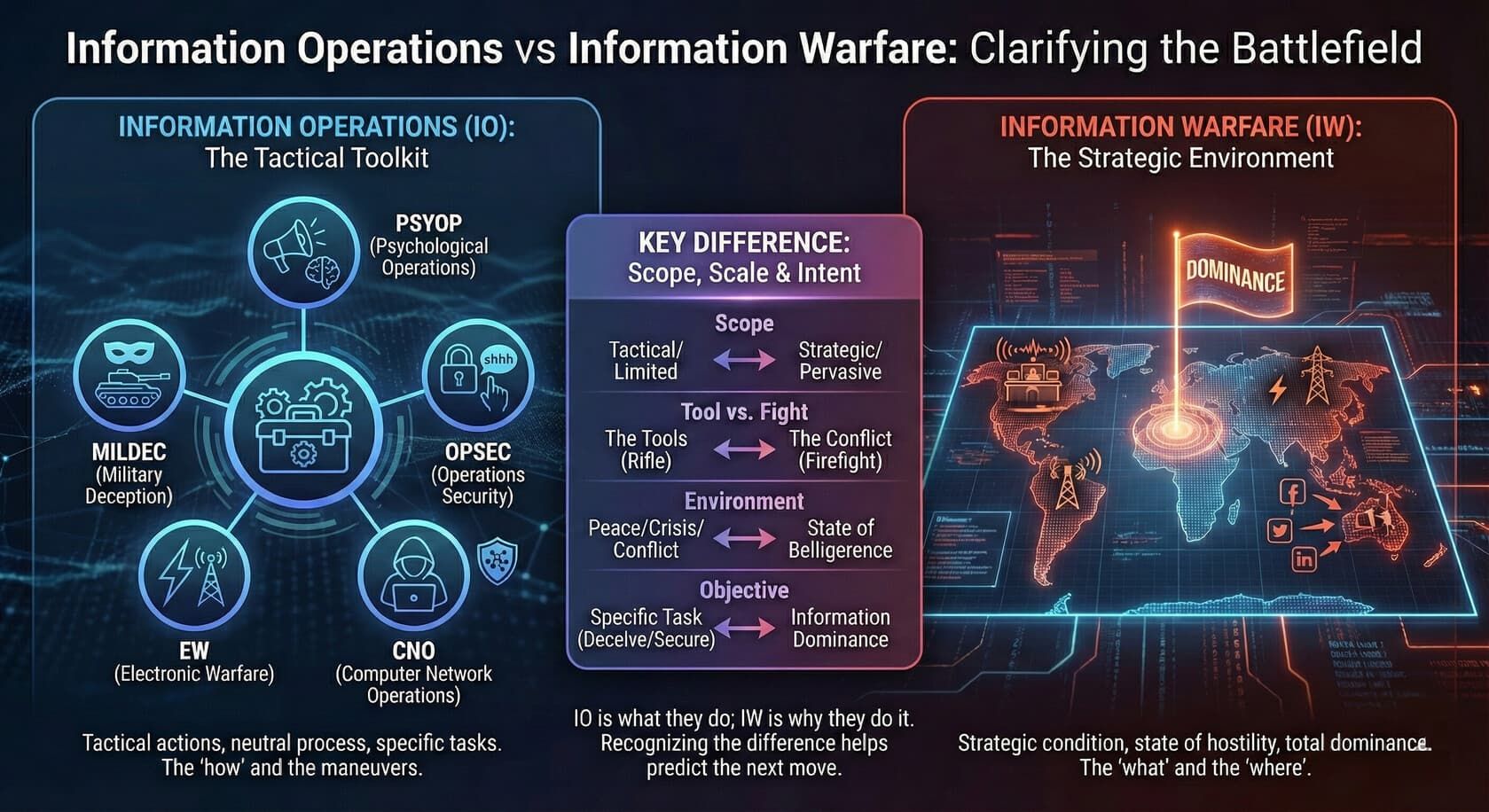
Information Operations (IO) are the integrated employment of information-related capabilities. Think of IO not as the fight itself, but as the maneuvers and the toolkit used to influence, disrupt, corrupt, or usurp the decision-making of adversaries and potential adversaries while protecting your own.
In my view
In my view, information operations are neutral in their nature. They are actions. A state can conduct IO during peacetime to maintain stability. A corporation might conduct a form of IO (though they wouldn’t call it that) to manage a PR crisis. It is a process of managing information flows to achieve a specific objective.
However, in the context of security and defense, we look at IO as a coordinated suite of capabilities. It isn’t just one guy posting on Twitter or a hacker deploying ransomware. It is the synchronization of those efforts. When we analyze a threat actor, we aren't just looking at the malware code; we are looking at the timing of the leak that followed the breach. That synchronization is the hallmark of sophisticated IO.
What are the 5 pillars of information operations?
To really grasp the scope, you have to look at the doctrine that shaped this field. While modern definitions evolve, the foundational framework relies on five core capabilities. These are the gears that make the machine turn.
- Psychological Operations (PSYOP). This is the one everyone thinks of first. It’s about conveying selected information to foreign audiences to influence their emotions, motives, objective reasoning, and ultimately, the behavior of foreign governments, organizations, groups, and individuals. In the OSINT world, we track this by mapping bot farms or identifying coordinated inauthentic behavior on social platforms.
- Military Deception (MILDEC). This is the art of misleading. It’s about encouraging the adversary to take specific actions (or inaction) that are detrimental to their interests. In cyber security, think of honeypots—systems designed to look valuable to lure attackers away from the real assets.
- Operations Security (OPSEC). If MILDEC is about showing the wrong thing, OPSEC is about hiding the right thing. It involves identifying critical information and analyzing friendly actions attendant to military operations and other activities. It’s keeping your mouth shut and your metadata clean so the enemy can’t derive your intentions.
- Electronic Warfare (EW). This brings us to the physics of the fight. EW is any military action involving the use of electromagnetic and directed energy to control the electromagnetic spectrum or to attack the enemy. Jamming a drone signal or intercepting unencrypted radio comms falls here.
Computer Network Operations (CNO). This is my home turf. It encompasses the capabilities used to attack, deceive, degrade, disrupt, deny, exploit, and defend electronic information and infrastructure. It’s the hacking, the patching, and the digital maneuvering.
When we discuss information operations vs information warfare, we often get stuck on just one of these pillars. But a true IO campaign uses them in concert. A cyber attack (CNO) might be timed to shut down a power grid, while PSYOP channels spread panic about the outage, and EW prevents emergency services from coordinating. That is the synergy of IO.
What is information warfare?
If IO is the "how," Information Warfare (IW) is the "what" and the "where."
Information warfare is the environment of conflict itself. It is the struggle for information dominance. It implies a state of hostility where information is both the weapon and the target.
IW is an older concept than cyber warfare
It dates back to Sun Tzu. The goal of IW is to deny the enemy the ability to acquire and use information accurately. It is about seizing the initiative. In a hot war, you bomb a command center. In information warfare, you flood the command center with so much noise and false data that the general makes the wrong decision, or you cut off their ability to communicate entirely.
We often view IW as the strategic umbrella. It is the total application of destructive and constructive information capabilities to compel an adversary. While IO comprises the specific tactical missions, IW is the broad strategy of using information to win.
Consider the difference in stakes. An operation might be a single campaign to discredit a political figure. Warfare is the sustained, multi-front effort to destabilize the political system itself. It aggregates all those operations into a strategy of dominance.
What is the difference between information operations and information warfare?
What is the difference between information operations and information warfare?
This is where the rubber meets the road. Distinguishing between information operations vs information warfare isn't just about splitting hairs; it's about understanding intent and scale.
The primary difference lies in the relationship between the action and the state of conflict.
- Scope and Scale. When we analyze information operations vs information warfare, we see that IO is often tactical or operational. It is a set of tasks. You plan an IO. You execute an IO. It has a start and an end. Warfare, however, is strategic and pervasive. It is a condition. You are in a state of information warfare. It involves the total mobilization of national or organizational resources to control the information environment.
- The "Tool" vs. The "Fight". Think of a rifle. Firing the rifle at a target is an operation. The firefight itself—the maneuvering, the suppressing fire, the objective to take the hill—that is warfare. Similarly, information operations vs information warfare can be viewed as the distinction between the tools (IO) and the application of those tools in a conflict (IW). IO provides the capabilities (the 5 pillars); IW provides the context and the strategic objective of dominance.
- Peacetime vs. Wartime. This is a nuanced point, especially here in Ukraine where the lines are blurred. Traditionally, IO can be conducted in peacetime, crisis, and conflict. It is a constant activity. Information Warfare, by its name, implies a state of belligerence. However, in the modern "gray zone" conflicts, this distinction is fading. We see adversarial states engaging in IW tactics—sabotaging infrastructure, meddling in elections—without a formal declaration of war.
- Comparing the Objectives. If we look at information warfare vs information operations, the objective of IW is always dominance—winning the information space. The objective of IO might be more limited: to deceive a specific radar system for one hour, or to secure a specific network segment. IO supports the broader goals of IW.
- The Human Element. From my background in cryptography and privacy, I see another layer. IO can often be technical—executing a script, jamming a frequency. IW is almost always psychological at the strategic level. It targets the "will to fight." You can have a successful CNO (a pillar of IO) that hacks a system, but if it doesn't contribute to breaking the adversary's will or decision cycle, it hasn't succeeded in the context of IW.
Why does this matter for your security?
You might be thinking, "I run a bank," or "I manage a logistics company, why do I care about military doctrine?"
Because the tactics have democratized. The tools used in state-level information operations vs information warfare are now available on the dark web or are being used by corporate spies and hacktivists.
If you are a business, you are likely the target of IO. Disinformation campaigns to tank your stock price? That’s PSYOP. Phishing attacks to steal your IP? That’s CNO. Competitors analyzing your supply chain based on your public data? That’s OPSEC failure.
Understanding these concepts allows you to build a defense that isn't just a firewall. It helps you build an information defense. You stop looking for just "hackers" and start looking for coordinated attempts to manipulate your perception and your reality.
In the end
The debate of information operations vs information warfare comes down to this: IO is what they do; IW is why they do it. Recognizing the difference helps you predict their next move. And in my line of work, predicting the next move is the difference between safety and catastrophe.