Look out the window. Look at your phone. Everything looks fine, right? Emails come in, you scroll through the news, and laugh at a few memes. It feels peaceful. But just below that glass screen, there is a fight going on. It isn't a war over land or oil—not the way we're used to thinking about it.
At Osavul, we’ve realized that the ultimate target isn't the database; it's the human mind that interprets it. This isn't just propaganda on steroids. It's something far more systemic and dangerous. So, what is cognitive warfare?
The Battlefield of the Mind
To understand the cognitive warfare definition, you have to step away from the idea of simple "fake news." Fake news is just a bullet; cognitive warfare is the entire strategy of the battlefield.
Cognitive warfare is the art of using information—true, false, or a mix of both—to alter how people think, feel, and act. The aim is to break the mechanism you use to process reality. It’s about pumping enough noise, fear, and manufactured rage into the system that a society forgets how to agree on anything. When people can't agree on basic facts, they can’t make decisions. They can't defend themselves. Eventually, they stop fighting the enemy and start tearing each other apart.
The true cognitive warfare meaning lies in its subtlety. It’s designed to bypass your critical thinking defenses by appealing directly to your biases, emotions, and tribal identities. It drafts every single one of us into the army, usually without us knowing. If an attacker can trigger you—make you angry enough to hit "share" without checking the source—you’ve just become a weapon for them.

What is the Difference Between Information Warfare and Cognitive Warfare?
People mix these up constantly. Even in the industry, you hear them used interchangeably, but they are completely different animals.
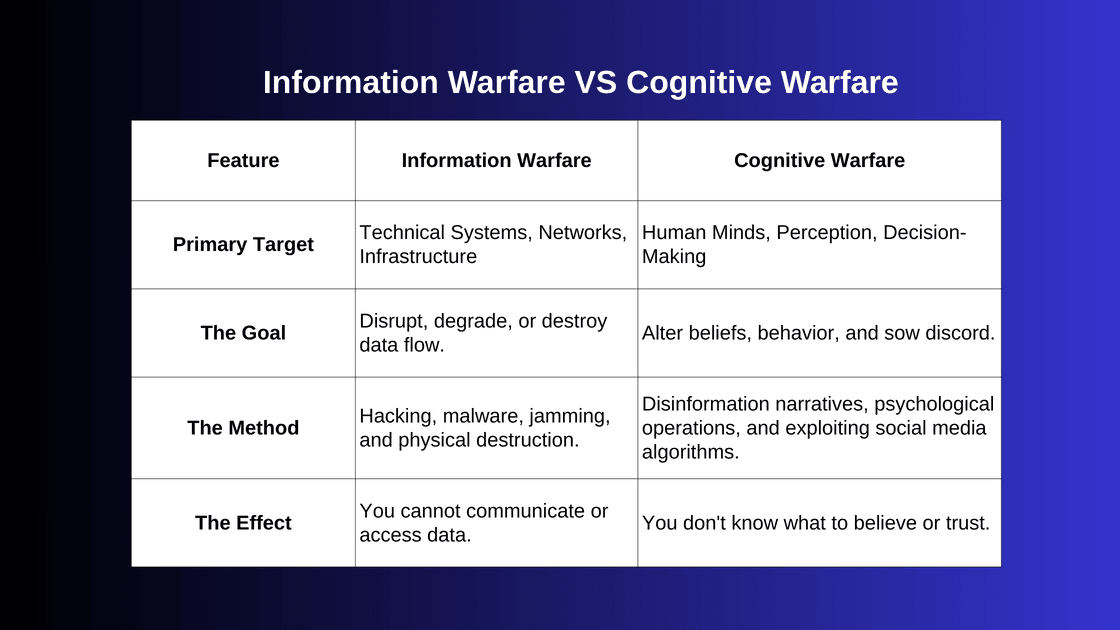
Think of Information Warfare as the plumbing. It’s technical. It’s DDoS attacks taking down a government portal, encrypting a database, or cutting a fiber optic cable. The target is the machine. The goal is to stop data from moving. If I hack a radar station so it can’t see a plane coming, that is information warfare.
Cognitive Warfare is controlling what people believe about what comes out of the pipe. The target is the human. You don't need to destroy the radar station if you can convince the operator that the blips on the screen are friendly, or that the radar system itself is part of a government conspiracy to lie to him.
Information warfare restricts access to reality. Cognitive warfare distorts the interpretation of reality. It doesn't attack the hardware; it attacks the "wetware"—the human brain's decision-making loop. It exploits psychology, sociology, and the very algorithms of social media platforms that are designed to keep us engaged through outrage.
Here is a simple breakdown of the difference:
What is an Example of Cognitive Warfare?
Living in Ukraine, I don't have to look far for cognitive warfare examples. We have been ground zero for this for over a decade. But to show you how universal this is, let’s look at an example that applies globally.
Consider the long-game narrative of "eroding trust in expertise." This isn't about one specific lie; it's about a thousand tiny cuts designed to make people doubt established institutions.
An attacker will identify a polarizing issue—let's say, public health or climate science. They don't just push "anti-science" propaganda. They create a sophisticated, multi-layered ecosystem of doubt.
- Seeding the Narrative. They create "alternative news" sites and pseudo-academic journals that publish fabricated or highly misleading studies. These look legitimate on the surface.
- Amplification. They use bot networks and paid trolls to amplify these misleading articles on social media, making them appear popular and organic.
- Weaponizing Identity. They frame the issue not as a scientific debate, but as an identity struggle. "They (the elites, the scientists, the government) think you are stupid, but we know the truth." This triggers defensive tribal instincts.
- The Echo Chamber. Social media algorithms, designed to maximize engagement, see people reacting to this divisive content and feed them more of it, trapping them in a self-reinforcing reality loop.
The result? When a real crisis hits—a pandemic, an environmental disaster, a war—a significant portion of the population has been preconditioned to reject official information. They don't just doubt the facts; they actively believe the exact opposite because their cognitive map has been redrawn. That is cognitive warfare in action. It’s not about winning an argument; it’s about breaking the mechanism we use to have arguments in the first place.
How to Defend against Cognitive Warfare?
If you asked me how to defend a server, I'd give you a list of protocols, firewalls, and encryption standards. Defending against cognitive warfare is infinitely harder because you can't patch a human brain. We are emotional, biased, and easily triggered creatures.
However, defense is possible. It requires a two-front approach - individual hygiene and technological tooling.
Cognitive Hygiene
This is on you. Just as we learned to wash our hands to stop a virus, we need to learn mental habits to stop viral disinformation.
- The Pausing Principle. The goal of cognitive attacks is to bypass your rational brain and hit your emotional center. When you see something online that makes you immediately angry or fearful, stop. That physical reaction is the malware executing. Give yourself five minutes before you react or share.
- Lateral Reading. Don't just read the "About Us" page of an unfamiliar website. Open new tabs and search for what other, established sources say about that website. Who funds it? What is its history?
- Recognize Your Biases. We all love information that confirms what we already believe. Attackers know this. Be extra skeptical of content that perfectly aligns with your worldview. It's likely tailored just for you.

Technological Defenses
We can't fight machine-speed attacks with human-speed fact-checking alone. We need better tools. This is why platforms that specialize in information environment assessment are critical.
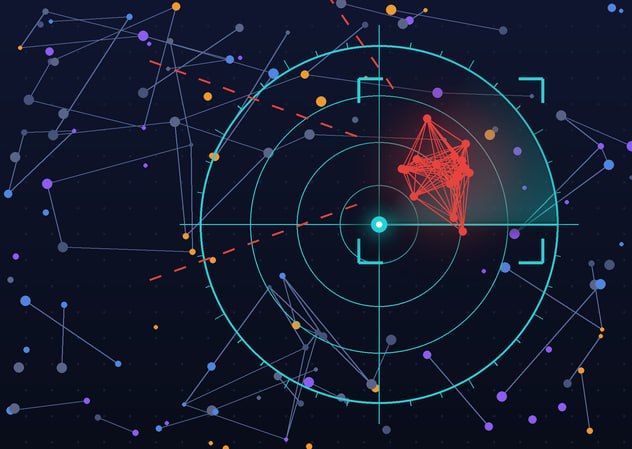
We need systems that don't just look at the content of a message, but at the behavior of how it spreads. These tools can identify coordinated inauthentic behavior—bot farms working in unison, narratives appearing simultaneously across disparate networks, and the artificial amplification of fringe voices.
We can't chase every single lie individually; that’s a losing game. We have to look at the network itself. By mapping how this stuff moves, we stop chasing the content and start dismantling the infrastructure that pumps it out. We have to see the battlefield to fight on it.
And let’s be clear. Fighting this isn't about censorship. Nobody wants a government telling them what to think. It’s about toughness. It’s about building up enough mental armor that when someone tries to hack your perception, you spot the con and shut it down. That is the only way we survive this.