A listening platform can capture a campaign perfectly and still tell you nothing worth knowing about it.
Last autumn, an energy client in Central Europe forwarded us a weekly digest they'd been getting for months. Clean document. 4,200 posts about a planned substation, sentiment marked mostly negative, a neat little volume curve. Nothing in it was wrong.
Here's what wasn't in it. Roughly 140 of the accounts making the noise had registered inside the same nine days. And the phrasing carrying the spike — an oddly specific line about groundwater — had run almost word for word against a different substation in a different country the previous spring. Their team read the digest as angry neighbours. Angry neighbours were in there, sure. They were the cover, not the campaign.
That distance between counting posts and understanding them is why tool selection deserves more scrutiny than it usually gets. So: what social listening tools actually do under the hood, which capabilities separate a working platform from a mention counter, and how the job changes in finance, energy, healthcare, retail, and government. Same software, five very different rooms.
What are social listening tools?
Social listening tools are software platforms that collect public conversations across social networks, messaging channels, forums, and online media, then analyze them to reveal patterns in opinion, emerging narratives, and coordinated behavior that no single post reveals on its own.
Analyze is doing the heavy lifting in that sentence. Collection stopped being hard years ago — you can have raw firehose access from a data reseller before lunch tomorrow. What a platform is really selling you is everything downstream of collection. Dedupe. Language handling. Clustering. Scoring. And the judgment baked into what gets escalated versus what quietly dies in a tab nobody opens.
One more wrinkle worth knowing before you sit in a demo. The term means two different things depending on who's saying it. Marketing means how does the audience feel. Security and risk mean who is organizing this. Identical raw posts — but the second question needs account registration dates, posting cadence, and cross-platform propagation chains. That's exactly the metadata consumer-grade platforms throw away to keep storage bills down. Ask about it early.
Social listening vs. social media monitoring
Social media monitoring tracks defined events and actors in real time; social listening aggregates conversation over longer windows to surface themes, sentiment shifts, and narrative structure. Monitoring answers what just hit us. Listening answers what's forming around us.
Most mature programs run both, and honestly the distinction only becomes expensive at procurement — when someone sells you one and the problem you had needed the other. Monitoring is tuned for latency, seconds and minutes. Listening is tuned for pattern recognition across weeks and months, which makes historical depth non-negotiable.
Thirty days of retention cannot tell you that the narrative attacking your board has surfaced three times since 2023. And the recurrence is the finding. Without the archive, you're looking at a first-time crisis every single time. We go deeper on the operational side in our guide to social media monitoring for security teams.
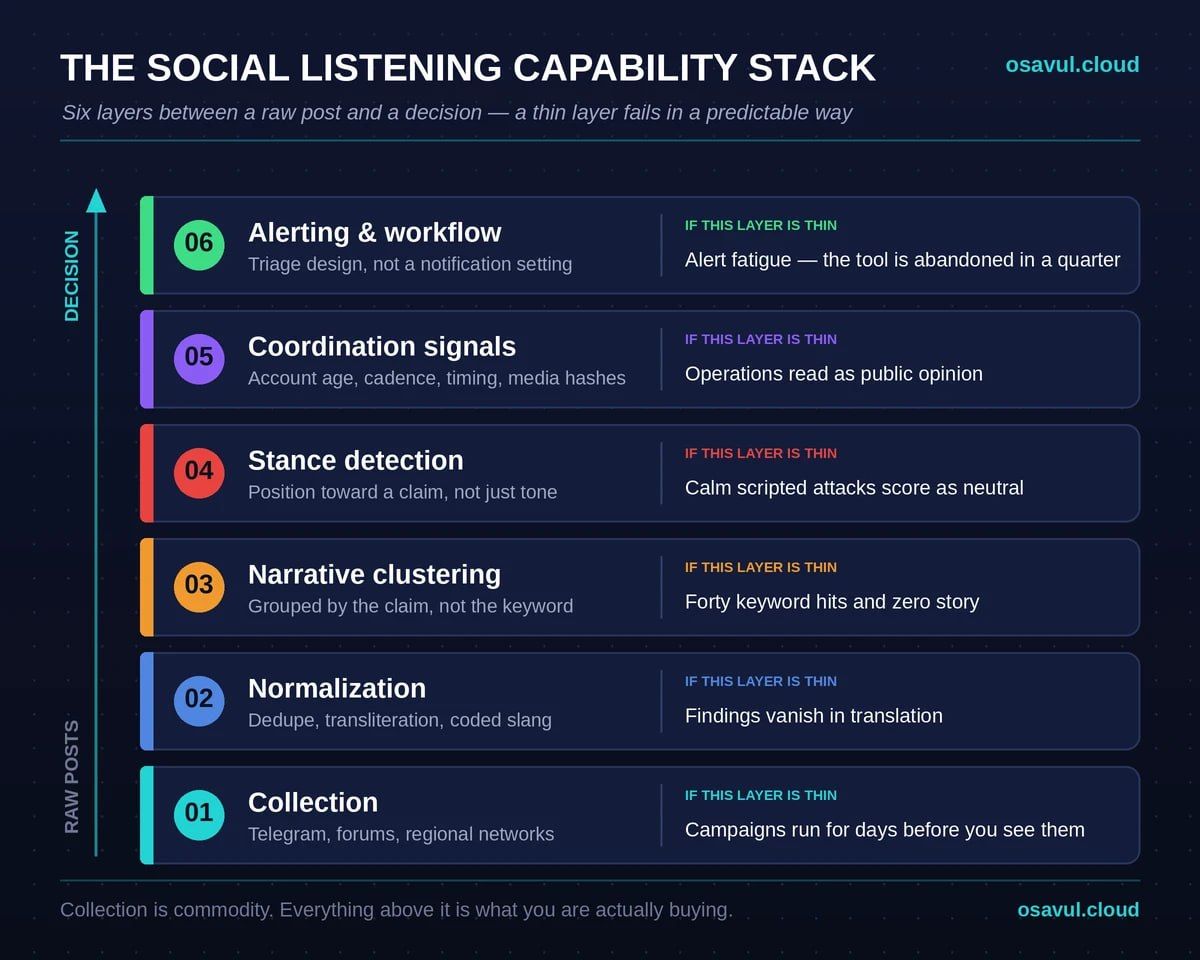
The capability stack: six things a social listening tool has to do
Every serious evaluation comes down to six capabilities, and a platform that is weak in any one of them will fail in a predictable, specific way. Vendors rarely lie about these. They just answer a narrower question than the one you asked.
Collection: coverage past the easy platforms
Collection quality is decided by which sources a platform reaches, not by how many posts it returns. X and Facebook are the cheap part. The expensive part is Telegram, VKontakte, regional forums, comment sections on local news sites, TikTok comment threads, and the Discord and WhatsApp-adjacent channels where operations get staged before they surface anywhere public.
We keep meeting teams whose volume charts look healthy and whose blind spot is total. A campaign against a Baltic client ran for eleven days inside Telegram and two Russian-language forums before a single tracked platform registered it. By the time the mainstream mention count moved, the narrative had already been laundered through three outlets and was being quoted back as fact.
Normalization and multilingual handling
Normalization is the work of turning messy, duplicated, multi-language content into records an analyst can actually compare. It means near-duplicate detection, transliteration, and translation that preserves the intent of slang and coded language rather than flattening it.
Most platforms translate. Fewer detect that a phrase is a coded reference. Test it with your own languages — bring three real posts to the demo and ask what the tool makes of them. Machine translation that turns an idiom into nonsense will quietly hide the thing you bought the tool for.
Narrative and entity clustering, not keyword buckets
Clustering groups posts by the claim they're making, not by the words they contain. That difference decides whether you see one narrative attacking your safety record or forty unrelated keyword hits.
Keyword tracking assumes you already know what you're looking for. Narratives don't cooperate. They mutate, get translated, drop your brand name entirely and attack the category instead. Entity extraction — people, companies, locations, claims — is what lets a platform connect a post that never mentions you to a story that's very much about you.
Sentiment, stance, and why sentiment alone misleads
Sentiment scores emotional tone; stance detection identifies the position a post takes toward a specific claim or actor. Risk lives in stance.
Sentiment is the metric that sells demos and the one analysts trust least. Sarcasm breaks it. Neutral-toned coordinated messaging breaks it completely — the calmest text in your dataset is often the scripted material. Sentiment tells you the room got louder. Stance tells you what the room decided.
Coordination and authenticity signals
Coordination detection looks at behavior rather than content: account creation clustering, posting cadence, identical timing across networks, repost chains, and shared media hashes.
This is the sharpest line between marketing-built social media listening tools and platforms built for security work. The signals are all metadata, and metadata is the first thing dropped when a product is designed to answer how do people feel. Ask directly: can I see account age distribution for a spike, and can I export it.
Alerting and analyst workflow
Alerting is a triage design problem, not a notification setting. A useful platform distinguishes a volume spike from a behavioral anomaly and routes only the second one to a human at 6 a.m.
The failure here is cultural, not technical. Alert every spike and your team learns within a month to ignore alerts. We've watched good tools get abandoned for exactly that reason.
| Capability | Ask the vendor | |
| Collection | Which non-mainstream sources, at what refresh rate? | Campaigns run for days before you see them |
| Normalization | How is coded slang in my languages handled? | |
| Clustering | Show a narrative that never names my brand | |
| Stance | Can I score position toward a claim, not just tone? | Calm scripted attacks read as neutral |
| Coordination | Account age distribution for this spike — exportable? | Operations look like public opinion |
| Alerting | What triggers escalation vs. a digest? | Alert fatigue, tool abandoned in a quarter |
The benefits of social listening tools: what you get that a dashboard doesn't
The value of a listening program isn't the report. It's the three things a report can't give you on its own: time, evidence, and a decision someone is willing to sign.
An early-warning window measured in hours
Well-run social listening tools buy you somewhere between six hours and several days of warning before a narrative reaches mainstream media — which is the entire window in which a response is cheap.
The mechanics are simple enough. Coordinated material almost always surfaces first in low-visibility channels, gets tested, gets refined, and only then moves to platforms with journalists on them. The EEAS documents this staging pattern in its reporting on foreign information manipulation, mapping the infrastructure that carries campaigns from seeding to amplification across the EU and partner states.
Miss that window and your options narrow fast. A false claim caught in a Telegram channel is a monitoring note. The same claim quoted in a national outlet is a legal matter, an investor question, and three days of your comms director's life.
Evidence that survives a legal or regulator review
Platform-grade evidence means preserved posts, timestamps, account metadata, and propagation chains, captured in a form that holds up when the original content is deleted.
Screenshots don't hold up. We learned this alongside a client who took a takedown request to a platform's trust and safety team with forty images and no metadata — and got nowhere, because nothing in the package showed coordination. The second attempt, built from exported account creation dates and repost timing, produced removals within a week.
If you operate under DSA obligations, sit in a regulated sector, or expect to file anything with a platform or a court, ask about export format and chain of custody before you ask about the dashboard.
Context a decision-maker can act on without a translator
Useful output tells an executive what is happening, who is driving it, whether it is organic, and what happens if nobody responds — in a page, not a dataset.
This is where most programs quietly fail. The analysis is sound, the delivery isn't, and a board hears "negative sentiment is up 40%" and reasonably asks what they're supposed to do with that. Forty percent of what baseline? Driven by how many distinct people, and are they people?
The reframe that lands: this narrative is being pushed by roughly 200 accounts, 60% of them under three months old, it has crossed from Telegram into two regional outlets, and on the pattern we've seen twice before it reaches national press in about 48 hours. That version gets a decision in the meeting it's presented in. Social listening analytics only earns its budget at the point where it changes what somebody does on a Tuesday afternoon.
Industry by industry: same tool, different job
The capabilities don't change across sectors. What changes is which signal you're willing to wake someone up for, and what a false negative costs you. That's the part vendors can't configure for you.
Financial services
Banks and asset managers use social listening tools primarily to detect rumor velocity — because in retail banking, a false claim about liquidity can move real money before the compliance team finishes reading it.
The 2023 regional-bank episodes in the US settled the argument for most risk committees: deposit flight now travels at posting speed. What matters here isn't sentiment, it's reach against a specific depositor or investor segment, plus stance detection tuned to claims about solvency, fraud, and outages. Coordinated short-selling narratives fall in the same bucket. Ask for retention long enough to prove a claim is recycled — regulators find that more persuasive than a volume chart.
Energy and critical infrastructure
Energy operators use listening to catch mobilization signals around physical sites, and outage disinformation during incidents, when a false cause narrative can outrun the utility's own statement.
Two distinct jobs, actually. One runs on a permanent baseline around named assets — substations, pipelines, terminals — watching for the shift from complaint to organizing. The other spins up during an incident, when the question is whether the story spreading about a blackout matches what your operations centre knows. In our tracking across Central and Northern Europe, protest mobilization against energy sites shows a consistent tell: a sharp rise in accounts sharing site coordinates and access-route detail, several days ahead of anything happening on the ground.
Healthcare and pharmaceuticals
Pharma and health systems use social listening tools to track safety and efficacy narratives, adverse-event chatter, and clinical trial discourse — under regulatory obligations that make the archive as valuable as the alert.
Pharmacovigilance teams have their own duty here, and it's a strict one. Beyond that, the sector carries a structural exposure: health misinformation converts to real behavior faster than in almost any other category, and it rarely names your product. It names the mechanism, the ingredient, or the regulator. Keyword tracking on brand terms misses all of it. Entity-level clustering doesn't.
Consumer brands and retail
Consumer brands use listening for impersonation detection, review manipulation, and boycott seeding — threats that begin as brand problems and turn into revenue problems inside a quarter.
Retail is where fake storefronts, cloned support accounts, and coordinated one-star campaigns live. Sentiment tooling built for campaign measurement will show you the dip and never the cause. What you want is the account-behavior layer underneath it: who opened the accounts, when, and whether the same cluster ran this play against someone else last season. We cover the defensive side of that in detail in our practitioner's guide to brand monitoring.
Government and public institutions
Government bodies use social listening tools for foreign information manipulation detection, election-period narrative tracking, and measuring whether official communication is reaching anyone at all.
The reach question is less obvious than it sounds. Reuters Institute research now finds that platforms have overtaken television and news sites globally as a source of news — which means a ministry publishing to its own website and a national broadcaster is, for a growing share of the population, publishing into silence. Listening tells you where the audience actually is before you write the statement.
| Sector | Dominant risk | ||
| Financial services | Rumor-driven deposit or investor flight | Reach by segment, solvency-claim stance, recycled narratives | Hours between first appearance and desk awareness |
| Energy & infrastructure | Site mobilization, outage disinformation | ||
| Healthcare & pharma | Safety/efficacy narratives, adverse events | ||
| Consumer & retail | Impersonation, review manipulation, boycotts | ||
| Government | FIMI, election narratives, reach failure |
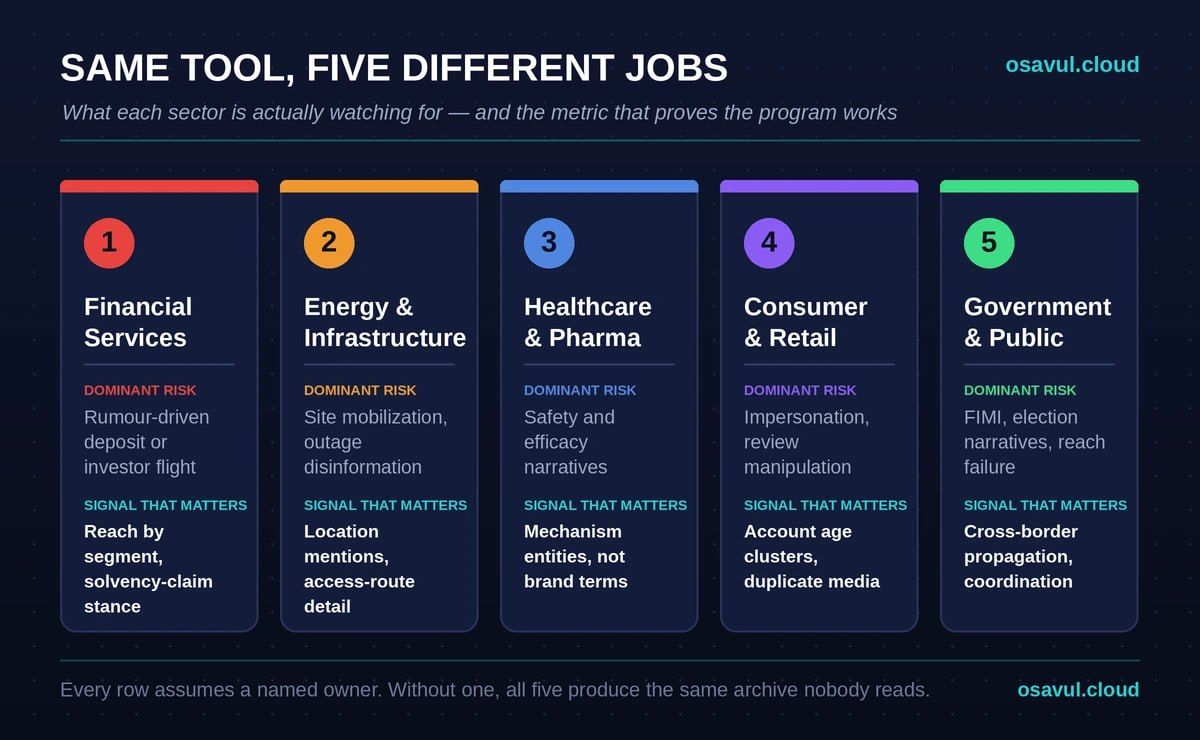
One caution on that table. Every row assumes someone owns the output. A sector-tuned platform with no named analyst behind it produces the same result in all five rows: a well-populated archive that nobody reads until after the incident.
How to evaluate social listening tools without buying a mention counter
The fastest way to test a platform is to bring it a case you already know the answer to. Pick an incident from your own history — one where you eventually learned who was behind it — and ask the vendor to reconstruct it in the demo. Roughly half decline once they understand what you're asking.
Search rankings for the best social listening tools will hand you a scored list of products. Useful for a shortlist, useless for a decision, because the ranking criteria are almost never the criteria that will hurt you at 3 a.m. Substitute your own.
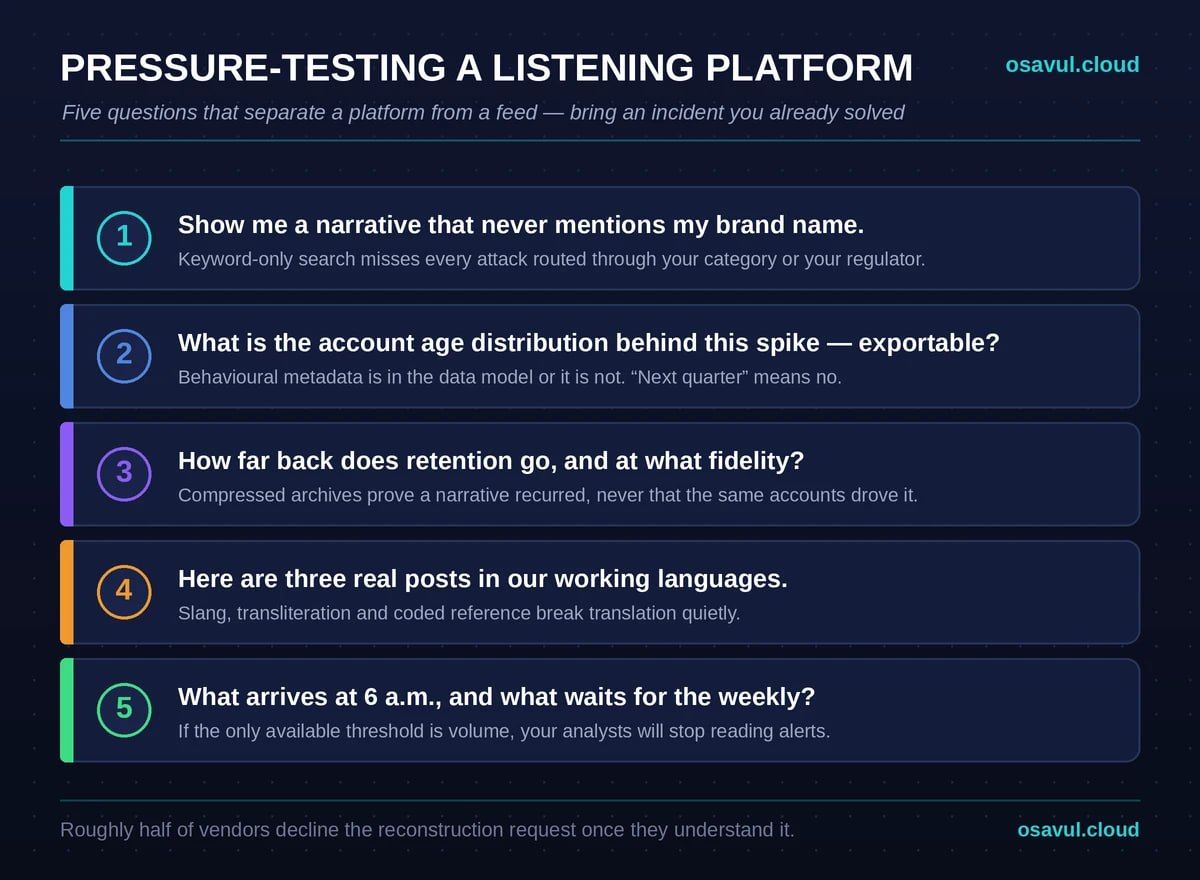
Five questions that separate real platforms from feeds
1. Show me a narrative that never mentions my brand name. If the demo can only find you by keyword, it will miss every attack routed through your category, your regulator, or your CEO's name. This one question eliminates more products than the other four combined.
2. What's the account age distribution behind this spike, and can I export it? Behavioral metadata is either in the data model or it isn't. Retrofitting is not a roadmap item — it's a rebuild, and "coming next quarter" here means no.
3. How far back does retention go, and at what fidelity? Ask specifically whether historical data keeps full metadata or gets compressed to counts. Compressed archives can tell you a narrative recurred; they can't tell you the same accounts drove it both times.
4. Bring three real posts in your working languages. Slang, transliteration, and coded references break translation quietly. You want to see the failure in a demo rather than in a quarterly report six months later.
5. What arrives at 6 a.m., and what waits for the weekly? Triage logic is a product decision, and if the honest answer is "you configure it," ask to see the configuration screen. Two of the platforms we've reviewed had exactly one threshold available: volume.
A last note on scope. Plenty of teams buy media monitoring tools expecting listening behavior, or the reverse, and discover the mismatch after the contract is signed. Monitoring watches named sources for named things. Listening finds the thing you didn't know to name. If your procurement document doesn't say which problem you're solving, whichever vendor writes the better proposal will decide it for you — and they'll decide in favor of the product they have.
Building the workflow around the tool
A platform is a collection and analysis layer. Everything that turns its output into a decision — ownership, thresholds, escalation paths, the standing question of what would we actually do about this — has to be built by you, before the contract starts.
Three things decide whether a social listening strategy survives its first year.
Somebody owns the queue by name. Not a team, a person, with a named backup. Shared ownership of an alert queue reliably produces zero ownership by month three.
Escalation is agreed while nothing is on fire. Write down which signal reaches the CEO, which reaches legal, which sits in the weekly. Do it in a quiet week, because the version drafted during an incident is always too cautious or too loud.
The tool's blind spots are documented. Every platform has them. Coverage gaps you know about are a risk you can price. Gaps you discover during an incident are the reason people stop trusting the program.
There's also a platform mix problem worth checking against reality. Pew's tracking of US social media platform use puts YouTube at 84% of adults and X at 21% — a distribution that looks nothing like most enterprise monitoring configurations, which are still weighted toward X because that's where the mentions are easiest to count. Configure for where your audience is, not where collection is convenient.
On AI social listening: the useful applications are clustering, translation, stance classification, and summarization — mechanical work at a volume no analyst can match. Attribution is not on that list. A model can tell you 140 accounts behave as a cluster. Whether that cluster is a state operation, a competitor's agency, or a genuinely angry community with a coordinator among them is a judgment call, and it stays one. Teams that skip that step publish attribution claims they can't defend, which is a worse day than the original narrative.
This is roughly the division of labor we've built toward at Osavul — automated collection and narrative clustering across sources most platforms don't reach, with the coordination signals surfaced in a form an analyst can interrogate rather than just accept. Our Nebula module handles the narrative intelligence side of that, and the solutions overview maps which pieces fit which mission. The machine sorts. The human decides. Any product that promises to collapse those two steps is selling you a conclusion, not evidence.
Frequently asked questions
What's the difference between social listening tools and social media monitoring tools?
Monitoring tracks named sources and actors in real time for known events; listening analyzes conversation at scale to find patterns and narratives you didn't know to search for. Monitoring is a tripwire. Listening is a map.
Most enterprises need both, and the practical difference shows up in retention and metadata rather than in the marketing copy. If you're sorting out where media monitoring fits alongside either, we worked through that distinction in media monitoring in 2026.
Can social listening tools detect coordinated or inauthentic campaigns?
Some can. Detection requires behavioral metadata — account creation dates, posting cadence, cross-platform timing, shared media hashes — and platforms built for marketing analytics generally don't retain it.
Test this rather than trust it. Ask for the account age distribution behind a spike in the demo. A product that can't produce that view in under a minute isn't going to produce it during an incident either.
How much historical data do social listening tools need to be useful?
Twelve months is a working minimum for risk and security use; 24 to 36 months is what you want if you need to prove a narrative is recycled rather than new.
Recurrence is often the single most persuasive finding you can put in front of a regulator, a platform's trust and safety team, or a board. And you cannot prove recurrence from a 30-day window — you can only report a fresh crisis, again.
Are free social listening tools enough for enterprise risk?
Free tiers work for keyword tracking on major platforms and for testing whether a team will use listening at all. They fall short on source coverage, retention depth, metadata export, and language handling.
There's no shame in starting there. Several teams we've worked with ran a free tool for a quarter purely to find out who would open the alerts — a cheaper way to learn that than a six-figure contract nobody logs into.
Which social listening analytics metrics actually matter?
Four: source diversity behind a spike, account age distribution, cross-platform propagation speed, and stance toward specific claims. Volume and sentiment are context, not findings.
Volume tells you something got loud. It doesn't distinguish 4,000 people from 200 accounts posting twenty times each — and those two situations call for completely different responses. If your reporting leads with volume and sentiment, the social listening benefits you're getting are mostly cosmetic. Lead with who, and how fast, and toward what claim.
Where this goes next
Two shifts are already changing what these platforms have to do.
The first is generated content at volume. Synthetic text, voice, and video have made the cost of running a narrative operation collapse, and the old tell — clumsy language, repeated phrasing — is largely gone. Detection is moving away from what does this say and toward how did this behave, because behavior is expensive to fake at scale in a way that text no longer is.
The second is fragmentation. Audiences keep dispersing into closed and semi-closed channels, which is exactly where collection is hardest and where operations prefer to stage. Any platform whose coverage story is built on the three or four largest networks is describing a shrinking share of the conversation that matters.
Neither shift makes the buying decision harder, oddly enough. Both push in the same direction: metadata over keywords, depth of source coverage over breadth of mention counts, and analysts who are trusted to make calls the model can't.
If you're building the program from scratch, start smaller than you think. One named owner, one sector-specific risk, twelve months of history, and a weekly review that someone senior actually attends. Get that loop working, then widen the aperture. The teams that buy the largest platform first and design the workflow afterward are the ones still asking, a year later, why nobody reads the digest.