A few months ago, one of our analysts flagged a "leaked memo" that looked sloppy, even by disinformation standards. The watermark was crooked and the letterhead was a year out of date. We almost ignored it.
We're glad we didn't. Over the next eleven days the same file moved from a handful of Russian-language Telegram channels onto TikTok. From there it reached a defense ministry's press office, a regional bank's fraud desk and a retail brand's comms team. Each of them opened its own investigation, and none of them knew the others were chasing the same fake.
That's the practical reason the phrase OSINT industries is worth unpacking. Open-source intelligence stopped being one agency's specialty a long time ago. Today it runs through government, security, finance, media and corporate risk, and each of those worlds asks it a different question. We'll walk through who uses it, what they're trying to learn, where their workflows crack, and what to do once manual searching can't keep up.
What Does "OSINT Industries" Mean?
OSINT industries are the sectors that collect and analyze publicly available information to make decisions about security, risk and reputation. Think news, social media, public records, satellite imagery, forums and messaging channels. The term also covers the market that has grown around this work: analysts, methods, training and software.
The word that carries the weight here is intelligence. A screenshot of a viral post is just data. It becomes intelligence only after someone has checked it, placed it in context and tied it to a real decision: escalate or wait, publish or hold, block the payment or let it through. We make the same point in our piece on HUMINT vs OSINT, because teams skip this step more often than they'd like to admit.
You'll also hear the phrase used two ways. Some people mean who uses OSINT: defense, police, cyber teams, banks, newsrooms, corporate security. Others mean the OSINT industry as a business, with vendors, courses and a job market that has grown quickly. We're sticking with the first meaning, because that's where the operational headaches are.
From Intelligence Tradecraft to a Cross-Sector Capability
OSINT spread beyond government because public data outgrew any single team's ability to read it, and because the threats inside that data began targeting companies too.
This isn't a new discipline. In 1941 the U.S. Foreign Broadcast Monitoring Service was already transcribing enemy radio, and in 2005 open source got its own center inside the U.S. intelligence community. For most of that history the work was done by linguists in headphones, working behind classified doors.
Then the internet changed the math. The amount of content exploded, most of it in languages the target organization couldn't read. Stories started travelling from a fringe channel to the evening news in an afternoon. The quieter change was that influence operations stopped caring whether their target was a ministry or a mid-size manufacturer.
We saw this ourselves while tracking FIMI operations targeting businesses in Central Asia. The actors used the same playbook they had run against government bodies: coordinated accounts, recycled "insider" leaks, amplification timed to local news cycles. Only the victims were different.
So the core question has moved. Teams used to ask what people were saying. Now they need to know who's pushing it, how organized it is, and how much time they have before it lands.
Which OSINT Industries Depend on Open-Source Intelligence Most?
The short answer is government and defense, law enforcement, cybersecurity, corporate security, finance and journalism, with human rights groups right beside them. The longer answer is messier. All of these sectors watch the same internet all day. Put a defense analyst and a bank compliance officer in front of the same Telegram post, though, and you'll get two completely different reactions. One sees an influence operation getting started. The other sees a sanctions problem.
| Sector | What they're trying to find out | ||
| Government & defense | Who is shaping the story against us, and where? | Foreign media, Telegram, state-linked outlets, satellite imagery | Situational briefs, attribution reports |
| Law enforcement | Who's behind this account, and where are they? | ||
| Cybersecurity | What can an attacker already see about us? | ||
| Corporate security & brand | Is someone going after our name or our people? | Social platforms, news, fringe communities, review sites | Early warnings, crisis briefs |
| Finance & compliance | Is this counterparty who the paperwork says? | Corporate registries, sanctions lists, adverse media | Due-diligence files, risk flags |
| Journalism & NGOs | What actually happened, and can we prove it? | User-generated video, satellite imagery, web archives | Verified, publishable findings |
Government, Defense, and National Security
Defense and national security teams use OSINT to catch hostile narratives while they're still small, days or sometimes weeks before they appear in official reporting.
Where do they start looking? Rarely in English. The early drafts of a campaign tend to show up in Russian-language Telegram channels and tiny regional outlets that nobody in a Western newsroom reads. The first sign is almost never one big viral post. In our tracking it's something much duller: a dozen accounts with no visible connection, all posting the same slightly-off translation within the same hour. Once you've seen that a few times, you stop believing in coincidences.
Law Enforcement and Public Safety
OSINT for law enforcement comes down to attribution: proving that an account belongs to a specific person, in a way that survives cross-examination.
The frustrating part is that finding the person is often the easy bit. The same handle on four platforms, the same profile photo, a pharmacy sign behind someone in a selfie, and you're done by lunch. Then a defense lawyer asks when the screenshot was taken, from which URL, by whom and with what tool. If nobody recorded that, a solid lead turns into a weak exhibit.
Cybersecurity and Threat Intelligence
What is OSINT in cyber security? It's looking at your own organization through an attacker's eyes, using nothing but public sources.
Try it once and you'll be surprised, maybe alarmed. Engineers name internal tools in their LinkedIn bios. A marketing microsite from 2019 still runs on an unpatched server. Passwords from someone else's breach sit on a paste site, reused. None of that took any hacking to find. Cybersecurity OSINT turns that pile into indicators a SOC can act on, then feeds them into the threat intelligence lifecycle alongside everything else.
Corporate Security and Brand Protection
Corporate security and brand teams use OSINT to spot smear campaigns, threats against executives and impersonation before any of it reaches the press.
This is where we've seen demand climb fastest. A few years ago, a comms lead's worst case was one angry review going viral. Today it's bot networks pushing boycott hashtags, "ex-employee" accounts created six days before a supposed leak, and fake support pages quietly collecting customer logins. Most of it starts on platforms a standard social listening dashboard never covers.
Finance, Compliance, and Fraud Investigation
Finance and compliance teams use OSINT to check that a counterparty is who its paperwork says it is.
Sanctions screening and adverse media checks are the bare minimum now. The good findings are in the gaps between databases. Picture one director running three shell companies, all registered on the same date at the same address in another country. No automated alert catches that. A curious analyst does.
Journalism, NGOs, and Human Rights Research
Journalists and human rights researchers use OSINT to verify events they couldn't witness in person, such as an airstrike, a detention or a rigged count.
Their standard is harsh, because every finding gets published and then attacked. That pressure produced the UN-backed Berkeley Protocol on Digital Open Source Investigations, a practical guide to collecting and preserving online material so it holds up as evidence. If you run corporate investigations, it's well worth reading.
Examples of OSINT Investigations Across Sectors
The clearest examples of OSINT come from real investigation patterns, not definitions. The three below are simplified and anonymized, but each is a pattern we run into again and again. Look closely and you'll notice the method barely changes from one to the next. What changes is what's at stake.
1. The "contaminated product" that never existed
A food brand's social team noticed a spike in angry comments on a Tuesday morning. By Tuesday afternoon, the claim (supposedly leaked lab results showing contamination) had been translated into four languages.
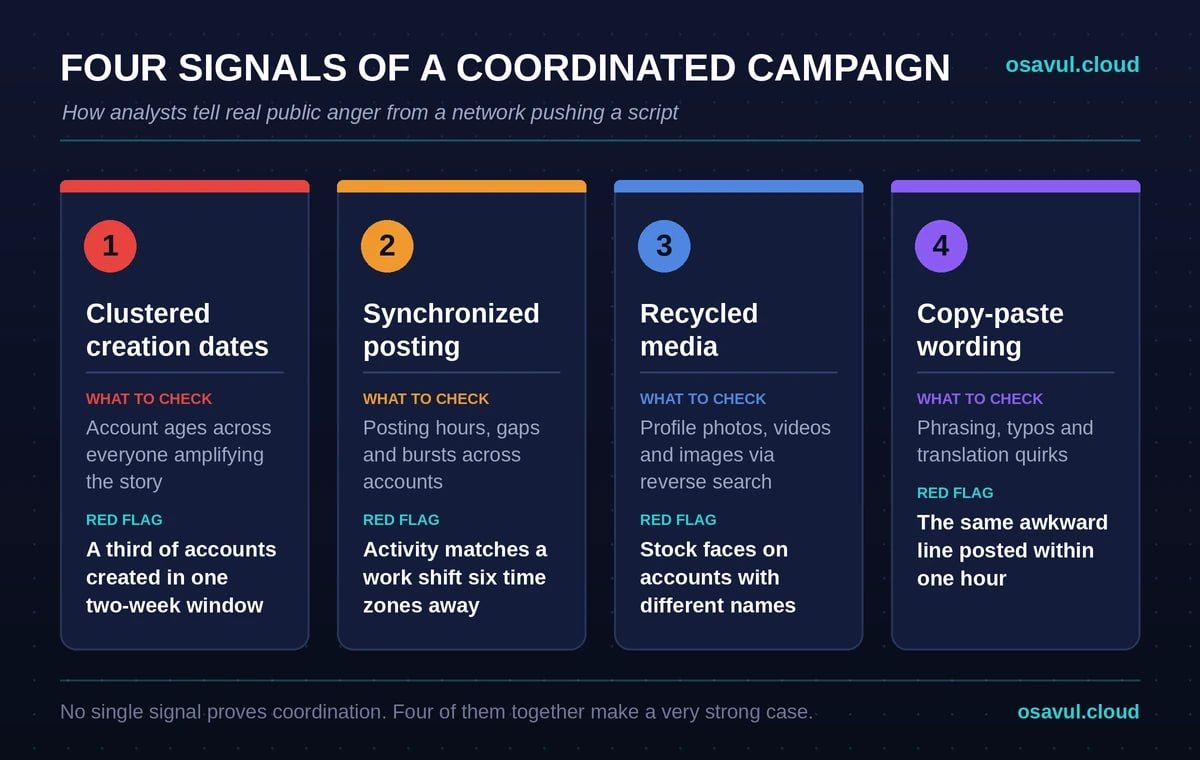
The OSINT investigation started by working backwards. Who posted it first? The trail led to a small Telegram channel, three days before the spike. Next came the amplifiers. Roughly a third of the accounts pushing the story had been created in the same two-week window, and several had spent the previous year posting purely political content. That's a borrowed network, not an angry customer base. With that evidence in hand, the comms team answered publicly before any journalist picked the story up. Timing was everything. (If you're wondering how teams spot those clusters, our explainer on bot detection covers the signals.)
2. "Local voters" in the wrong time zone
Ahead of a regional election, a batch of accounts presented themselves as ordinary residents worried about one specific candidate.
Individually they looked convincing. Together they gave themselves away. They posted at the same hours, and those hours matched a working day about six time zones east. Several profile photos turned out to be recycled stock images. Two accounts even repeated the same typo in the same sentence. No single signal proves coordination. Four of them together make a very strong case.
3. A supplier with a beautiful website
A procurement team was close to signing with a new logistics partner. The pitch deck was polished and the website looked expensive.
Twenty minutes of OSINT changed the conversation. The domain was three weeks old. The "leadership team" photos came from a stock library. The registered address was a virtual office shared by about forty companies. The director's name appeared in insolvency records in another country. The deal was paused, and nobody was sorry.
The toolkit is the same across all three: source tracing, account forensics and record matching. That's why the same analyst skills show up across so many OSINT industries, which is where we're going next.
What Does an OSINT Analyst Do in Each Sector?
An OSINT analyst collects public information, checks it and turns it into a judgment someone can act on. That someone might be a general, a detective, a CISO or a compliance officer.
Job titles are all over the place. We've met people doing almost identical work as "threat researcher," "digital investigator," "trust and safety specialist" and even "media analyst." Underneath, the daily routine barely changes. A question lands on their desk. They work out where the answer might be, collect it, test it, and write it up so a non-specialist can use it in five minutes. That last step gets underrated. A brilliant finding buried in a 30-page PDF helps nobody.
Shared OSINT Investigation Techniques
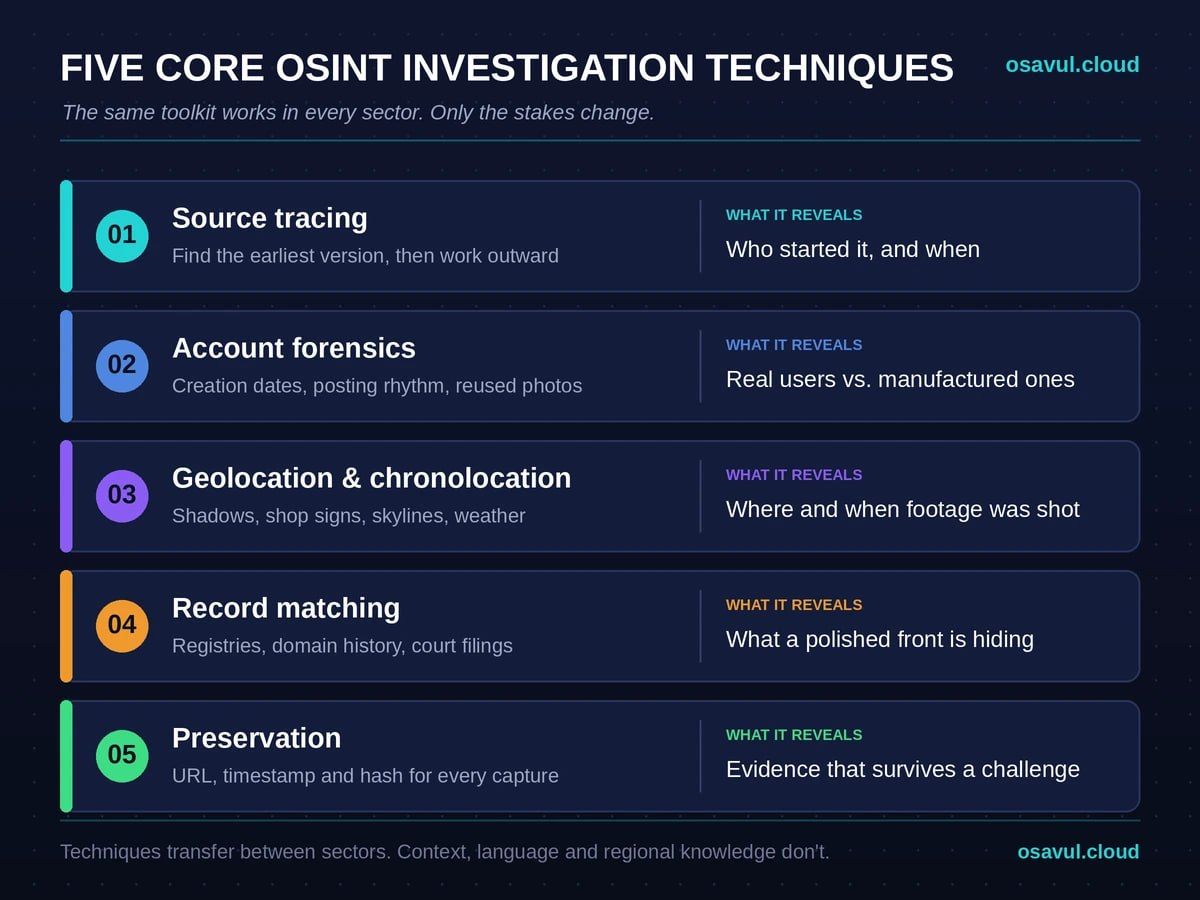
The core OSINT investigation techniques are the same in every sector: source tracing, account analysis, geolocation, record matching and careful preservation.
- Source tracing. Find the earliest version of a claim, image or video, then work outward to see who picked it up and when.
- Account forensics. Creation dates, posting rhythm, recycled photos and copy-paste bios are the everyday material of social media OSINT.
- Geolocation and chronolocation. Shadows, shop signs, skylines and even weather records can pin down where and when something was filmed.
- Record matching. Company registries, domain history, court filings and property records often reveal what a polished website hides.
- Preservation. Capture every item with its URL, timestamp and hash, so the finding still holds when someone challenges it.
For the step-by-step version, our guide to the OSINT process walks through each stage. Analysts who want to formalize these skills often go through SANS SEC497, which has become a standard training route.
Where Sector Expertise Stops Transferring
Techniques carry over between sectors. Context doesn't.
A cyber analyst who can pivot through infrastructure records in minutes may completely miss that a harmless-looking meme is a political dog whistle in the Balkans. A compliance specialist can map ownership structures half asleep, but may never have had to judge whether 400 accounts are acting in concert. A defense analyst spots propaganda tropes instantly, yet may not know what a board considers a material risk.
In our experience, language, regional politics and platform culture are the slowest skills to build. They're also the ones that most often decide whether an investigation lands or quietly goes nowhere.
The Pain Points Every Sector Hits
Whatever the sector, OSINT teams hit the same three walls: too much content in too many places, coordination that's hard to prove, and legal limits that tighten just as the pressure to move fast peaks. We hear these complaints almost word for word from defense ministries and retail brands alike. That tells you something.
Volume, Language, and Platform Fragmentation
The biggest practical problem across OSINT industries is not access to data. It's the sheer amount of it, spread across platforms and languages no single team can cover.
Think about what "monitoring" means now. X, Facebook and news sites, sure. But also hundreds of Telegram channels, TikTok clips that are 90% visual, VK groups, niche forums and messaging apps that only show up once something leaks. Half of it isn't in English. Keyword alerts miss most of it, because the early version of a narrative rarely uses the words you'd think to search for. We've written about why Telegram monitoring now sits at the center of modern OSINT, and it's only one piece of the puzzle.
Detecting Coordination, Not Just Content
Finding harmful content is easy. Proving that it's coordinated, and by whom, is where most investigations stall.
A thousand posts attacking your CEO could be real public anger. They could also be forty operators running a botnet from one office. From a keyword dashboard, the two look identical. Telling them apart requires network-level evidence: shared creation dates, synchronized posting, recycled media, overlapping follower graphs. That's slow to assemble by hand. By the time an analyst has it, the story has often moved on. The EU's diplomatic service documents exactly this playbook in its report on foreign information manipulation and interference (FIMI) threats, and the same tactics now target private companies routinely.
Legal and Ethical Guardrails
Collecting public information is generally lawful, but "public" doesn't mean "anything goes."
Privacy law such as GDPR still applies to personal data you gather, even from open profiles. Platform terms restrict scraping and fake personas. Law enforcement has its own rules on covert online work. And there's a plain ethical line: investigating a coordinated campaign is not the same as profiling an ordinary critic. The teams that stay out of trouble write down their purpose, keep collection proportionate to it, and log everything. It's dull, and it's also the only thing that protects the work when someone asks, "How did you get this?" (This is general guidance, not legal advice. Check the specifics with counsel in your jurisdiction.)
Why Manual Toolkits Break at Scale
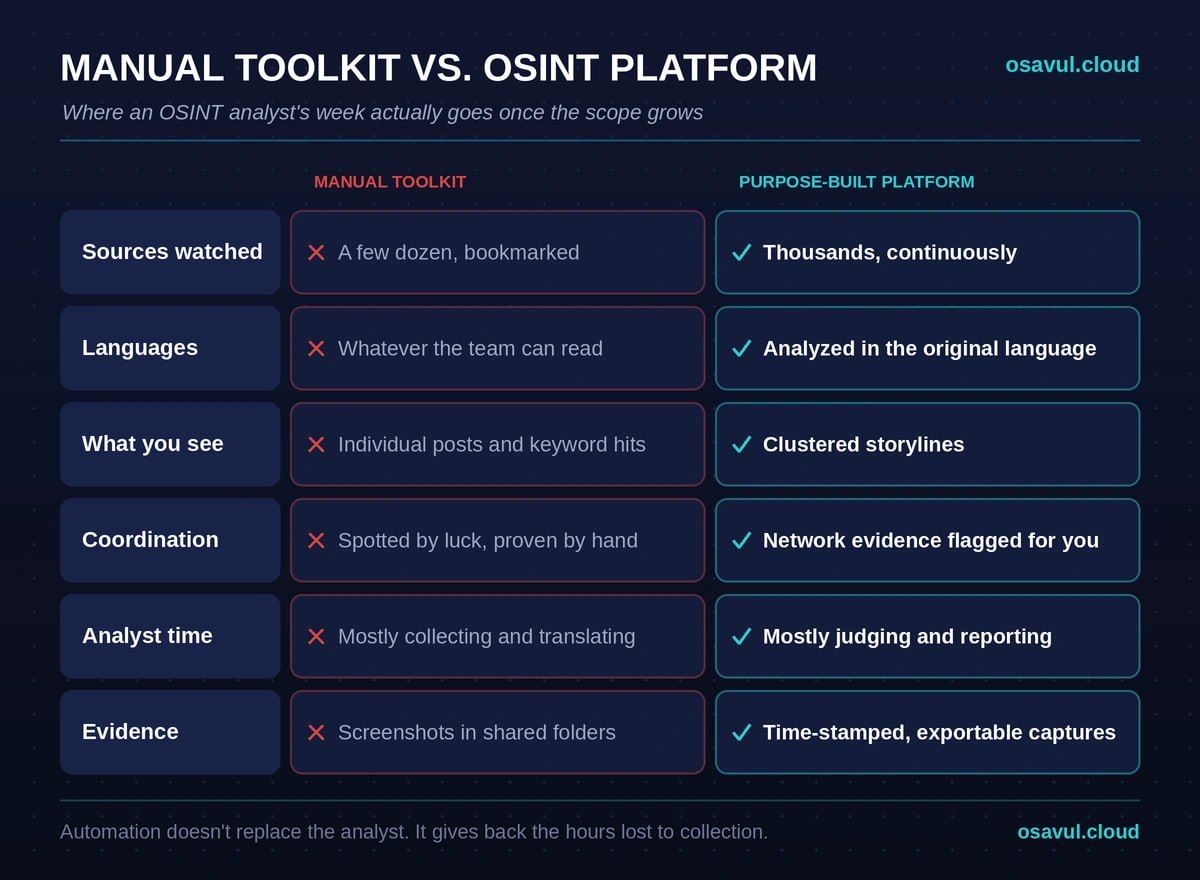
Manual OSINT toolkits break once the job shifts from answering one question to watching a threat continuously. A bookmarks folder, a few browser extensions, some saved searches and a spreadsheet can carry a single investigation surprisingly far. They can't watch a thousand channels overnight.
We've seen the same pattern many times. A team builds a clever manual workflow and it works. Then scope grows: more languages, more platforms, a CEO who wants daily updates. The analysts spend most of their week collecting and translating, and very little of it thinking. Worse, coordination signals get lost, because nobody can hold 5,000 accounts in their head long enough to notice that 300 of them were created in the same month.
This is the gap purpose-built platforms fill. At Osavul, we built our tooling around the problems described above rather than around keyword counts. Narrative intelligence groups thousands of posts into the handful of storylines behind them, across languages. Bot detection and monitoring surfaces the network-level evidence that separates real anger from a paid campaign. Telegram monitoring covers the channels where so many campaigns start, and media monitoring follows the story once it crosses into mainstream outlets.
None of this replaces the analyst. It gives them back the hours they were spending on collection, so they can do the part a machine can't: judging what a pattern means and what to do about it.
What to Look For in an OSINT Platform
A good OSINT platform should cover the sources your threats actually use, find coordination automatically, work in the original language, and keep an evidence trail you can defend. Use this checklist when you evaluate options:
| Capability | Why it matters | |
| Source coverage | Campaigns start on Telegram, TikTok and fringe forums, not just X and news | Which platforms and regions are covered today, not "on the roadmap"? |
| Narrative clustering | Analysts need storylines, not 40,000 separate mentions | |
| Coordination detection | Separates organic backlash from bot-driven attacks | |
| Multilingual analysis | Early signals rarely appear in English | Is analysis done in the original language, or only after machine translation? |
| Early warning | Hours matter before a story reaches the press | How fast does a new narrative trigger an alert? |
| Evidence preservation | Findings must survive legal, board or public scrutiny | Are captures time-stamped and exportable with their source? |
| Reporting | Decision-makers read summaries, not dashboards | Can it produce briefs non-specialists understand? |
If a vendor can't answer the last column clearly, keep looking.
FAQ
What are OSINT industries?
It's shorthand for every sector that makes decisions using open-source intelligence: government and defense, law enforcement, cyber teams, corporate security, finance, and newsrooms. That list used to end there. It doesn't anymore. Over the past couple of years we've watched consumer brands, energy companies and even sports federations quietly build small OSINT teams of their own, usually right after a campaign caught them off guard.
What is OSINT in cyber security?
Put simply, it's seeing yourself the way an attacker does, using nothing but what's public. Leaked passwords. A forgotten test server. An org chart someone rebuilt from LinkedIn in an afternoon. Security teams collect that exposure and fix it before anyone uses it.
Is OSINT legal for private companies to use?
Generally, yes. Public information is fair game to collect, but that doesn't mean anything goes.
Privacy law still applies. Under GDPR, a person's data doesn't stop being personal because they posted it openly. Platform terms limit scraping and fake accounts. The companies we see staying out of trouble aren't doing anything clever. They write down why they're investigating, collect only what that reason justifies, and keep a log. If something feels grey, it probably is, so call your lawyer. (This is general guidance, not legal advice.)
How do companies run an OSINT investigation?
Most run the same loop: ask a sharp question, collect, verify, analyze, then report in plain language.
The loop itself is easy. The question is where teams slip up. "Find everything about this campaign" buries you in noise by Wednesday. "Is this boycott coordinated, and who kicked it off?" gets you an answer by Friday. If you want the stages spelled out, our step-by-step guide to structuring OSINT work covers each one.
What skills does an OSINT analyst need?
Curiosity, patience and a healthy distrust of their own first answer. Those matter more than any tool.
The technical skills (search operators, geolocation, account forensics) can be learned in a few months. A second language or real knowledge of a region takes years, and it's often what cracks a case. The best analysts we've worked with have one habit in common. When they think they've found something, they spend the next hour trying to prove themselves wrong.
Where Your Team Should Start
Start small and specific. Pick the one threat that would hurt most if it caught you unprepared, and build your OSINT effort around that question before anything else.
For a bank, that might be counterparty fraud. For a consumer brand, a coordinated boycott. For a ministry, a foreign narrative aimed at an upcoming vote. Write the question down. Then list where that threat would appear first, and be honest about which of those places your team can't read today because of language, platform or plain volume.
That gap is your real starting point. Some teams close it with training and a sharper process. Most, once they're watching more than a few dozen sources, need automation to handle collection and pattern detection so their analysts can spend time on judgment. That's the job we built Osavul's platform to do: spot narratives and coordinated networks early, across languages, with evidence you can put in front of a board.
The sectors we've covered look different from the outside. Across OSINT industries, though, the teams that stay ahead do the same three things. They know what they're looking for. They look where the threat actually starts. And they don't wait for the story to reach the news before acting on it.