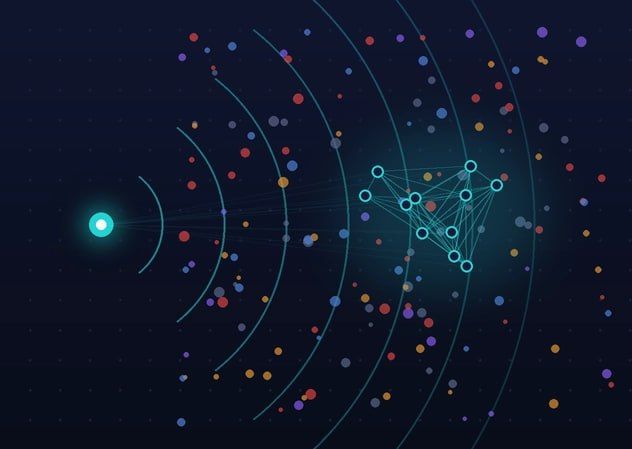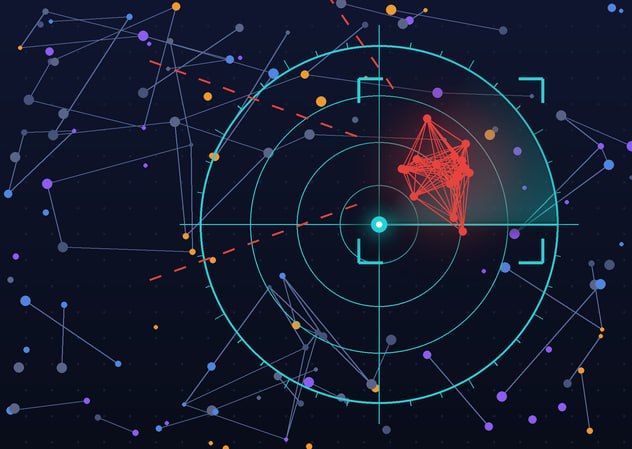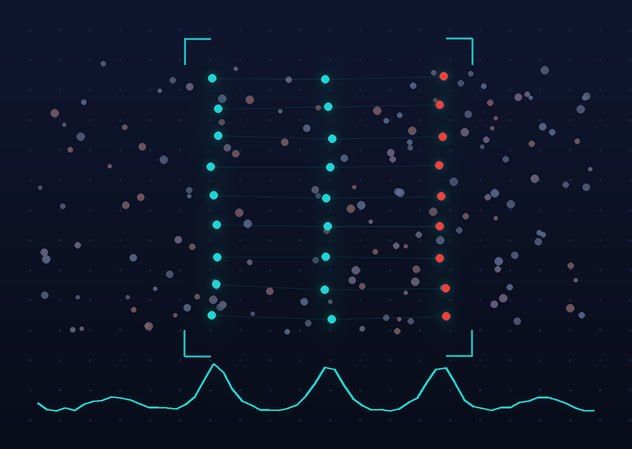
The sentiment chart said neutral. That was the problem.
This spring, a logistics client in the Baltics asked us to look at a week their dashboard had scored as calm. Mention volume was flat. Tone sat squarely in the middle, and nobody had been paged. Underneath, about 90 accounts were pushing the same claim about unsafe cargo at a port terminal, in three languages, on a schedule tight enough to set a watch by. The wording was neutral and the delivery was coordinated. By the time a regional outlet picked the story up, it already had a history nobody on the client side had seen.
The dashboard wasn't broken. It answered the question it was built for: how do people feel? Nobody had asked it the other one: who is organizing this, and why now?
That gap is what this piece is about. We'll cover what a social listening tool is, how it turns millions of raw posts into findings an analyst can defend, where the marketing versions quietly stop, and what security and risk teams should expect instead.
What is a social listening tool?
A social listening tool is software that collects public conversation from social networks, messaging channels, forums, blogs, and news comment sections. It then analyzes that material to show what people are saying about a topic, how the conversation is shifting, and who is driving it.
That's the textbook version, and it covers the social listening meaning most people are searching for. The working version is shorter: the tool reads everything, so your analysts only have to read what matters.
Two words in that definition carry most of the weight. Collects matters because coverage decides what you can ever find. Analyzes matters because a pile of 40,000 posts isn't a finding. It's homework. Nearly every serious difference between products sits in that second word.
If you've asked "what is social media listening?" in a meeting and got three different answers, this is why. A brand team hears "audience mood." A security team hears "early warning." The data feed is the same, but the job is different, and as we'll see, the software often is too.
Social listening vs social monitoring: two different questions
Social monitoring tracks known accounts, keywords, and events in close to real time. Social listening studies conversation over weeks or months to find themes and narratives you didn't know to search for. Monitoring asks whether something just happened. Listening asks what is taking shape.
The social listening vs social monitoring debate gets more airtime than it deserves. In practice, mature teams run both on the same data. Monitoring is the smoke detector. Listening is the building survey that tells you which wing keeps catching fire.
Where the difference really bites is retention. Monitoring can live on 30 days of data; listening can't. A narrative that resurfaces every election cycle only looks like a pattern if your archive reaches back to the last one. We cover the real-time side in more depth in our guide to social media monitoring for security teams.
How does social listening work? The five-stage pipeline
Social listening works in five stages:
- Collect public posts from chosen sources.
- Clean and normalize them.
- Enrich each record with entities, sentiment, and stance.
- Detect patterns such as narratives and coordinated behavior.
- Deliver the result as alerts, briefs, or preserved evidence.
Most products are strong at the first stage and thin at the fourth.
Stage 1: Source collection. A social listening tool pulls posts, comments, channel messages, and articles through platform APIs, licensed data feeds, and its own crawlers. Coverage sets the ceiling for everything downstream. If a source isn't collected, no model can analyze it. In Eastern Europe we regularly watch campaigns incubate on Telegram channels and small regional forums for a week or more before they reach a platform most dashboards cover well.
Stage 2: Cleaning and language handling. Raw data is noisy. The same text arrives as a post, a repost, a screenshot, and a quote in someone else's thread. A good pipeline collapses near-duplicates, strips spam, and matches Cyrillic and Latin spellings of the same name. It also translates without flattening slang. You'll never see this stage in a demo, but it decides whether the tool works in production.
Stage 3: Enrichment. Each record gets tagged with people, organizations, places, claims, language, and a sentiment score. Social listening sentiment analysis is useful for tracking mood over time, but it has a known weak spot. Sarcasm reads as praise, and scripted messaging is often written in a calm, neutral register on purpose. That's why stronger systems add stance: the position a post takes toward a specific claim or actor. Stance tells you far more than tone.
Stage 4: Pattern detection. Here the software stops looking at single posts and starts looking at groups of them. Narrative clustering groups posts by the claim they make, even when they never mention your brand.
Coordination analysis checks behavior:
- accounts created in the same window
- identical posting intervals
- synchronized reposts across platforms
- recycled images and video
This is the stage that separates a mention counter from an intelligence instrument.
Stage 5: Output. Findings leave the system as real-time alerts, scheduled briefs, or exportable evidence packages with timestamps, account metadata and propagation chains. The format matters more than teams expect. A platform's trust and safety team will shrug at forty screenshots. They act on a timeline showing 200 accounts, their creation dates and the order in which they posted.
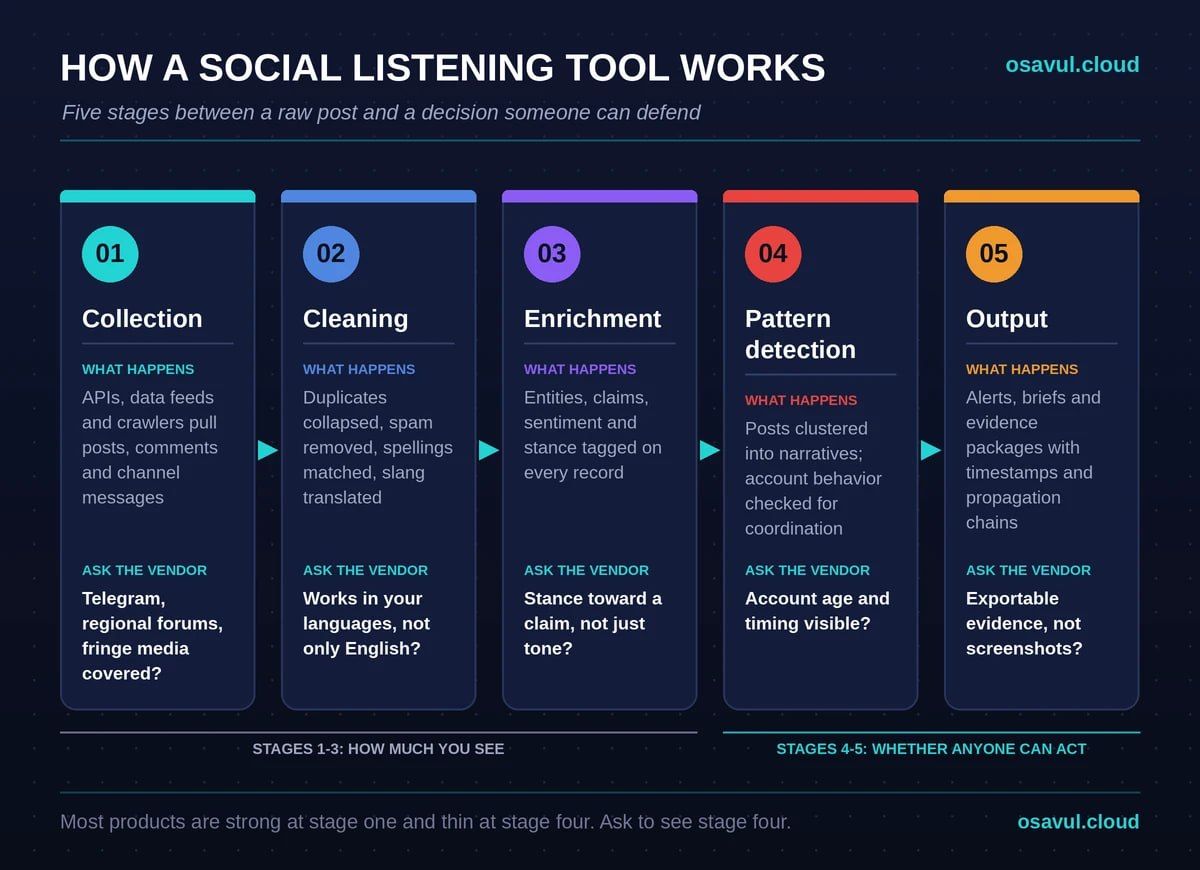
Put simply, stages one to three decide how much you see. Stages four and five decide whether anyone can act on it. So when a vendor spends most of the demo on sentiment pie charts, ask to see stage four. The pause before the answer tells you a lot.
Marketing-grade vs intelligence-grade social listening software
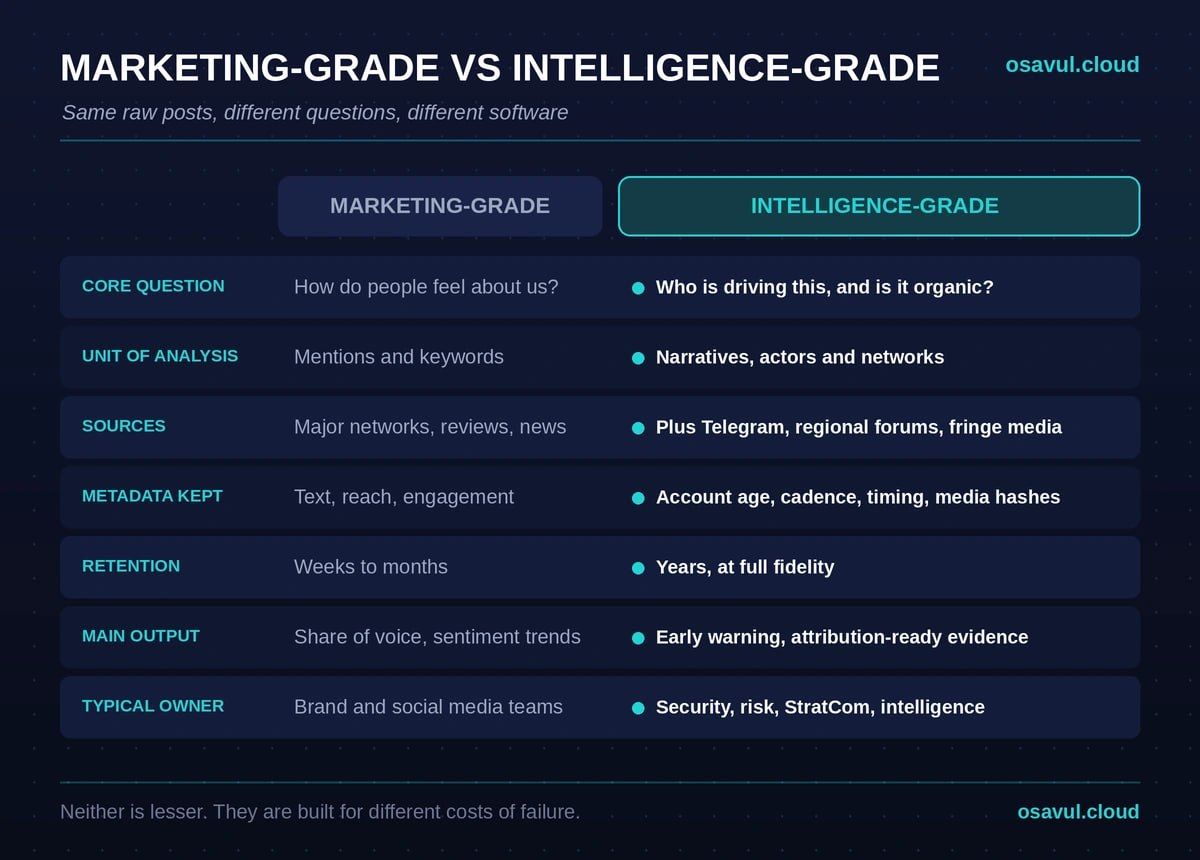
Marketing-grade social listening software measures how audiences react to brands, campaigns and products. Intelligence-grade social listening platforms are built to detect narrative attacks, coordinated inauthentic behavior and foreign information manipulation. To do that, they keep the behavioral metadata that marketing tools throw away.
Neither category is the lesser product. They're built around different costs of failure. A missed trend costs a marketing team one campaign. A missed operation can cost a security team a news cycle, a share-price dip or a letter from a regulator.
| Marketing-grade | ||
| Core question | How do people feel about us? | Who is driving this, and is it organic? |
| Unit of analysis | Mentions and keywords | |
| Typical sources | Major networks, review sites, news | |
| Metadata kept | Text, reach, engagement | Account age, posting cadence, cross-platform timing, media hashes |
| Retention | Weeks to months | Years, at full fidelity |
| Main output | Share of voice, sentiment trends | Early-warning alerts, attribution-ready evidence |
| Typical owner | Brand and social media teams | Security, risk, StratCom and intelligence units |
Why a brand dashboard misses a narrative attack. Coordinated campaigns are designed to look like public opinion. That's the whole point of them. They borrow real grievances, stay close to normal volume, and often avoid naming the target directly. A tool that finds you by keyword and scores you by tone is looking in exactly the place the operation has learned to avoid.
Researchers at the NATO Strategic Communications Centre of Excellence have made this point the hard way. They repeatedly bought fake engagement on major platforms as a test and found most of it still live weeks later. If the platforms struggle to spot purchased activity on their own systems, a dashboard that only reads the text of posts has little chance.
So the practical test is simple. Ask whether the product can show you a narrative that never mentions your name. Then ask whether it can show you the accounts behind a spike, sorted by creation date. If both answers are yes, you're looking at a social listening tool that can do security work. If not, you're looking at a very good marketing product.
Social listening examples from the field
The clearest social listening examples come from incidents where the answer turned out to be who, not how many. Here are three cases from our work, anonymized, where the volume chart told one story and the pattern underneath told another.
A rumor about a bank's liquidity. On a Friday evening, a claim began circulating that a mid-sized Central European bank was about to cap ATM withdrawals. By 21:00 there were around 2,000 posts. On its own, that number would have gone into Monday's digest. What moved it to the duty officer's phone was the structure behind it:
- roughly 60% of the earliest sharers had accounts under 90 days old
- the claim jumped from two Telegram channels to X in under 40 minutes
- the wording matched a rumor used against a different lender the year before
The bank published a clear statement before branches opened on Saturday. The rumor never reached the queues it was built to create.
A protest campaign against an energy site. A grid operator in Northern Europe had a steady baseline of local complaints about a new substation, which is normal for any infrastructure project. Then the tone shifted from complaint to logistics. Posts started sharing access roads, shift-change times and photos of the perimeter fence. The volume barely moved. The tool flagged the change in content type, not the number of posts, and the operator's security team had five days of lead time before people arrived on site.
A cross-border narrative before an election. Three weeks before a national vote, a public institution we support saw a claim spreading about "pre-filled ballots" found at a counting center. Seen on its own, it looked local and new. The archive showed otherwise: the same claim, with the same photo, had run during an election in a neighboring country two years earlier. It had been seeded through the same cluster of outlets. That's the kind of cross-border recycling DFRLab regularly documents in its election research. Because the institution could prove the recurrence, it prebunked the claim with evidence instead of a denial.
In all three cases, a social listening tool that only counted mentions would have reported "increased activity" and stopped there. The value was in the second layer: account age, propagation paths and history. That layer is what turned noise into a decision someone was willing to sign.
Why a platform like Osavul fits security and risk teams better
Security and risk teams get more from an intelligence-grade platform like Osavul because it treats narratives, actors and networks as the unit of analysis, not mentions. It collects from the channels where operations are staged, and it keeps the behavioral metadata needed to prove coordination. A marketing-first social listening tool usually drops that metadata to keep the product light.
We built Osavul after years of tracking Russian information operations against Ukraine and its partners. That origin shapes the product more than any feature list. Collection reaches 150,000+ sources across 100 countries and 30 languages, including the Telegram channels, regional outlets and fringe sites where most campaigns we investigate first appear. Analysis runs in the original language, so the coded phrase that gives an operation away doesn't vanish in machine translation.
Here's what changes in daily work when the platform is built this way:
- Narratives, not keywords. Posts are clustered by the claim they make. An attack routed through your CEO's name, your regulator or your product category still lands in the same story.
- Coordination is visible by default. Account creation windows, posting rhythm and cross-platform timing sit next to the content. Analysts don't have to rebuild them by hand in a spreadsheet.
- History at full fidelity. When a narrative returns, you can show it's the same narrative, pushed by the same cluster, through the same outlets.
- Evidence that travels. Findings export with timestamps and propagation chains that hold up in front of a platform's trust and safety team, a regulator or a board.
Our work with NATO on a virtual manipulation brief is one public example of that output in practice.
None of this removes the analyst. It removes the six hours an analyst used to spend stitching exports together before any thinking could start. The machine sorts and scores. The human decides what the pattern means and what to do about it. If you want to see how the modules map to specific missions, from brand risk to government StratCom, the Osavul solutions overview lays it out.
How to pick the best social listening tool: three red flags in a demo
The best social listening tool for your mission is the one that can rebuild an incident you already understand. It should show the narrative, the accounts behind it and how the story spread, using your languages and your sources. Rankings and feature grids help you build a shortlist. A live test on your own case is what makes the decision.
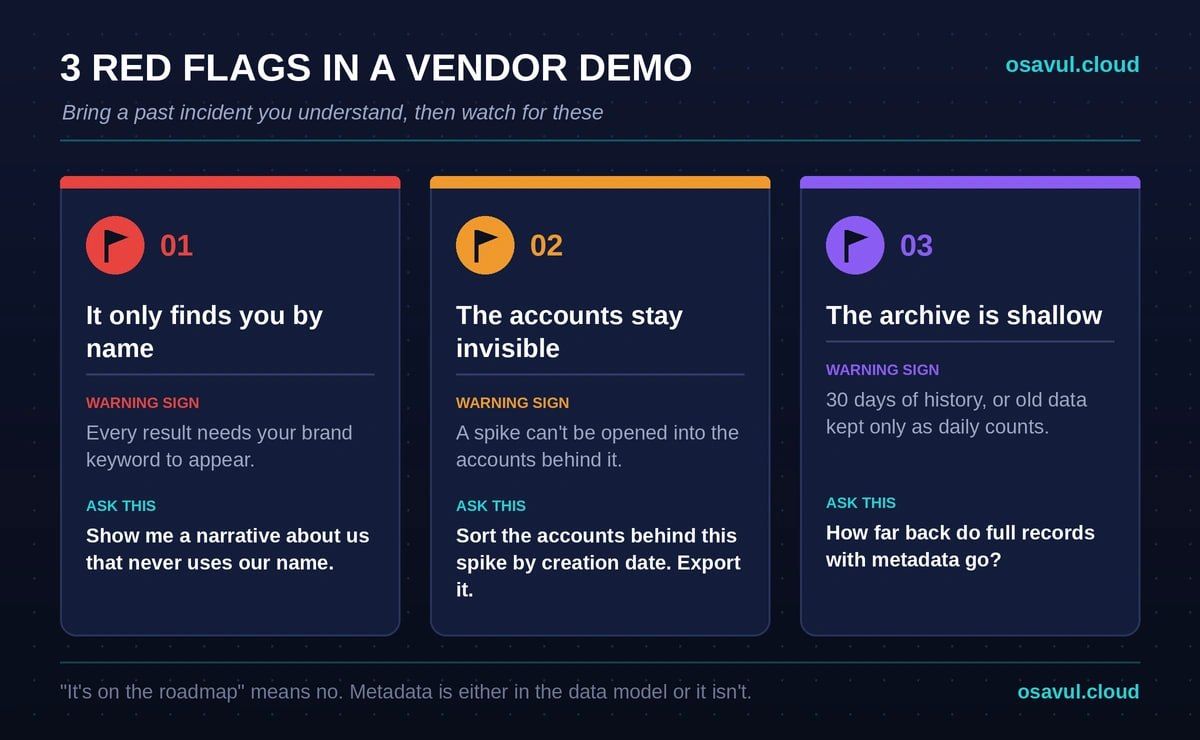
Bring a past incident to the demo, ideally one where you eventually learned who was behind it. Then watch for three red flags.
1. It only finds you by name. If every result needs your brand keyword to appear, the product will miss attacks aimed at your category, your leadership or your regulator. Ask for a narrative about you that never uses your name.
2. The accounts stay invisible. A spike should open into the accounts behind it, with creation dates and posting patterns you can export. If the answer is "that's on the roadmap," treat it as a no. Behavioral metadata is either in the data model or it isn't.
3. The archive is shallow or compressed. Thirty days of history can't show recurrence. Neither can an archive that keeps only daily counts. Ask how far back full records go, and whether metadata survives in older data.
If you want the full vendor checklist, we worked through it question by question in our guide to social listening tools.
Your first 30 days with a social listening tool
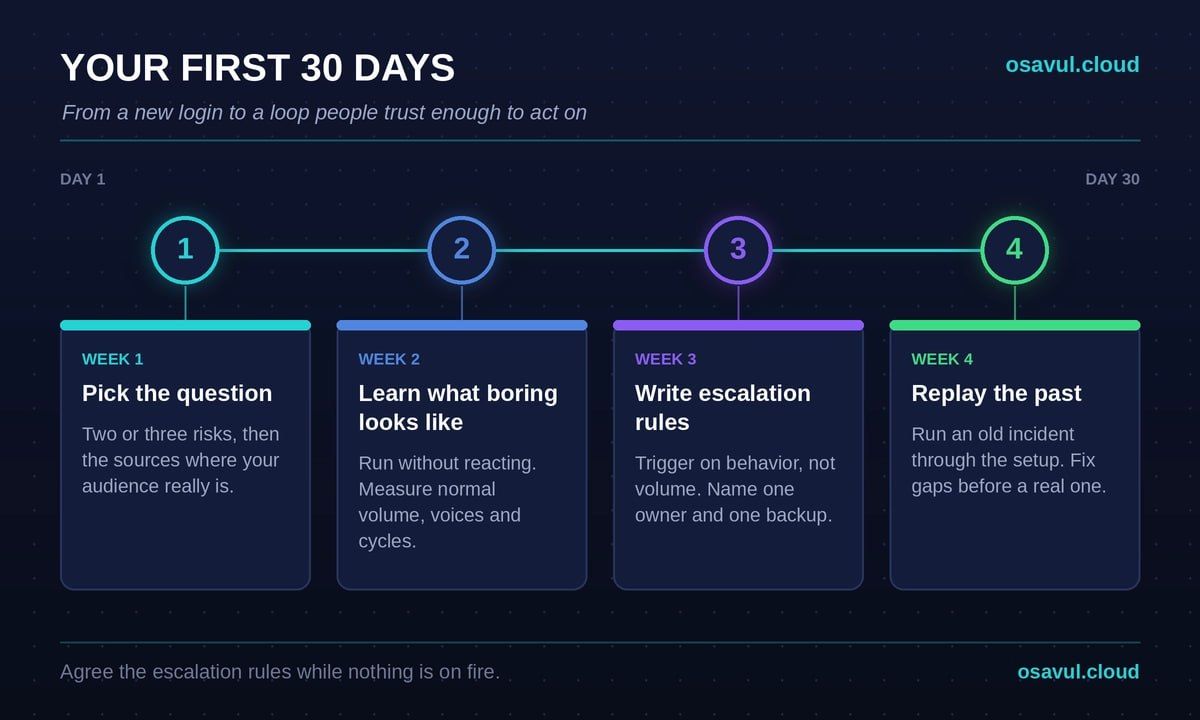
The first month decides whether a new platform becomes part of how your team works or a browser tab nobody opens. Aim for one working loop by day 30: one clear question, one named owner, and alerts people trust enough to get out of bed for.
We learned how much that loop matters from a client who skipped straight to the dashboards. The tool was configured well, but nobody had decided what counted as urgent. Every spike triggered a notification. By week six, the security lead had muted the channel on his phone. The alert he eventually missed was a real one.
So, a slower start.
Week 1: pick the question before the sources. What would hurt you most? It might be a solvency rumor, people organizing around a physical site, or a foreign narrative aimed at your institution. Pick two, at most three. Only then decide where to listen. Go where your audience actually is, which is rarely where posts are easiest to count. The Reuters Institute Digital News Report keeps tracking audiences drifting toward video platforms and messaging apps. Most setups we audit are still built around the networks that were dominant five years ago.
Week 2: learn what boring looks like. Let the system run and don't react. You're measuring a normal Tuesday: typical volume, the regular voices, the complaints that come back every month. One energy client found that their scariest-looking "spike" happened every quarter, right after billing day. It wasn't a campaign.
Week 3: write the escalation rules down. Do this while nothing is on fire. Decide what reaches a named person at 6 a.m. and what waits for Friday's brief. Trigger on behavior, like a sudden cluster of new accounts or a claim jumping platforms, not on volume. Name one person as owner and one as backup. A team is not an owner.
Week 4: replay the past. Take an old incident you understand well and run it through the new setup. Would it have fired in time? If yes, you're live. If not, you've found a gap for free, before the next real incident finds it for you.
Frequently asked questions
Is a social listening tool the same as social media listening software?
Yes. The two terms describe the same category of product, and vendors use them interchangeably. The real difference is between products, not names. Some are built to measure brand sentiment. Others are built to detect narratives and coordinated behavior.
When you read a product page, skip the label and look at the data model. If account metadata and cross-platform timing aren't there, the product is marketing software, whatever it calls itself.
Can a social listening tool detect bots and coordinated accounts?
Only if it keeps behavioral metadata: account creation dates, posting intervals, repost chains and shared media. Most marketing-focused products don't retain it, so they can't detect coordination.
One caution from our own work: modern operations rarely use crude bots anymore. They use aged accounts, a few real people and generated text. What gives them away is timing and structure, not grammar. Ask vendors to show coordination on a real case, not to describe it.
How is AI used in a social listening tool, and where does it stop?
AI handles the mechanical work at scale: translation, clustering posts by claim, stance classification, spotting behavioral anomalies and summarizing. It stops at attribution and judgment.
A model can tell you 140 accounts behave as one cluster. It can't tell you, reliably and defensibly, whether that cluster is a state operation, a competitor's agency or an angry community with one loud organizer. That call belongs to an analyst, and it should stay there.
Does a small team need a dedicated platform, or is a free tool enough?
A free tool is enough to track your brand name on major networks and to find out whether anyone on the team will actually read the alerts. It isn't enough for security work that needs fringe sources, deep history or evidence you can export.
Plenty of teams start free for a quarter. It's a cheap way to learn who owns the output before you sign anything bigger.
The tool listens. A person still decides
A social listening tool finds the pattern. It can't tell you what the pattern means, or whether it's worth a phone call at midnight. That part is still a person's job, and it's the part most programs underfund.
One of the strongest listening setups we've worked alongside wasn't the biggest. It belonged to a small public-sector team with a modest configuration and one stubborn analyst. Every morning, before coffee, she opened each flagged cluster and asked the same three questions. Who started this? How fast is it moving? Have we seen it before? Nine times out of ten, the answer was "noise." The tenth time, her team was the first in the country to know, by a full day.
That habit matters more every month. Generated text has made narrative operations cheap to run, and the old giveaways, like awkward phrasing and copy-paste typos, are mostly gone. What's left is behavior: timing, structure, and who moves first. Good software surfaces those signals. It still takes someone curious enough to look at them every day.
So choose the tool carefully. Then invest at least as much in the person reading it.