As a security professional, I have spent nearly two decades staring at screens, analyzing packet dumps, and reverse-engineering malware. For a long time, we thought the perimeter was defined by firewalls and encryption keys. We were wrong.
At Osavul, we learned the hard way that the battlefield isn't just physical or digital—it is cognitive. The modern adversary doesn’t just want to encrypt your database for ransom; they want to rewrite your reality. They don't just hack servers; they hack trust.
If you are a CISO or a brand manager, you might feel prepared for a data breach, but are you prepared for a lie that spreads faster than a zero-day exploit? This guide explores how to protect your brand in an era where narratives are weaponized.
What is an information attack?
Technically, we often separate "cyber" (the code) from "info" (the content). But in the wild, they are increasingly merged. An information attack is a coordinated effort to manipulate public perception, damage credibility, or incite physical action against an organization using false, misleading, or mal-contextualized information.
Unlike a standard PR crisis, which usually stems from an actual mistake your company made, information attacks are manufactured. They are engineered. The Cybersecurity and Infrastructure Security Agency (CISA) outlines tactics like "astroturfing" (creating fake grassroots support) and "flooding" (spamming channels to drown out truth).
“Kill Chain” Campaigns
I have analyzed campaigns where bot farms utilized thousands of fake accounts to amplify a single fabricated customer complaint. Within hours, the algorithm picks it up, real users get angry, and the company's stock price dips. That is not bad luck; that is a targeted information attack.
These campaigns often follow a "Kill Chain" similar to cyberattacks:
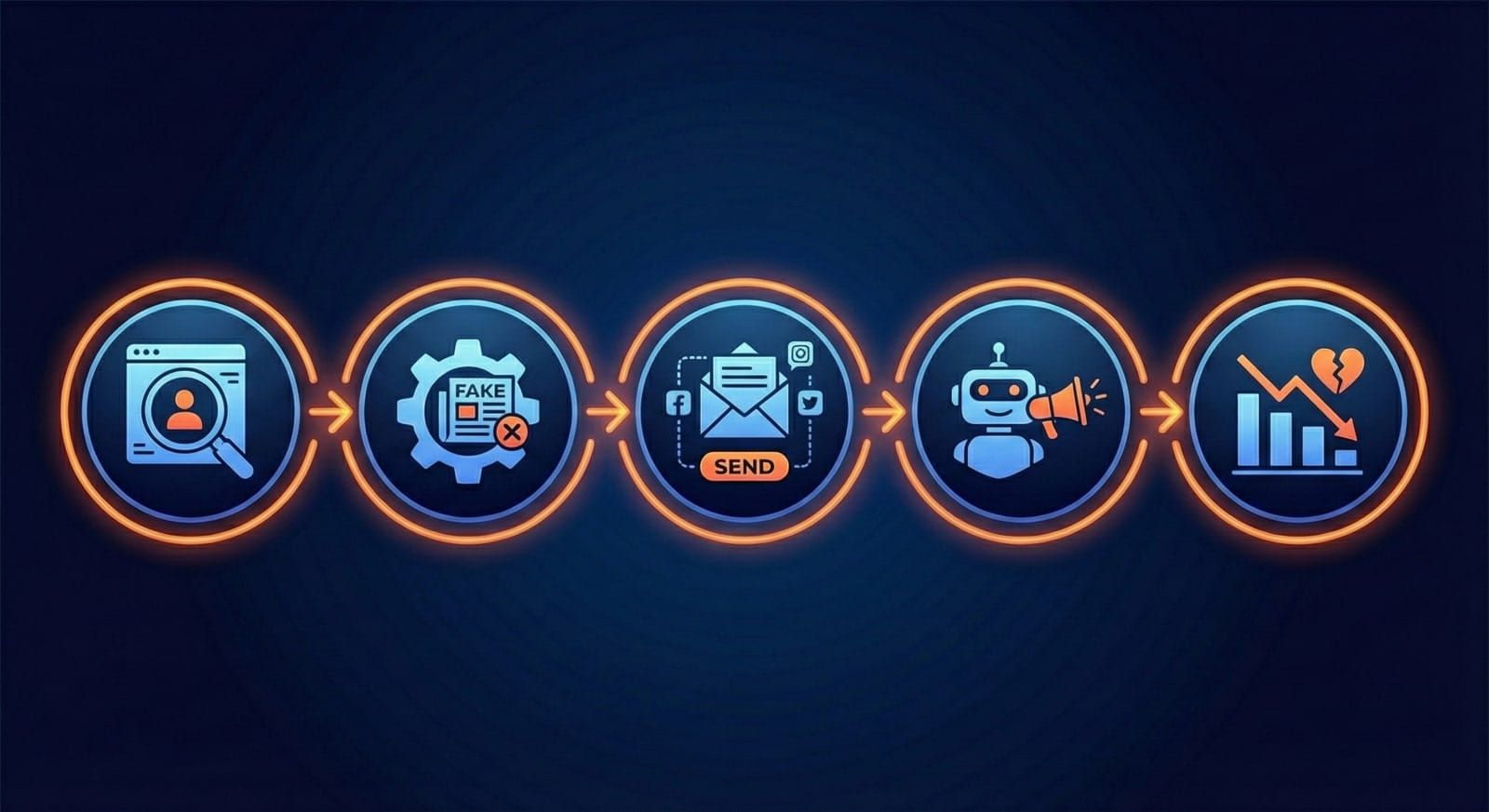
- Reconnaissance. Finding your controversial policies or weak points.
- Weaponization. Creating the meme, the fake article, or the doctored video.
- Delivery. Posting it on fringe forums or social media.
- Exploitation. Amplifying it with bots to trick trending algorithms.
- Action on Objectives. Causing financial loss or reputation damage.
How can you help to protect your company's sensitive information?
You cannot separate data security from reputation security. Disinformation campaigns are most effective when they are mixed with a grain of truth. A classic tactic is "hack-and-leak"—stealing mundane internal emails and releasing them with misleading context.
So, the first step in protecting reputation online is actually rigorous data hygiene. If you starve the attacker of legitimate internal documents, they have to rely on pure fabrication, which is easier to debunk.
To secure the data that could fuel an attack, you should look at frameworks, which detail how to protect controlled unclassified information. The principles apply to your brand's secrets, too.
The Triangle of Data Defense
- Access Control. We often see leaks coming from a third-party vendor with too much access. Implement "Least Privilege." If a marketing intern doesn't need access to the CEO's emails, revoke it.
- Encryption. Encrypt data at rest and in transit. If an attacker steals your data but can't read it, they can't spin it.
- Insider Threat Detection. Not every leak is a hack. Sometimes it is a disgruntled employee. Specialized software can detect anomalous download patterns before the files leave your network.
By hardening your internal systems, you are removing the ammunition used in hybrid information attacks.
How to protect your brand online?
Now, let's look at the external defense. How to protect your brand when the attack is already live on popular social media?
The defensive strategy requires a shift in mindset. You cannot just "firewall" a conversation. You must engage with it.
1. Build a Narrative Monitoring System
You need to know you are under attack before it hits the mainstream news. Google Alerts are not enough. You need tools that monitor sentiment anomalies. If your brand mentions spike by 400% at 3:00 AM on a Sunday, you are likely being targeted by bots.
2. Establish a "Truth" Repository
When an information attack hits, speed is everything. You do not have time to draft a press release from scratch. Have a "Dark Site" or a dedicated status page ready to go. This page should be the single source of truth. When the lies spread, you point every stakeholder—journalists, employees, investors—to this URL.
3. Pre-bunking vs. Debunking
Research shows that once a person believes a lie, it is chemically hard for their brain to accept the correction. This is why "pre-bunking" is vital. If you know you are about to announce a controversial change, communicate the context before the disinfo actors can twist it. You inoculate your audience against the virus.
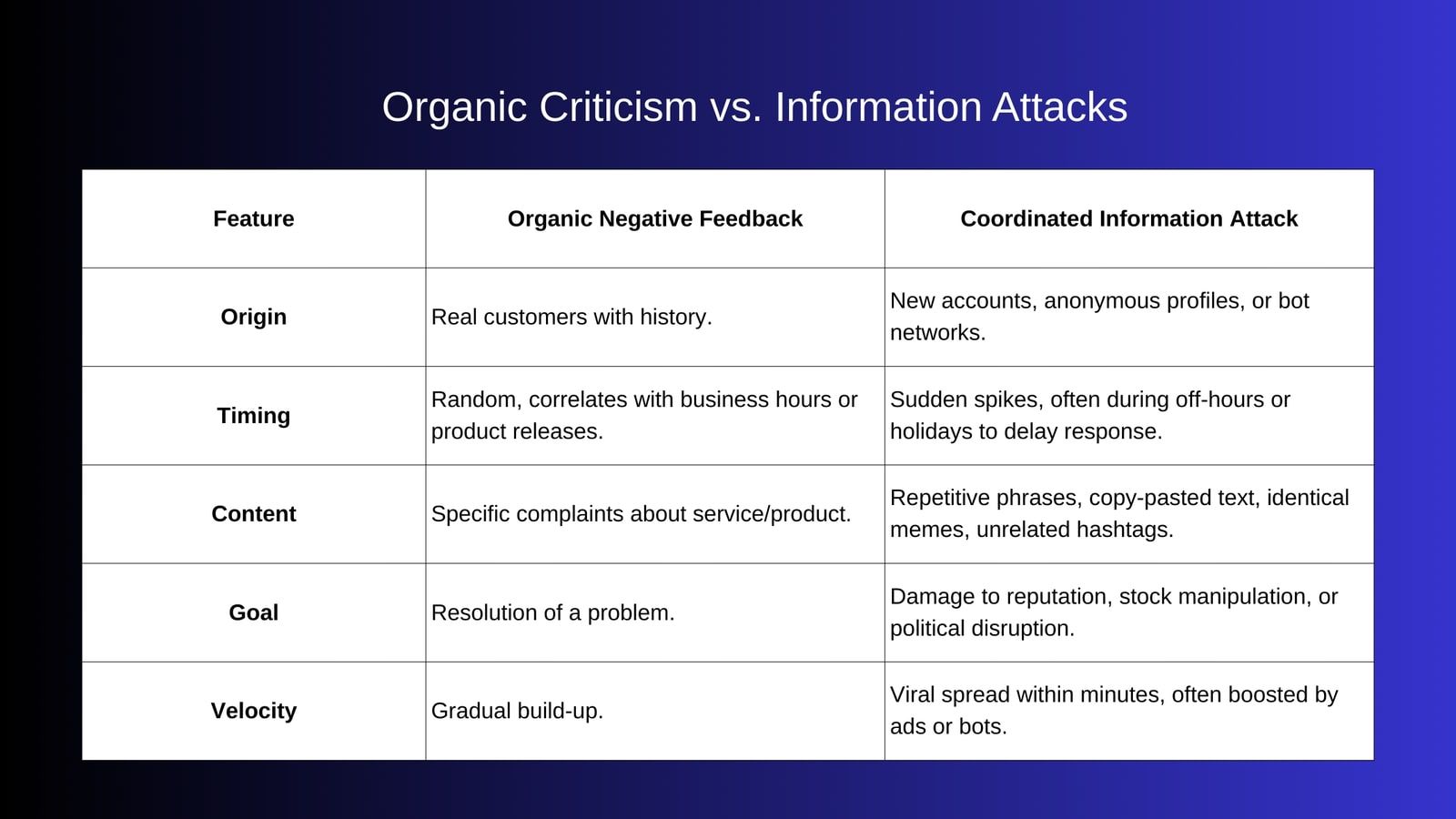
Organic Criticism vs. Information Attacks
To help you understand the difference in response, I’ve compiled this comparison.
The Role of Employee Advocacy
How do you protect your reputation online when thousands of bots are screaming at you? You use your biggest asset: your people.
Authentic voices kill synthetic noise. An academic study from the University of Georgia suggests that during a crisis, employees who speak up on their personal channels to support their company are significantly more effective than official corporate statements.
However, you must train them. Do not turn them into bots. Give them the facts and let them speak in their own voices. This authenticity is the kryptonite to the artificial nature of information attacks.
Analyzing the Source
When you see a negative spike, ask:
- Are the accounts new? (Created in the last month?)
- Do they have generic usernames? (e.g., user123456)
- Are they posting at humanly impossible speeds?
If the answer is yes, do not engage directly. You cannot argue with a script. Instead, report the network to the platform and communicate directly with your real audience.
Conclusion
The question of how to protect your brand is no longer just for the marketing department. It is a security imperative. As we move deeper into the age of AI-generated text and deepfakes, the line between truth and fiction will blur even further.
Protecting reputation online requires the same discipline as protecting your network: constant monitoring, rapid response, and a resilience strategy that assumes you will be targeted eventually.
We often say in cryptography: "Don't roll your own crypto." The same applies here. Don't try to improvise your defense when the attack is underway. Build your framework now. The integrity of your brand depends on it.