I have spent the last fifteen years of my life in the trenches of information warfare. My background is in cryptography and network security, and I hold a PhD in information assurance. But where I come from—Ukraine—we learned a long time ago that the most dangerous attacks do not always involve cracking a password or injecting SQL code. Sometimes, the most devastating "exploit" is a narrative—a reality we confront daily at Osavul.
For a global enterprise, a coordinated disinformation campaign can cause more financial damage in 24 hours than a ransomware attack. I have watched coordinated botnets dismantle trust in public institutions, and I have seen the exact same tactics used to tank the stock price of publicly traded companies. This is why I view online reputation management for big brands not as a marketing task, but as a critical component of your security posture.
If you are still treating reputation management as simply "responding to bad reviews," you are fighting a modern war with a musket. Here is my analysis of how big brands need to evolve their approach to reputation in an age of information weaponization.
What is online brand reputation management?
From a security perspective, online reputation management for big brands is the continuous process of monitoring, analysing, and mitigating threats to your organisation's standing in the digital information space. It is about distinguishing between the organic noise of the internet and coordinated signals designed to cause harm.
In the past, this was a passive exercise. You waited for a mention, and you responded. Today, it is active defence. It involves tracking how narratives form around your brand, understanding the velocity of those narratives, and identifying the actors behind them. When we manage online reputation at an enterprise level, we are essentially protecting the brand’s integrity in the same way we protect its data. We are looking for anomalies. A sudden spike in negative sentiment might be a product failure, or it might be a "sybil attack"—where a single adversary uses thousands of fake identities to create the illusion of a mass movement.
Why is online reputation management important?
The internet has no "delete" button, and it has zero latency. Information travels at the speed of light, and distinct falsehoods travel six times faster than the truth. For large multinational corporations, the stakes are existential.
Online reputation management for big brands is important because your reputation is directly tied to your market capitalization and your operational freedom. I have analysed incidents where deepfake audio of a CEO caused a 5% drop in stock value within minutes. I have seen "astroturfing" campaigns—fake grassroots movements—funded by competitors to block regulatory approvals for new products.
Without a robust strategy, you are vulnerable to:
- Stock Volatility. Algorithms trade on sentiment. If sentiment is manipulated, your value fluctuates.
- Loss of Consumer Trust. Once trust is eroded by a disinformation narrative, it is incredibly expensive to buy back.
- Operational Disruption. Online attacks often bleed into the real world, leading to protests, boycotts, or regulatory scrutiny based on false premises.
What are the 7 dimensions of reputation?
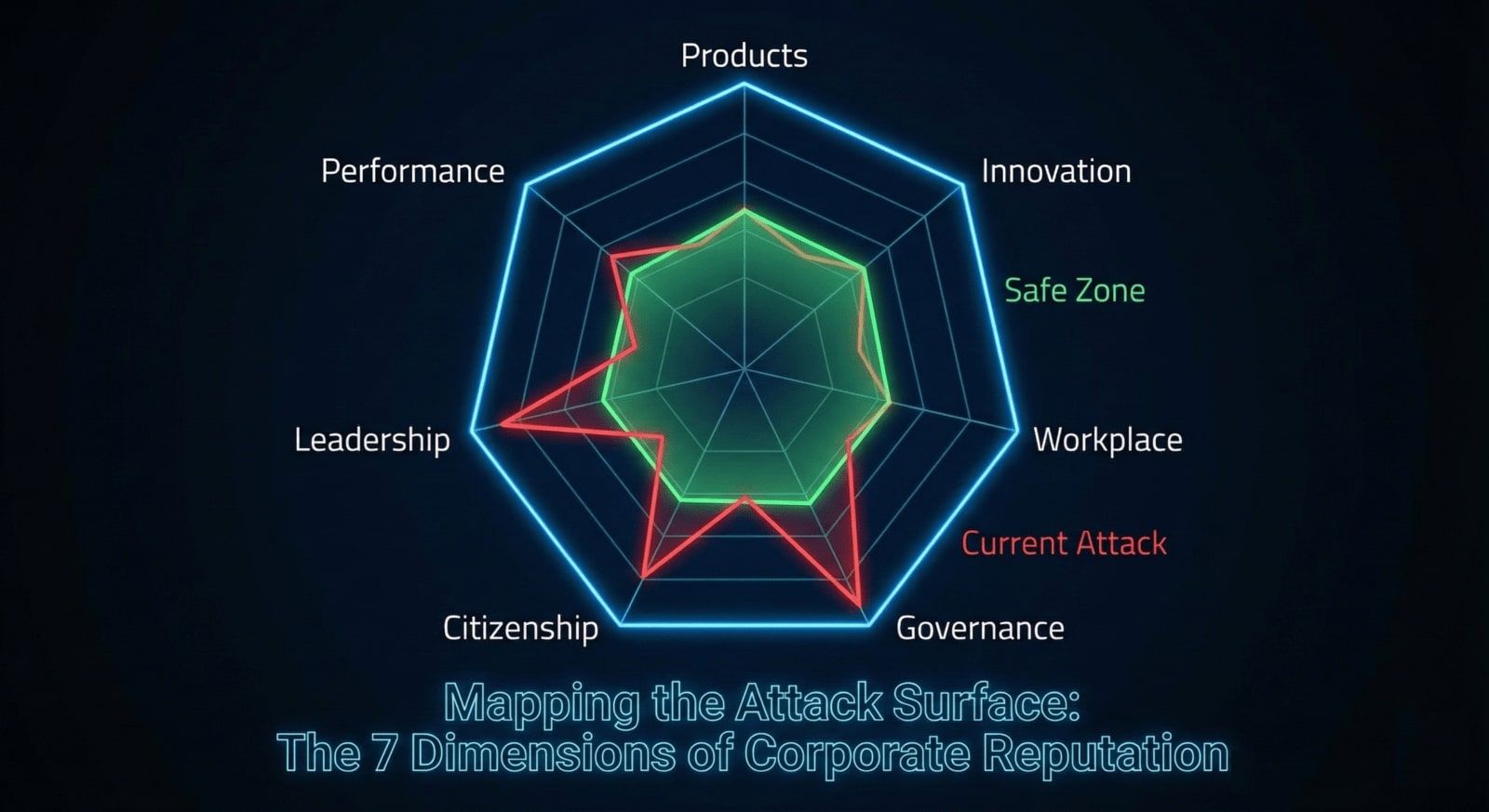
To defend a surface, you must map it. In the corporate world, we often refer to the "RepTrak" model, which outlines seven key pillars. As a security professional, I view these as seven distinct attack vectors. If an adversary wants to hurt you, they will target one of these specific areas.
- Products and Services. The quality and value you offer. Attacks here often involve fake reviews or fabricated safety hazards.
- Innovation. Your perception as a forward-thinking entity. Competitors may spread narratives that your tech is obsolete.
- Workplace. How you treat employees. We see frequent targeted leaks or exaggerated stories about internal culture to deter talent.
- Governance. Openness, transparency, and ethics. This is a massive target. accusations of corruption or covering up data breaches fall here.
- Citizenship. Your contribution to society and the environment. "Greenwashing" accusations, often amplified by bots, target this dimension.
- Leadership. The public perception of your CEO and executives. Personal smear campaigns against leadership are a standard tactic in corporate information warfare.
- Performance. Financial profitability and growth prospects.
Understanding these dimensions is crucial because effective online reputation management for big brands requires you to know exactly where you are being hit so you can deploy the right counter-narrative.
What is the primary goal of managing online reputation?
You might think the goal is "to be liked." It is not. As a security expert, I tell you: the goal is resilience.
The primary goal is to build an information environment where your brand can withstand an attack. It is about establishing a baseline of truth so strong that when a disinformation campaign hits, it fails to take root. We want to reduce the "mean time to recovery" (MTTR) after a reputational incident.
By achieving resilience, you ensure that your online brand reputation is an asset that defends itself, rather than a liability that needs constant rescuing. This requires a shift from reactive damage control to proactive threat intelligence.
5 Key Points for Securing Your Reputation
Based on my experience analysing threat actors and protecting data integrity, here are the five strategic pillars that should define your approach.
1. Speed is Security. Real-Time Detection
In cryptography, we know that time is the enemy. The longer a vulnerability exists, the more likely it is to be exploited. The same applies here. A false narrative that is allowed to spread unchecked for 4 hours creates a "truth effect" that is hard to reverse. By the time your PR team drafts a press release the next morning, the damage is permanent.
You need capabilities that detect anomalies in real-time. This isn't just about keyword alerts; it's about detecting shifts in sentiment velocity. If negative mentions jump 400% in 15 minutes at 3:00 AM on a Sunday, that is not a customer service issue—that is likely an automated attack. Online reputation management for brands at this level requires 24/7 automated vigilance.
2. Distinguish Organic Criticism from Inorganic Attacks
This is where my background in network security becomes relevant. We use traffic analysis to spot DDoS attacks. We must use narrative analysis to spot "Semantic DDoS" attacks.
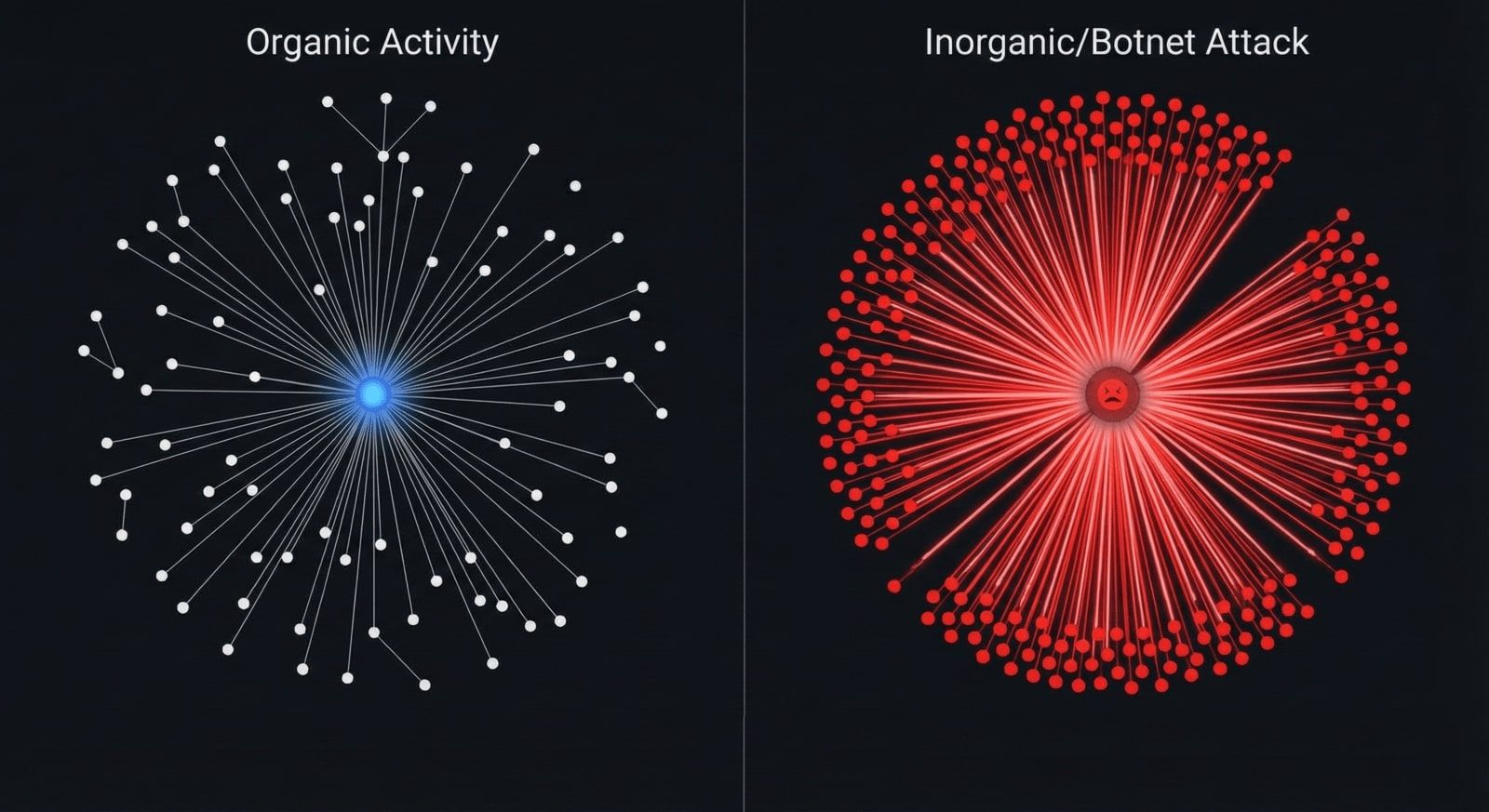
Big brands naturally get complaints. That is organic. But when you see thousands of accounts created within the last week, all using the same hashtag, all posting with the same syntax errors, and all retweeting each other within seconds—that is inorganic. That is online reputation management for big brands in the age of AI. You must be able to tell your board of directors: "This isn't real public outrage; this is a bot farm located in a specific region." How you respond to a real customer is totally different from how you neutralize a botnet.
3. Intelligence Over Monitoring
Brand reputation monitoring is passive; intelligence is active. Monitoring tells you what is happening. Intelligence tells you why and who.
Modern reputation management involves analysing the networks spreading the information. Who started the rumour? What other narratives are they pushing? Are they linked to known state actors or "hacktivist" groups? Tools like Osavul do not just count mentions; they map the information environment. This allows you to predict where the narrative will go next. Will it jump from a fringe 4chan board to Reddit, and then to mainstream news? If you have intelligence, you can intercept it before it breaches the "mainstream firewall."
4. The Integration of Cyber and Comms
For a long time, the CISO (Chief Information Security Officer) and the CCO (Chief Communications Officer) rarely spoke. This must change. Most major reputational crises today have a cyber component—a data breach, a hack, or a deepfake.
Online reputation management for brands effectively requires these two departments to share a war room. The Commms team needs the forensic data from the Security team to craft accurate statements. The Security team needs the Commms team to understand how technical details will be interpreted by the public. When these teams are siloed, you get conflicting messages, which fuels further distrust.
5. Leveraging Advanced Tools
You cannot fight algorithms with spreadsheets. The volume of data generated about big brands every second is beyond human processing capabilities. You need to leverage online reputation management tools that utilize artificial intelligence to process natural language at scale.
These tools serve as your radar. They can sift through millions of posts across social media, forums, and dark web sources to find the "patient zero" of a negative narrative. Without AI-driven tools, you are effectively blind to the early warning signs of a reputation attack.
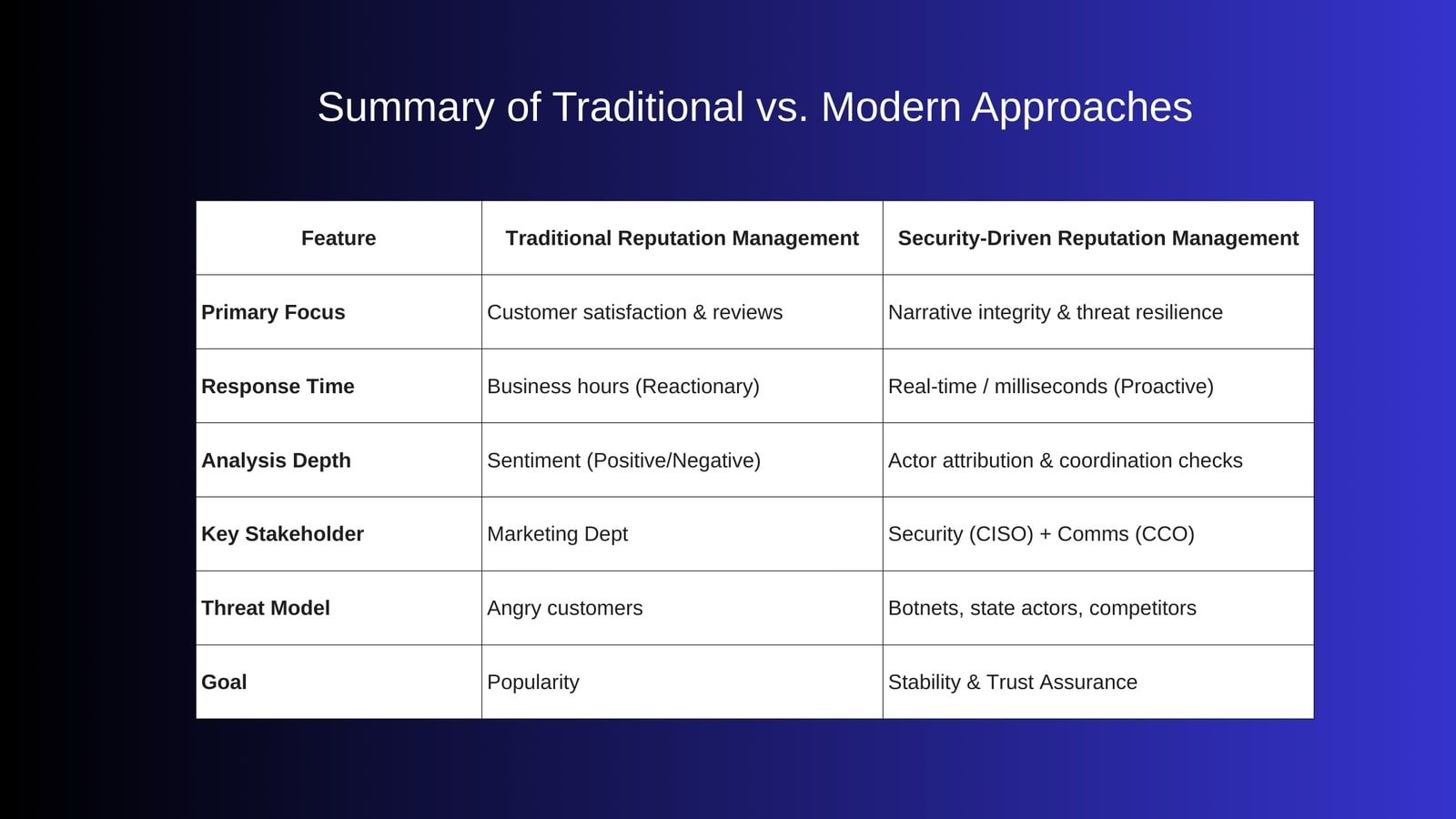
Summary of Traditional vs. Modern Approaches
To visualize the shift I am describing, I have compiled this comparison table. This is how we move from a marketing mindset to a security mindset.
Online reputation management for big brands is a complex, high-stakes discipline. It requires the precision of a surgeon and the vigilance of a sentry. In my career, I have seen that the brands that survive are the ones that treat information not just as content, but as a critical asset to be defended.
Online reputation management for brands is no longer just about saying the right thing; it is about protecting the truth of who you are against those who would rewrite it.